






 Portuguese
  Spanish
  3 min of reading
  0 comments



Researchers at the University of California, Santa Barbara have developed a molecule that captures sunlight, stores energy in its chemical structure, and then releases heat, in an advance related to molecular solar thermal storage
A team at the University of California, Santa Barbara has developed a molecular solar battery capable of capturing energy from light and storing it within a chemical structure for later use as heat. The system, described in the journal Science, achieved a density greater than 1.6 MJ/kg and was able to boil water under environmental conditions.


Solar battery stores energy within the molecule itself
The technology is part of the field known as molecular solar thermal storage, called MOST.
Unlike conventional solar panels, which convert light into electricity, this type of system stores energy directly in molecules.
-
NASA is advised to create a biocontainment facility on the Moon to prevent samples from Mars, the Moon, or other places in space from arriving directly on Earth with possible dangerous contaminants.

-
Scientists open lost cave in Norway and encounter a forgotten Arctic world with 46 species that existed 75,000 years ago.

-
Scientists were looking for a black hole in a galaxy 11 billion light-years away, but ALMA revealed a “factory” of neutrinos hidden by dust and powered by intense star formation.

-
Sandisk stock soars 5,636% in 14 months, surpasses Bitcoin’s appreciation in nine years, and shows how the race for artificial intelligence has turned SSDs and memory cards into coveted pieces by tech giants.





The advancement targets one of the main limitations of solar energy: the dependence on daylight. For heating applications, efficiently storing energy is still an important challenge to expand the use of renewable sources.
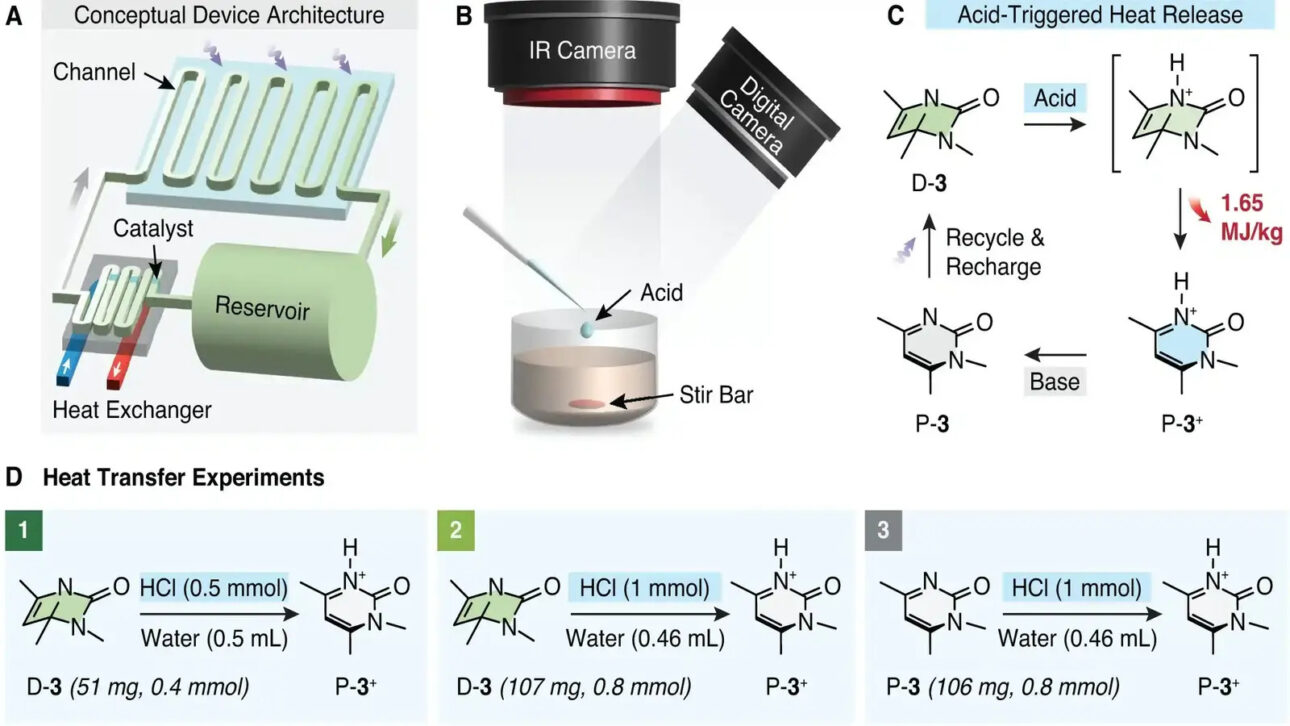
The molecule developed by the team is called pyrimidone. When exposed to sunlight, it changes structure and enters a high-energy state. Later, it can release this stored energy in the form of heat.

Molecule works like a compressed spring
Nguyen Han, the lead author of the study, compared the functioning of the molecule to a compressed spring.
The pyrimidone absorbs energy when activated by light and later releases this energy content when triggered.
The researcher highlighted that the team’s interest is in the reversibility of the process. The material can store energy, release it when necessary, and be reused multiple times, without degradation noted in the consulted material.
“This type of reversible change is what interests us. However, instead of changing color, we want to use the same idea to store energy, release it when we need it, and then reuse the material multiple times,” stated Nguyen.
Inspiration came from DNA and transition lenses
To reach pyrimidone, the researchers were inspired by DNA structures and photochromic materials, such as transition lenses. These systems change shape reversibly when exposed to light.
The structure of the molecule mimics components found in DNA that respond to ultraviolet light. With computational support from KN Houk, from UCLA, the team refined the compound to ensure it remained stable and conserved energy for longer.
Nguyen stated that the design of the molecule aimed for simplicity. The team removed elements considered unnecessary to create a compact and efficient structure for solar energy storage.
Energy density surpasses typical lithium-ion batteries
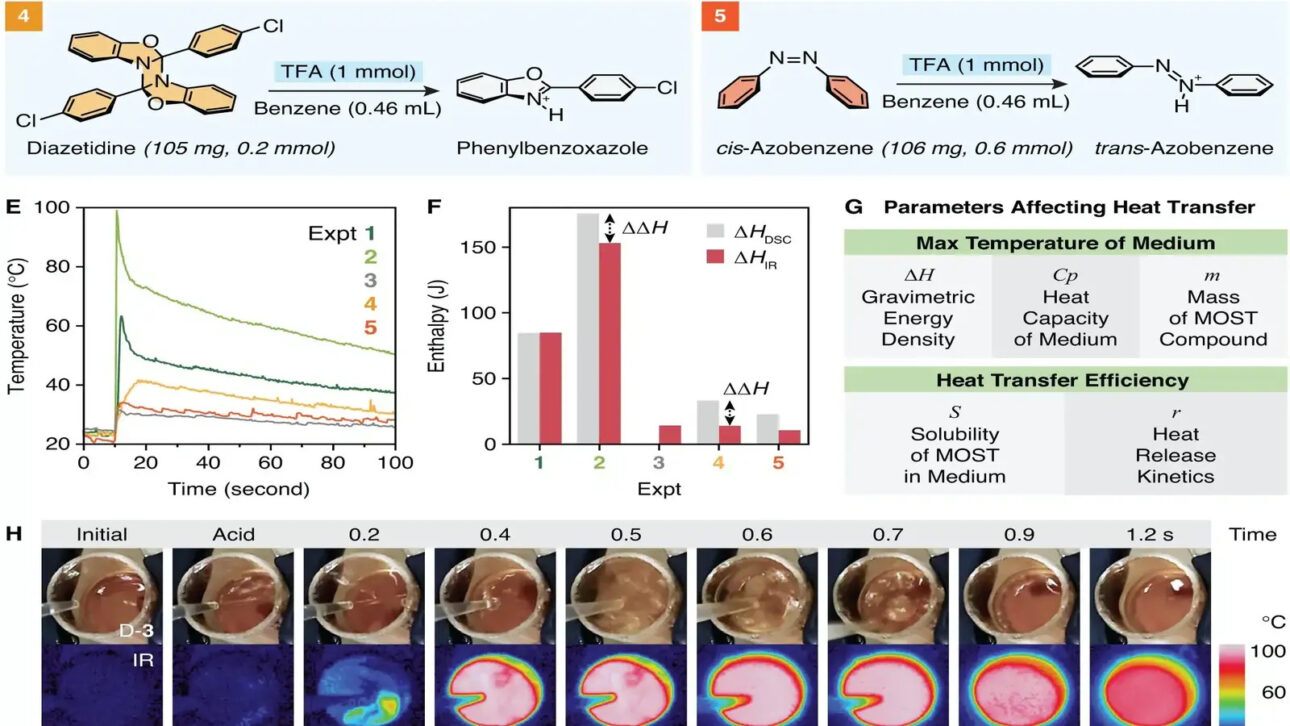
The material achieved an energy density greater than 1.6 MJ/kg. This value is above typical lithium-ion batteries, which are around 0.9 MJ/kg, according to the data presented in the study.
This performance is considered relevant for MOST systems, especially because the molecule was able to provide enough energy to boil water under environmental conditions.
“Boiling water is a process that consumes a lot of energy,” stated Nguyen in a university statement. For her, achieving this result under environmental conditions represents a significant achievement.
The solubility of the molecule also paves the way for use in solar collectors. The material could circulate through the system, store energy during the day, and release heat later.
Co-author Benjamin Baker summarized the practical difference: in solar panels, an additional battery system is needed. In molecular solar thermal storage, the material itself stores the solar energy.
This article was prepared based on information from the University of California, Santa Barbara, and the journal Science, with data, numbers, and statements preserved as per the consulted material.







Be the first to react!