






 Portuguese
  Spanish


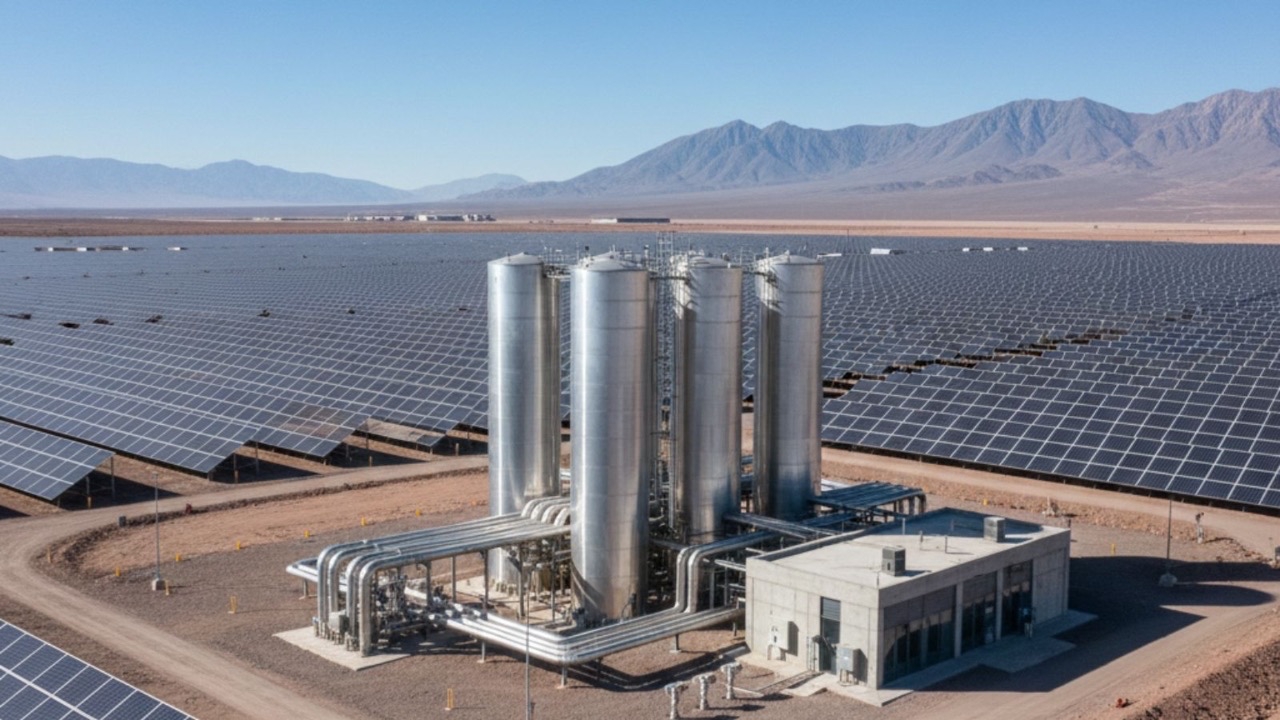

A Megaproject From China, In The Tibetan Plateau, Uses Liquid Air To Store Energy, Prevent Nighttime Blackouts, And Transform The Desert Into One Of The Most Advanced Power Centers On The Planet
Liquid air is the technology that China started using, from 2024, to stabilize the largest solar plant installed in the Tibetan Plateau, in the west of the country, solving a historical problem of renewable energy: the lack of electricity when the sun sets. The system works by transforming regular air into liquid at extreme temperatures, storing energy in cryogenic tanks and delivering it back to the power grid during the night, preventing failures and waste in a remote, cold, and strategic region.
In the province of Qinghai, where the Tibetan Plateau meets the Gobi Desert, an area of 610 square kilometers has completely changed its appearance. Seven million solar panels cover the ground, forming what Chinese researchers call a sea of silicon.
The constant shade has created an unexpected microclimate capable of retaining moisture and allowing sheep to graze among the photovoltaic panels, something impossible until a few years ago.
-
Brazilian Researcher Develops Protein Supplement from Tilapia Waste, Combining Innovation and Sustainability with Economic Potential

-
Women in São Paulo Unknowingly Tracked by Coin-Sized Tags Hidden in Cars and Belongings, Raising Stalking Concerns
-
Near a $750 million AI data center in Brazil, a resident’s well runs dry, leaving her unable to afford the $25,000 needed for repairs.

-
16-Year-Old from Brazil’s Sertão Wins Young Scientist Award for AI Predicting Rainfall with 94.5% Accuracy to Aid Farmers


Why Liquid Air Became The Solution To A Problem That Lithium Does Not Solve

The advancement of solar and wind energy has presented a known technical challenge. Production depends on the weather and the time of day. When the sun disappears on the horizon of the Gobi, generation drops sharply.
According to researcher Wang Junjie, from the Electrical Engineering Institute of the Chinese Academy of Sciences, these sources are naturally intermittent and require robust storage systems.
Lithium-ion batteries work well in cell phones and electric cars, but in large projects, they face high costs, accelerated wear, and dependence on rare minerals.
Liquid air emerges as an alternative because it is abundant, free, and does not suffer from chemical degradation over time.
An analysis published by CleanTechnica shows that air, when liquefied, can reach a density up to 750 times greater than in its gaseous state, allowing for the storage of large volumes of energy without dams or specific terrain.
White Giants In The Desert And The Largest Liquid Air System On The Planet
In the vicinity of the city of Golmud, enormous white tanks stand out in the arid landscape. They are part of the largest liquid air energy storage project in the world, locally known as the Super Air Energy Bank.
The facility belongs to the state-owned China Green Development Investment Group and has entered the final commissioning phase, according to the Xinhua agency.
The system has a capacity of 60 megawatts and can release up to 600,000 kilowatt-hours per cycle, enough to power tens of thousands of homes at night. The Xinhua source is mentioned only at this point as the main reference for the project.
How The Technology From China Transforms Air Into Electricity In Extreme Cold
The process begins during the day when the 250-megawatt solar plant in the region produces more energy than the grid consumes.
This electricity powers compressors that purify the air and cool it down to around minus 194 degrees Celsius, the temperature at which air becomes liquid.
The heat generated during this compression is not wasted. It is stored in thermal tanks for later use.
When demand grows or solar generation falls, the liquid air is heated. As it returns to its gas state, its volume expands hundreds of times, driving turbines that produce electricity again.
An Energy Laboratory At Three Thousand Meters Altitude
The location of the project is not casual. At over three thousand meters altitude, the cold air improves the efficiency of solar panels and reduces cooling costs.
Data from the Chinese government indicates that the electricity generated there is already about 40 percent cheaper than that produced from coal.
In addition to supplying cities, the energy supports data centers used in artificial intelligence, taking advantage of the chilly climate of the plateau to cool servers.
The model combines solar, wind, hydroelectric, and now liquid air storage, creating a stable network in one of the most extreme environments on the planet.
By betting on liquid air, China signals that the future of energy does not depend only on new panels but on smart solutions for storing electricity.
In the silence of the desert, between cryogenic tanks and grazing sheep, a practical answer emerges for a world that needs clean energy day and night.


