





 Portuguese
  English
  Spanish
  3 min of reading
  12 comments





Strategic Technology Developed Under Secrecy Placed Brazil in the Restricted Group of Countries with Mastery of Uranium Enrichment and Consolidated Aramar as a Central Piece of the National Nuclear Program, with Impacts on Energy Generation and Defense Projects.
Brazil developed, under secrecy and with central participation from the Navy, its own method of uranium enrichment based on gas centrifugation and applied at the Aramar Experimental Center, in Iperó (SP), the technical base of the Navy’s Nuclear Program.
The Brazilian technology, officially described as gas centrifugation of uranium hexafluoride, aims to raise the concentration of the isotope uranium-235 from its natural level to levels used in commercial reactors, generally in the range of a few percent.
Uranium Enrichment and Strategic Importance
Enrichment is the most sensitive stage of the nuclear fuel cycle because it relies on extremely high-precision engineering and industrial facilities capable of operating in cascade, with strict control of vibration, temperature, vacuum, and safety.
-
R$ 5,000 scattered on the street, a lost wallet, and an honest decision: the case in Goiás that moved even those who only read the story

-
Dissatisfied with seeing people sleeping on the street, a man named Ryan Donais started building small mobile homes so that homeless people can escape the cold, each equipped with a bed, running water, electricity, and heating.

-
ET in Paraná? After intriguing videos, mysterious sounds in the forest, and theories that dominated social media, the Brazilian Air Force reveals what its radars recorded and increases the mystery about the alleged UFO seen in Campo Largo.
-
In North Korea, residents take bottles, plastic, fabric, paper, and metal to recycling shops and exchange waste for products as sanctions, closed borders, and a more than 80% drop in trade with China pressure the country to replace imports.


For this reason, access to equipment and components is often restricted by international regulations, diplomatic pressures, and export controls, which historically pushed non-holding countries into dependence on foreign suppliers.
Nuclear Agreement with Germany and Limits of External Cooperation
Brazil’s search for autonomy gained momentum starting in 1975, when the government signed the nuclear agreement with West Germany, which provided for broad cooperation and the construction of eight reactors, but progressed much less than announced.
In practice, part of the program was marked by the adoption of the so-called Jet Nozzle, frequently cited as an experimental, expensive, and inefficient industrial alternative, which increased costs and frustrations at the time.
Parallel Program and Research in São Paulo
With the impasse of the agreement and the scenario of technological restrictions, the Navy structured a parallel effort to master enrichment, with development associated with facilities in São Paulo and later consolidation in Aramar, according to public records on the program.
By concentrating expertise in engineering and applied physics, the team sought to solve the main industrial obstacle: maintaining rotors spinning at extremely high speeds for long periods, with mechanical stability and energy consumption compatible with continuous operation.
Aramar and the Álvaro Alberto Enrichment Unit
The Navy describes the Álvaro Alberto Enrichment Unit, in Aramar, as responsible for the isotopic enrichment process carried out by gas centrifugation, focusing on producing material suitable for powering electric generation reactors.
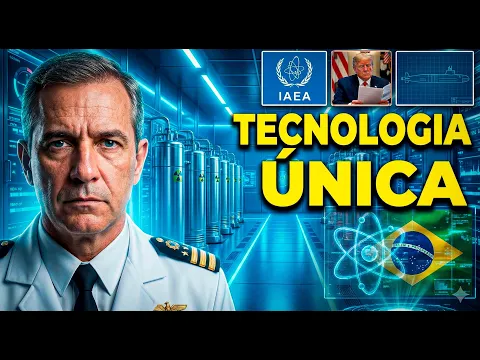

This same technological mastery is pointed out as a pillar for strategic projects linked to nuclear propulsion, a theme associated with the Navy’s Nuclear Program and, in a connected way, with the national effort in submarines, although sensitive details are treated discreetly.
How Many Countries Master Enrichment
The claim that enrichment is exclusive to a small group varies according to the criterion adopted, but the INB itself recorded, based on a reference to the World Nuclear Association, that 13 countries had enrichment facilities at different industrial scales, including Brazil.
Meanwhile, the expression “complete uranium cycle” also depends on definition, as it involves stages such as mining, conversion, enrichment, and fuel fabrication, and there is not always a public and updated consensus on the closed list of countries.
What Is Public and What Remains Secret
Official documents and pages confirm the gas centrifugation method and the purpose of enrichment in Aramar, but information such as detailed equipment architecture, type of bearing, exact rotation speed, and precise operational benchmarks does not appear, as a rule, in complete form.
This secrecy is often justified by the strategic nature of the subject and by safeguards, which limits the independent verification of specific numbers repeated in unofficial reports, even though the operation of the process itself is recognized.






Esta matéria esta atrasada pelo menos 40 anos. Em 1986 o jornal Folha de São Paulo fez uma matéria onde falava como o Brasil estava fazendo enriquecimento de urânio com tecnologia totalmente brasileira na Serra do Cachimbo(PA). Procure no Google e vocês acharam a matéria abaixo, com muito mais informações.
Compreendo sua observação sobre a importância histórica e, de fato, a Folha de S.Paulo publicou, inclusive em seu banco de memórias “Folha 80 anos”, relatos sobre o programa nuclear brasileiro desenvolvido com tecnologia nacional, incluindo o trabalho na área de enriquecimento de urânio e os projetos paralelos.
Folha de S.Paulo
Folha de S.Paulo
A cobertura da época (meados dos anos 80) destacava a busca pela autonomia tecnológica brasileira, envolvendo o Centro de Pesquisas da Marinha, a USP e o projeto de ultracentrífugas.
Folha de S.Paulo
Folha de S.Paulo
Aqui estão alguns fatos complementares sobre esse período e a evolução da tecnologia brasileira:
Programa “Paralelo” e Cachimbo: Durante os anos 80, o Brasil desenvolveu um programa nuclear “paralelo” ao oficial, focado no enriquecimento de urânio através de ultracentrífugas, com instalações em Aramar (SP) e estudos na Serra do Cachimbo (PA).
Domínio Tecnológico: O Brasil alcançou, com tecnologia própria (ultracentrífugas), o domínio do ciclo do combustível nuclear, tornando-se um dos poucos países do mundo a possuir essa tecnologia.
Finalidade do Enriquecimento: Embora o programa tenha iniciado com objetivos de pesquisa e, no contexto da ****, com o potencial de desenvolver artefatos nucleares, o enriquecimento atual realizado pela INB (Indústrias Nucleares do Brasil) em Resende (RJ) é voltado para fins pacíficos, atingindo o nível de enriquecimento necessário para o combustível de usinas nucleares, não para fins bélicos.
Fim do Projeto de Bomba: O desenvolvimento de artefatos nucleares foi oficialmente descontinuado no início da década de 1990, e o Brasil comprometeu-se com o uso pacífico da energia nuclear, ratificando tratados internacionais.
Gazeta do Povo
Gazeta do Povo
+6
A tecnologia desenvolvida nos anos 80 foi a base para a atual fábrica de enriquecimento de urânio em Resende, que hoje supre o combustível para Angra 1 e 2.
Folha de S.Paulo
Folha de S.Paulo
+1
Esta matéria esta atrasada pelo menos 40 anos. Em 1986 o jornal Folha de São Paulo fez uma matéria onde falava como o Brasil estava fazendo enriquecimento de urânio com desenvolvimento totalmente brasileiro na Serra do Cachimbo(PA). Procure no Google e vocês acharam a matéria.