






 Portuguese
  Spanish


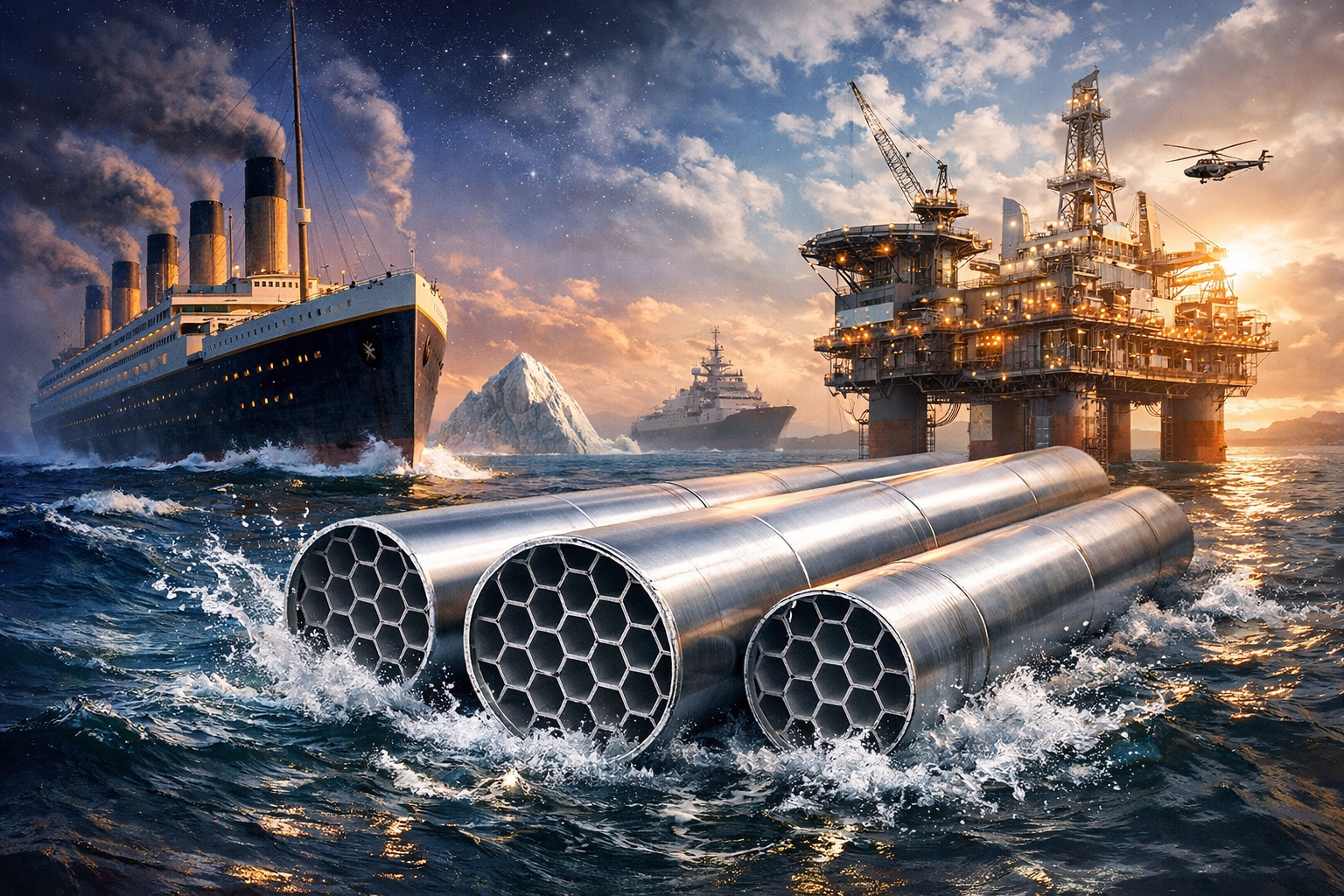

The New Bet of Science to Solve an Old Problem That Gained Worldwide Fame After the Sinking of the Titanic: Floating Structure Technology That Works Even When Punctured Promises to Change Ships, Platforms, and Clean Energy in the World
Unsinkable Metal Tubes are the new bet of science to solve an old problem that gained worldwide fame after the sinking of the Titanic in 1912. Created by researchers in the United States, they float even after extreme damage, using microstructures that trap air and prevent water from entering. The discovery was released at the end of January 2026 and reignites the idea of much safer vessels.
Building something truly unsinkable has always seemed impossible. The Titanic sank. More than a century later, engineering returned to the topic with a different approach, focused not on the size of the ship but on the behavior of the material when it comes into contact with water.
How Unsinkable Metal Tubes Can Float Even When Submerged
Unsinkable metal tubes are primarily made of common aluminum. The secret lies not in the shape but in the surface. Scientists have created micro and nano pores in the metal using chemical processes and lasers. This makes the material super hydrophobic.
-
China Develops Custom 140-Ton Electric Mining Truck with 770 kWh Swappable Battery, Deploys 290 Units in Xinjiang’s Largest Zinc Mine

-
Meta to Launch Arena, a New Prediction App Targeting 3.56 Billion Users, Competing with Polymarket and Kalshi

-
Scientist Challenges Famous Human Evolution Theory, Argues Homo Sapiens Evolved Gradually Over Thousands of Years
-
15-Year-Old American Builds Ocean Generator with PVC Pipe and 3D-Printed Propeller for $12, Wins National Prize, Presents at White House, and Makes Forbes 30 Under 30 List




In practice, water cannot spread over the surface. When the tube enters the liquid, a bubble of air gets trapped around and inside the structure. This bubble remains stable and ensures buoyancy, even after long periods submerged.
The phenomenon is similar to what happens in nature. Some spiders can breathe underwater by keeping air bubbles trapped on their bodies. Fire ants also use hydrophobicity to form living rafts during floods.
According to laboratory tests, even when the tube is pushed fully underwater, it returns to the surface on its own. For this, researchers added internal dividers that prevent the escape of air, even in a vertical position.
Damaged Tubes Continue to Float and Challenge Traditional Engineering Laws
One of the most impressive points about unsinkable metal tubes is their resistance to damage. Large holes, cracks, and cuts do not compromise buoyancy. Even when punctured repeatedly, the tubes continue to float.
The explanation lies in the multiplication of air bubbles. Each microstructure creates its own retention point. Thus, there is no single critical location that can cause the entire system to fail.
The main source of the research is the University of Rochester in the United States, which published the results in the scientific journal “Advanced Functional Materials.” The tests were conducted over weeks in turbulent environments, simulating real conditions of open sea.
This performance solves a common problem in traditional floating structures, which lose stability when subjected to impacts or extreme tilts.
From Isolated Tubes to Rafts and Bases for Ships and Platforms
Scientists in the United States did not stop at individual tubes. In the lab, they connected dozens of units and created metal rafts almost half a meter long. Even when loaded with extra weight, the structures remained stable.
This type of application paves the way for floating bases, signaling buoys, offshore platforms, and even support for larger ships. The advantage is modularity. It is possible to increase or decrease the size according to need.
Another promising application is in renewable energy. The rafts made with unsinkable metal tubes can capture the movement of waves. This displacement can be converted into electricity, according to initial tests.
The Sinking of the Titanic: An Advance That Rescues the Past and Points to the Future
More than 112 years after the Titanic, the idea of unsinkable structures is back at the center of the debate. This time, with solid scientific basis and controlled tests. Unsinkable metal tubes show that small changes in the material can generate significant impacts on safety and maritime sustainability.
The technology still needs to advance for large-scale applications, but initial results indicate a promising path. Naval engineering, energy generation, and environmental protection can be transformed by this innovation.






