






 Portuguese
  Spanish


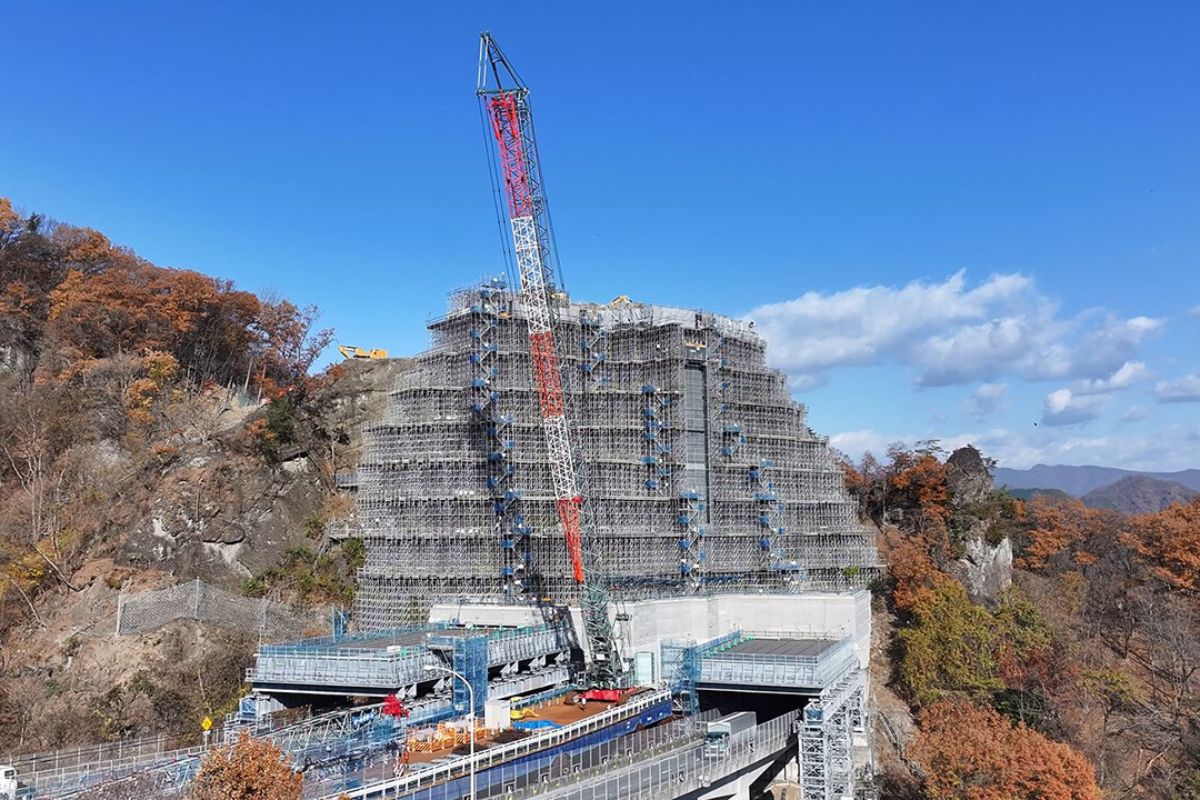


Japanese Engineers Performed The Most Complex Rock Removal In The World On The Joshinetsu Highway In Gunma, Building A 70-Meter High Scaffold To Disassemble A Mass Of Millennial Andesite Directly Over An Active Expressway Without Dropping A Single Stone.
The Joshinetsu Highway, which connects Kanto to Nagano and Niigata, has become the stage for one of the greatest feats of modern civil engineering. An immense metal structure was erected to allow for the removal of rock 70 meters high and 80 meters wide, located above the roadway, without interrupting traffic and without any debris falling. The operation, conducted by Obayashi Corporation, took a decade of preparation, simulations, and execution, redefining global safety and precision standards.
The project was motivated by a tragedy that occurred in 1996, when a landslide in Hokkaido killed 20 people by collapsing the Toyohama Tunnel. Since then, Japan has systematically reviewed slopes near highways and tunnels. In Gunma, inspections revealed the risk of a landslide from a gigantic block formed about five million years ago. The response was an unprecedented operation that combined cutting-edge technology, millimeter logistics, and a total commitment to safety.
Vertical Engineering Under The Risk Of Gravity
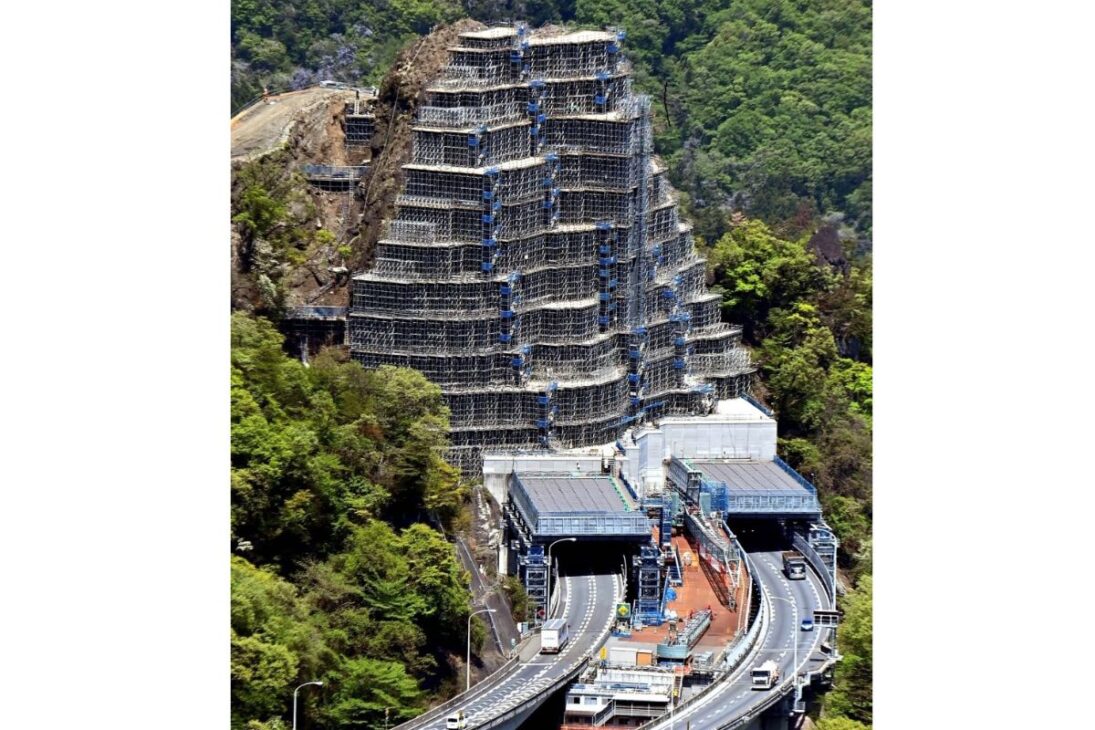
The first stage involved the construction of a 70-meter scaffold, equivalent to a 23-story building, covering the entire slope above the highway.
-
Cape Verde’s World Cup Surprise: Betting on Electric Cars, a 5 MW Solar Plant, and an Ambitious Plan to Transform Energy for 600,000 Residents

-
Man Finds 1,469 Ancient Roman Silver Coins While Metal Detecting in Romania
-
Young Brazilian Siblings Go Viral for Catching Giant Fish, Launch Sport Fishing Project
-
72-Year-Old Retired Professor from Rural Brazil Recites 247 Digits of Pi in One Minute, Setting National Memory Record


This structure functioned as a technical fortress, allowing engineers to access every point of the rock without interrupting the intense flow of vehicles below.
A two-meter-thick cushioning layer was installed over the pavement to contain any potential fragments, although the goal was clear from the beginning: not to drop a single stone.
The project was calculated through dozens of simulations, totaling 85 computational models to predict the behaviors of the rock mass during fragmentation.
Each stage of rock removal required precise planning, as the scaffold, cranes, and access tracks needed to withstand the simultaneous weight of trucks and excavators up to 80 tons.
Diamond Tools And Controlled Dismantling
Due to its location over an active road, demolition with explosives was discarded.
The type of rock, andesite, is extremely hard and compression-resistant, which required special drills with diamond tips for drilling and subsequent manual fragmentation with hydraulic crushers.
The process was carried out from the inside out, avoiding fragments being thrown toward the road.
The edges were removed in stages, utilizing a method of angled impact that caused the rock to fall inward into the slope rather than outward.
This millimeter control of energy was essential to ensure stability and safety throughout the work.
Continuous Operation And Precision Logistics
The work progressed 24 hours a day for years, requiring synchronization between human teams and heavy machinery.
Temporary tracks and a vertical monorail were installed on the slope to transport equipment to the top, enabling daily access to the risk area.
Each advance was monitored by sensors and drones, ensuring the integrity of both the scaffold and the roadway below.
The operation involved hundreds of specialized professionals and established Japan as a global reference in high-complexity rock removal.
The project manager, Takuma Ohga, stated that the goal was twofold: to completely remove the unstable mass and, at the same time, to demonstrate that engineering and safety can coexist even in the most adverse conditions.
Technical Legacy And Public Inspiration


After ten years, the project was successfully completed, and the details were opened to the public in guided tours that received seventy times more registrations than anticipated.
The public interest reflected the impact of the project, viewed as a symbol of perseverance and technical precision.
Participants of the tours highlighted the discipline and attention to safety as inspiring examples of Japanese engineering.
In addition to eliminating a critical geological risk, the project established new construction standards in mountainous areas, showing that it is possible to operate with high technical complexity without compromising mobility.
The rock removal on the Joshinetsu Highway has become a global landmark of engineering applied to disaster prevention.
Do you believe that techniques of this level could be applied to Brazilian highways with similar risks? Share your opinion in the comments.





Duraria o dobro do tempo para terem motivos para roubarem muito, contratariam empresas corruptas coniventes,fariam mal feitas e desmoronarim tudo
Não daria certo mesmo aí o governo iria roubar pra caralh0
Muito bonito, mas existem formas mais rápidas, inteligentes e baratas para fazer isso, estas coisas acontecem quando as pessoas se perdem do foco do realmente necessário.