Portuguese
  Spanish


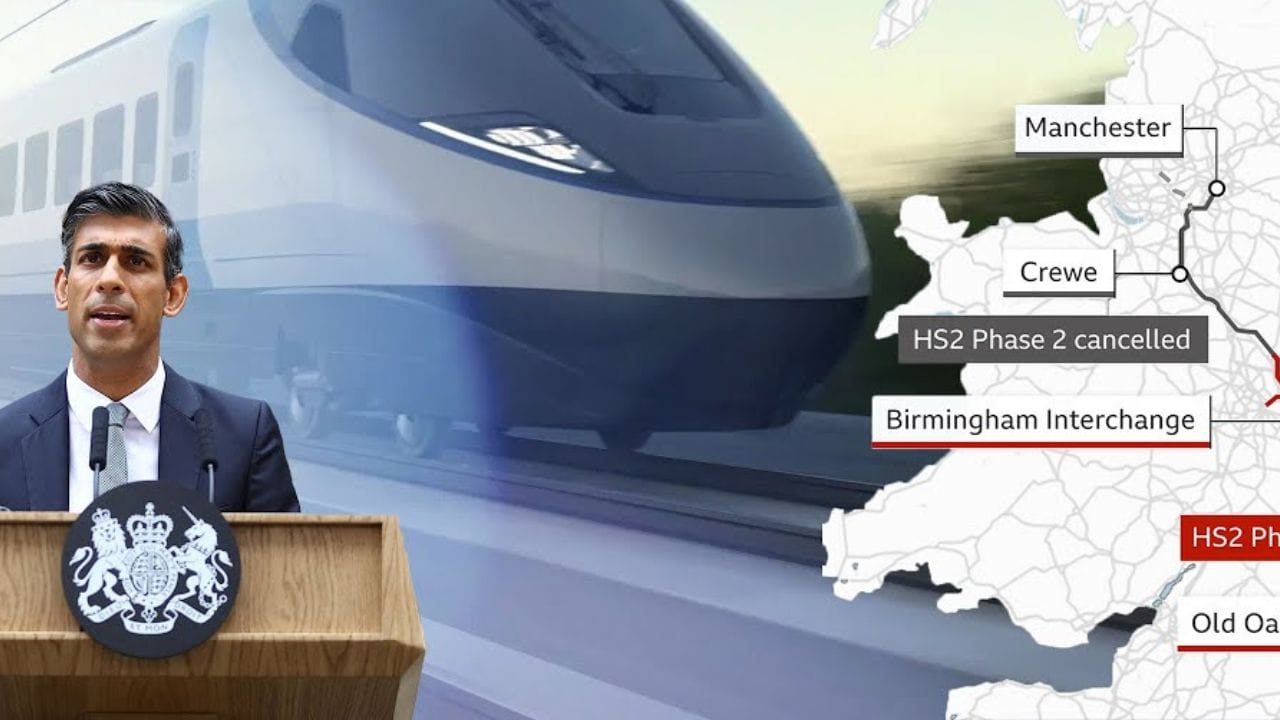

High Speed 2 (HS2), the ambitious UK railway project, originally conceived to revolutionize the country’s rail infrastructure and unite regions, is now facing significant degradation. This project, which promised to connect 8 of the 10 largest British cities through a Y-shaped network, has seen its critical phases canceled, including the important extension to Leeds.
The railway project for High Speed 2 (HS2), once considered a milestone in modernizing the UK’s rail infrastructure, is facing an uncertain fate. The original plan included an extension of the HS1 line, forming a comprehensive Y-shaped network that would connect the North, Midlands, and South of the UK, providing accessibility to 8 of the 10 largest British cities.
Unfortunately, the project has suffered significant deviations from its original vision. Instead of integrating with HS1 and providing an effective connection between the South and North regions, the result has been a fragmented endeavor. HS2 was designed to be executed in two phases. Phase 1 aimed to connect London to Birmingham, while Phase 2 would extend to the north, splitting into western and eastern branches, with stations planned at strategic locations, including Manchester and Leeds.
However, Notable Changes Have Occurred


In November 2021, Phase 2b, which would extend to Leeds, was canceled, as well as the east-west high-speed line connecting Manchester to Leeds. This cancellation was justified by efficiency and cost reduction. Consequently, work on the Euston station was halted due to rising costs.
-
Two-Bedroom Home Built in a 40-Foot Shipping Container Delivered and Ready for Same-Day Living in São Paulo Countryside

-
China Constructs Artificial Island 32 km Offshore for Yangshan Port, Connected to Shanghai by 32 km Bridge, Unloading 3,000 Containers in 20 Hours
-
China’s $70 Billion River Diversion Project, the World’s Largest, Moves 44.8 Billion Cubic Meters Annually, Crosses Under the Yellow River, and Displaced 330,000 People
-
Indian Driver Spends 14 Years Digging 10-Meter Tunnel Through Mountain to Connect Isolated Village to the World



In 2022, Rishi Sunak made the decision to cancel the entire Phase 2 of HS2, driven by the increasing project costs, which had more than doubled since the initial approval, and the change in passenger behavior patterns after the COVID-19 pandemic. As a result, only the London-Birmingham segment will be completed.
The Cancellation of Phase 2 Has Deep Implications
The contract for the acquisition of 54 high-speed trains, based on the modified Zefiro V300 model, is now subject to re-evaluation. The expansion of the Manchester Piccadilly station also faces challenges, as the station struggles to accommodate HS2 train sets. The planned train consists, at 400 meters long, are twice the length of the station tracks, which are limited to 200 meters. And of course, without tilt capability, HS2 trains will have lower maximum speeds than those currently on the West Coast Mainline, not exceeding 177 km/h in certain sections.
Another concerning development is the sale of publicly acquired land for Phase 2. Sunak’s decision led the Department of Transport to remove the protection of this land, eliminating the possibilities for future resumption of the complete HS2 project. It is worth noting that £3.4 billion has already been invested in land and property acquisitions for the original HS2 route, including £584 million allocated to the planned legs north of Birmingham.
Savings from the Cut of Phase 2
The estimated savings from cutting Phase 2 are around £36 billion, which should be reallocated to transportation projects in northern UK. However, the reception of the “Network North” investment plan has been lukewarm, overshadowed by misconceptions, such as the commitment to extend Manchester’s Metrolink tram system to Manchester Airport, an extension that has been operational since 2014.
Regarding Phase 1, approximately £22.5 billion has already been spent, primarily on constructing complex engineering structures, such as the 51 km of tunnels involved in the project. The tunnel boring machines “Florence” and “Cecilia” are advancing through the Chiltern Tunnel, while “Sushila” and “Caroline” have progressed in the Northolt Tunnel.
Although the main objective of HS2 is capacity expansion, the lack of political will in the UK contrasts with the development of high-speed rail systems in countries like France and Spain. With the degradation of HS2, the UK remains significantly behind its European counterparts in high-speed rail infrastructure, with a network of just 108 km, compared to 2,800 km in France.
HS2, which promised to be a transformative project for the UK, now faces an uncertain future. Changes to the project, especially the cancellation of Phase 2, drastically reduce the scope and original ambition of the endeavor. With a substantial investment already made, but with a significant reduction in final delivery, the HS2 project represents a critical moment in UK rail infrastructure. The decision to limit the project to the London-Birmingham route, while a cost-saving measure, marks a setback in the vision to effectively connect the country through a modern high-speed rail network.