





 Portuguese
  English
  Spanish
  3 min of reading
  0 comments


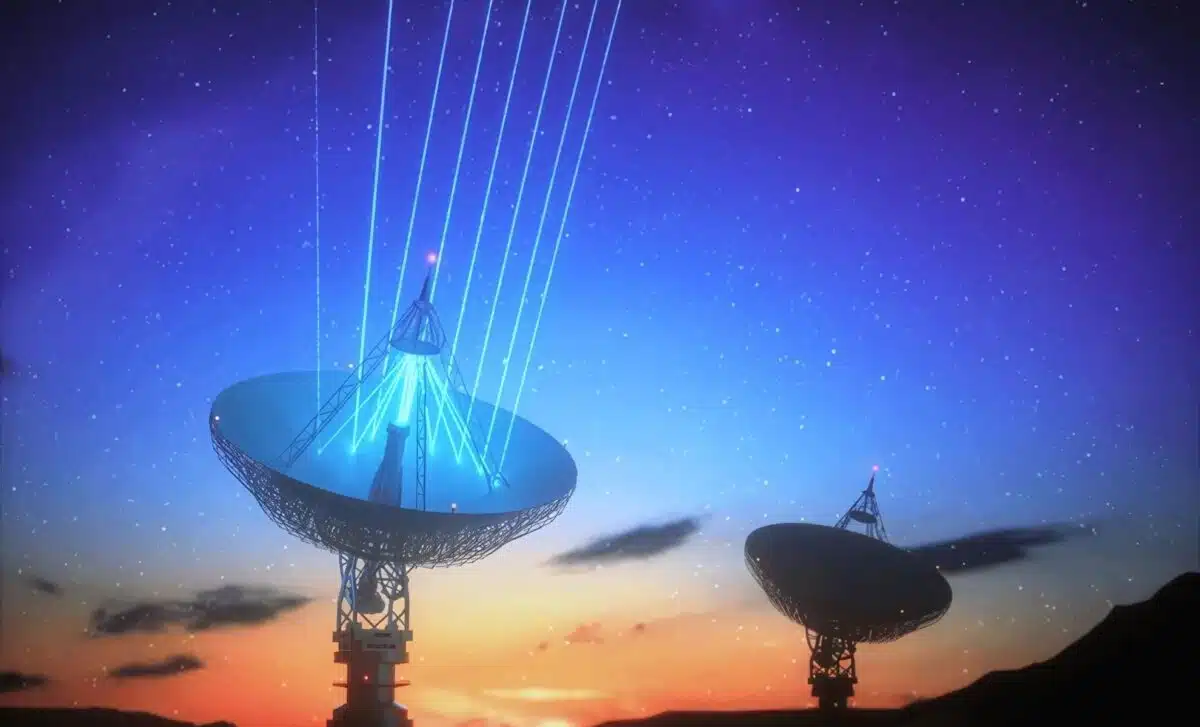
Radio Signal From 2.3 Billion Light-Years Raises New Speculations About Alien Life
An intriguing radio signal from a distant galaxy has reignited the debate over the enigmatic Fast Radio Bursts (FRBs), quick bursts of radio waves that puzzle science. Captured by a Russian radio telescope, the signal stands out for its low frequency specifications and impressive energy.
But its origin remains a mystery: could it be a natural characteristic or a message from an advanced civilization?
The radio signal, dubbed FRB 20190203, lasted only 211 milliseconds, just enough time to leave a trail of doubts. Detected at a frequency of 111 MHz, one of the lowest ever recorded, it carries unique characteristics that have intrigued researchers.
-
Indigenous peoples of the Andes surprise scientists by revealing a rare genetic adaptation linked to potato consumption 10,000 years ago, a discovery that could change what we know about evolution, diet, and human survival.

-
China unveils unprecedented quantum computer with 2 cores and 200 qubits: new architecture promises to reduce errors, increase stability for up to 100 seconds, and accelerate the global race for more powerful and scalable quantum machines.
-
Laser that once occupied an entire laboratory now fits on a tiny chip and delivers 147 femtosecond pulses, paving the way for portable atomic clocks, medical diagnostics, and high-precision sensors.

-
Without a steering wheel, pedals, or driver, a Chinese electric minibus that carries up to six passengers at a maximum of 30 km/h is already operating in cities in China and abroad, and places South America among the markets being observed by the manufacturer.


The telescope responsible for the discovery was the Large Phased Array (LPA), one of the most sensitive currently available. The event occurred in February 2019.
What Makes The Radio Signal FRB 20190203 So Special?
The data provided by scientists revealed fascinating investigations into this signal:
- Frequency: 111 MHz, much lower than the average of known FRBs.
- Flux Density: 20 Jy, classified among the most intense signals ever observed.
- Dispersion Measure (DM): 134.4 pc/cm³, indicating an origin about 2.3 billion light-years away.
- Duration: 211 milliseconds, longer than the norm.
These numbers, while technical, highlight the rarity of FRB 20190203. What adds to the mystery is the lack of repetition — a common behavior in better-documented fast radio bursts — and the absence of gamma-ray emissions, typically associated with such events.
What Is A Jansky?
To understand the impact of this signal, it’s important to grasp the jansky (Jy). This unit of measurement in radio astronomy evaluates the flux density of radio emissions, helping quantify their intensity. One jansky equals 10−2610^{-26} watts per square meter per hertz (W/m²/Hz). In the case of FRB 20190203, the peak of 20 Jy reveals a powerful specific signal.
Although invisible to the naked eye, the recorded energy indicates a strong emission capable of transmitting billions of light-years. This illustrates the escalation of events that generate FRBs and the sensitivity of modern instruments that detect them.
An Extraterrestrial Message?
The possible origins of the signal are a matter of debate. Many scientists point to natural characteristics, such as magnetars, extremely magnetized neutron stars capable of generating fast radio bursts. Others suggest supernovae or synchrotron maser emissions, linked to intense magnetic fields.
However, the idea of a technosignature — evidence of specific technology — also remains on the table. Non-repetitive FRBs, like FRB 20190203, fuel speculation about extraterrestrial communication. Its uniqueness and the absence of concrete explanations make these possibilities irresistible for many enthusiasts.
Still, scientists emphasize that the lack of additional data prevents definitive conclusions. “Without repetition, it becomes difficult to study the origin of the signal in greater depth,” stated one of the researchers involved.
Signal Update in 2024
So far, there is no specific information or updates available about this particular event. Research on FRBs remains active, with scientists seeking to understand their origins and characteristics.
Scientists will continue to observe the sky for similar signals, especially at low frequencies. The advancement of radio telescopes, such as the LPA, will enable the identification of new patterns and expand knowledge about FRBs.
In the meantime, FRB 20190203 remains an enigma. Perhaps it is a milestone in understanding extreme cosmic aspects, or maybe the first clue to something even more extraordinary.


Be the first to react!