Portuguese
  Spanish


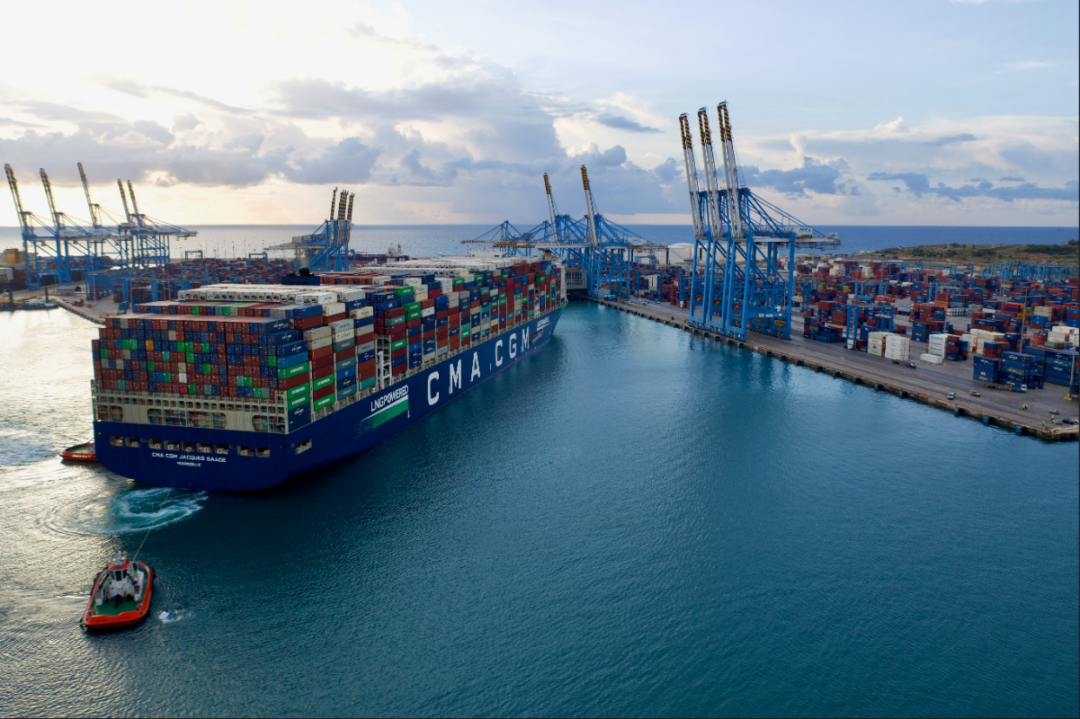

The Largest Liquefied Natural Gas (LNG) Container Ship in the World, the CMA CGM Jacques Saade Continues Its Record-Breaking Maiden Voyage with Its First Call in the United Kingdom
The largest liquefied natural gas (LNG) container ship in the world, the CMA CGM Jacques Saade continues its record-breaking maiden voyage with its first call in the United Kingdom in Southampton and Northern Europe. With a capacity of 23,000 TEUs, the megamax boxship is completing its first passage from Asia to Europe, operating as part of a weekly service consisting of 13 calls over 84 days.
Read Also
- The Senate CCJ Bans the Sale of Diesel and Gasoline-Powered Vehicles by 2030, Opens Space for Renewable Energy and Threatens the Oil Industry
- Installation of Pipelines and Submarine Structures Are the Theme of the Inaugural Class of the Professional Master’s Program in Structural Projects at Poli-UFRJ
- Investments in the Container Terminal at the Port of Santos Will Generate Jobs
- Santos Brasil, One of the Largest Terminals, Begins Investments of BRL 1 Billion
New World Record with the LNG-Powered Ship
The new flagship powered by LNG from the CMA CGM Group has set a new world record by leaving Singapore with a load of 20,723 full containers. The last world record was set in May when the HMM Algeciras left Yantian with 19,621 TEU on board. The Algeciras currently holds the title of the largest container ship in the world, surpassing the CMA CGM Jacques Saade and the MSC Gulsun with a nominal capacity of nearly 24,000 TEU.
The ship is the result of more than seven years of research and planning, the CMA CGM Jacques Saade is the first of a new class of boxships for CMA CGM and is at the forefront of efforts to build larger and more efficient containers. It measures 1,312 feet in length and has a beam of 200 feet. Its height is 256 feet.
-
French Brand Transforms 6 Million Brazilian PET Bottles into Sustainable Sneakers for Global Fashion Market

-
Abandoned Factory in Rio’s North Zone Becomes Urban Hazard with Standing Water and Debris

-
The U.S. Navy Conducts Submarine Tests in Idaho Lake to Detect Underwater Noises Hidden by the Ocean
-
British Factory Transitions from Mechanical Parts to Producing 420,000 Electric Power Units Annually, Supplying 70% of Ford’s Electric Cars Sold in Europe


State-of-the-Art Technology
The new class of CMA CGM ships features state-of-the-art technologies, such as route prediction, smart eye projection technologies, and augmented reality screens to assist the captain and crew in navigating and docking the giant.
To improve its performance, the design incorporates a straight-shaped hull with an integrated bulb, redesigned propellers, and rudder blades, which contribute to improving performance by optimizing water flow and significantly reducing energy consumption.
The LNG tank also required significant engineering. The shipyard reports that it took nine months to build and install the LNG tank on the ship. It has a capacity of 18,600 cubic meters, giving the ship the ability to make round trips between Asia and Europe between tank refills. Each of the ships will operate with a crew of 25 plus a gas officer.
According to CMA CGM, the gas director will be responsible for overseeing the process of gasification and pressurization of the gas. Stored in a liquid state, natural gas is converted to a gaseous state to power the ship’s engines. This process will need to be adjusted according to the vessel’s speed and the onboard electrical energy consumption.