Portuguese
  Spanish


The Yuan Gains Ground in International Trade and Challenges the Dollar’s Hegemony, Creating Unprecedented Influence at the IMF Since World War II.
The rise of the Chinese currency in international trade is becoming one of the most significant economic movements since the end of World War II. From an almost irrelevant share two decades ago to an increasingly solid presence in bilateral transactions and the reserves of various countries, the yuan — or renminbi — is consolidating itself as a strategic alternative to the dollar. And this advance is not just economic: it carries profound geopolitical implications, placing the International Monetary Fund (IMF) and the United States faced with an unprecedented scenario in over 70 years.
From Domestic Plans to Global Offensive: How China Built the Strength of the Yuan
The strategy for the internationalization of the yuan began timidly in the 2000s when China initiated currency reforms to allow its currency to be used in external trade transactions.
The real impetus came after the financial crisis of 2008, which exposed the vulnerability of countries overly dependent on the dollar.
-
Family Quietly Transforms Old Sawmill into $700 Million Business, Opens 25 Stores in Two Years Across 22 Brazilian States

-
Couple Sold Their Home to Save Business, Now Run Platform Handling $180 Million Monthly and Managing Over 51 Million Listings
-
Brazil’s 2026 Tax Refund: Record 9.58 Million Filers in Largest Payout Ever, But a Key Detail on Priority Recipients Draws Nationwide Attention

-
Itaú Alters Hybrid Work Model, Increasing Office Days from 2028, Prompting Employees to Adjust to New Routine






Beijing took advantage of the moment to close bilateral currency swap agreements with dozens of countries, allowing companies and governments to directly trade in yuan. Today, more than 60 countries have liquidity lines with China, covering strategic regions such as Latin America, Africa, Central Asia, and the Middle East.
Progress in International Trade and Diversification of Global Reserves
According to data from the Society for Worldwide Interbank Financial Telecommunication (SWIFT), the share of the yuan in international payments surpassed 5% in 2024 — a significant jump from the 2% recorded just four years earlier. Although still far from the dollar’s dominance (around 46% of transactions), the growth is rapid and constant.
In the field of international reserves, the International Monetary Fund estimates that approximately 3% of the assets held by central banks are already denominated in yuan.
This may seem small, but this figure is strategic: until 2016, the yuan was not even part of the basket of currencies that make up the Special Drawing Rights (SDR) of the IMF. Its inclusion was a milestone that officially recognized the Chinese currency as part of the global financial core.
The Debt of Countries to China and the Impact of the Belt and Road Initiative
Another fundamental vector of the yuan’s expansion is China’s financing of global infrastructure through the Belt and Road Initiative (BRI).
It is estimated that more than US$ 1 trillion has already been lent to participating countries, much of it under conditions that encourage the use of the yuan as payment and debt settlement.
This practice creates a web of financial dependency: by owing in yuan, countries feel compelled to use the currency in their commercial operations, strengthening its role in local economies and reducing the direct influence of the dollar.
Strategic Sectors Where the Yuan is Gaining Ground
The advance of the Chinese currency does not happen uniformly, but is particularly visible in strategic sectors:
- Energy: contracts for oil and liquefied gas with countries like Russia, Iran, and Saudi Arabia are already partially settled in yuan.
- Rare Minerals and Metals: agreements with African and Latin American countries have used the yuan as the preferred currency, especially in the supply of lithium, copper, and cobalt.
- Technology: payments and investments in telecommunications, including partnerships with companies like Huawei, often include clauses for settlement in Chinese currency.
The Challenge to the IMF and the Dollar-Led System
Since the end of World War II, the IMF and the World Bank have operated as pillars of the global financial system, with the dollar as the base of international reserves and credit operations.
The growing relevance of the yuan challenges this structure, not only because of its share in trade but also by creating parallel liquidity and financing networks to the traditional ones.
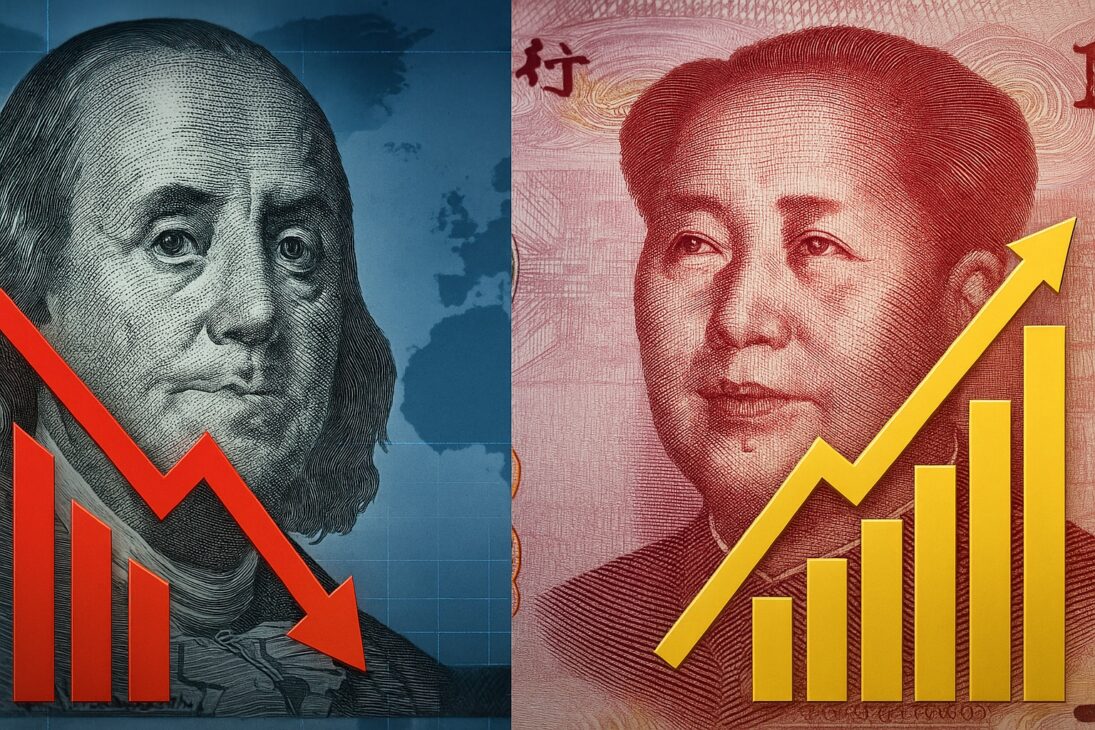
This means that, for the first time in decades, indebted countries have the option to seek resources outside the orbit of the IMF — and without necessarily adhering to the conditionalities imposed by the fund, which include economic and political reforms.
The Role of BRICS and Alignment with Strategic Partners
The strengthening of the yuan is closely linked to the BRICS bloc, where China acts as the main economic force. The expansion of the group, with the entry of countries like Saudi Arabia, Egypt, and the United Arab Emirates, creates new opportunities for trade agreements in local currencies, reducing conversion to dollars.
The integration of the yuan with initiatives such as BRICS Pay and central bank-issued digital currencies may further accelerate the trend of partial de-dollarization.
Limits and Obstacles to the ‘New Chinese Dollar’
Despite its progress, the yuan still faces significant obstacles to replace or rival the dollar. The Chinese currency is not fully convertible, which limits its free use in international markets.
Additionally, the government’s tight control over capital flows can generate distrust among investors who value transparency and the institutional stability of the American system.
Another point is that, even with the increase in trade in yuan, global liquidity is still largely concentrated in the dollar, which has decades of built trust and a deep, open capital market.
What to Expect in the Coming Years
Analysts diverge on the potential of the yuan to become a true ‘new dollar’. Some believe that the Chinese currency can reach a share of 10% to 15% in global trade by 2035, especially when combined with central bank digital currencies and alternative settlement systems. Others, however, argue that the lack of total currency liberalization and China’s political centralization will limit this rise.
In any case, the expansion of the yuan is already sufficient to alter trade and diplomatic strategies, forcing governments and companies to rethink their exposure to the dollar and their financing alternatives.
The advancement of the yuan does not mean the death of the dollar — at least not in the short term. But, for the first time since 1945, the global financial architecture faces a competitor with real economic weight, political support, and the ambition to reshape world trade. The ‘new Chinese dollar’ may not replace the original, but it is already writing its chapter in the battle for global economic power.