





 Portuguese
  English
  Spanish
  4 min of reading
  0 comments


The Century-Old Industrial Routine of the Okada Brick Factory Reveals How Tradition, Strict Technical Control, and Extreme Thermal Processes Ensure Durable Red Bricks That Span Generations in Japan
Brick production may seem simple at first glance, however, within the oldest brick factory in Japan, the process reveals a level of industrial precision that spans over a century. Founded in 1897, the Okada Brick Factory still maintains traditional methods combined with strict technical control, capable of transforming natural clay into highly durable red bricks resistant to time and weather.
The information was disclosed during a technical visit to the factory, which opened its doors to show, step by step, how each brick is produced. From the extraction of raw materials to the final inspection before shipment, everything follows a carefully planned logic to ensure uniformity, structural strength, and fidelity to the colors desired by customers.
From the Extraction of Mikawa Clay to Controlled Preparation of Raw Materials

Initially, everything starts outside the factory, in the quarries of the Mikawa region, recognized in Japan for its high quality natural clay. Mikawa clay is collected and, even before entering the production process, undergoes a careful screening based on particle size. This initial care is essential to ensure stability throughout the brick manufacturing process.
-
Six 400,000-year-old teeth found in China contained a protein that was believed to exist only in the mysterious Denisovans: the discovery reveals that Homo erectus interbred with this extinct relative and left a genetic trace that still lives in human populations today.

-
American donated US$ 5,000 to a Chinese farmer to plant trees in the desert, and decades later the money turned into a forest with more than 50,000 trees.

-
Almost no ship sails directly between South America and Australia, and the reason is a combination of the vast distance, winds that circle the planet nonstop, and the absence of ports along the way, leaving the South Pacific as a water desert.

-
More than 85 million homes in China heat water for free with vacuum glass tubes invented at a Chinese university, a cheap technology with no moving parts that faces certification rules and codes in the United States, making installation too expensive.


Next, the clay is conveyed to the factory through hoppers, large industrial funnels that direct the material to the ground floor. There, a precise amount is deposited on conveyor belts. Meanwhile, a second load of Mikawa clay, coming from another excavation area, is inserted into a second hopper. The goal of this stage is to stabilize quality, compensating for natural variations between different quarries.
Shortly after, the two clays proceed together to the first crusher, where they are mixed and broken into smaller particles. Next, a smaller diameter roller further refines the composition. Subsequently, the material is taken to the second crusher, equipped with a larger roller responsible for reducing the clay to even finer and more homogeneous particles.
Molding, Vacuum, and Precise Cutting Considering Thermal Shrinkage

After crushing, the mixed clay is directed to the third hopper, where it joins other previously blended batches. From this point on, all the material follows the same production flow. A feeder with a screen ensures that only particles in the correct standard proceed, while the clay is kneaded and homogenized to equalize composition, moisture, and particle size.
In the next stage, the clay is taken to the second floor of the factory, where it enters a vacuum extruder. In this equipment, air is removed from the mass inside a vacuum chamber, preventing internal bubbles that could cause cracks during firing. The clay is then extruded through a progressively narrower outlet, acquiring the initial shape of the brick.
The cutting is done by adjustable wires, which define the exact thickness of each piece. This adjustment already considers the natural shrinkage that occurs during drying and firing. The irregular ends are automatically reused and returned to the extruder, avoiding material waste.
Gradual Drying with Residual Heat and Strict Moisture Control
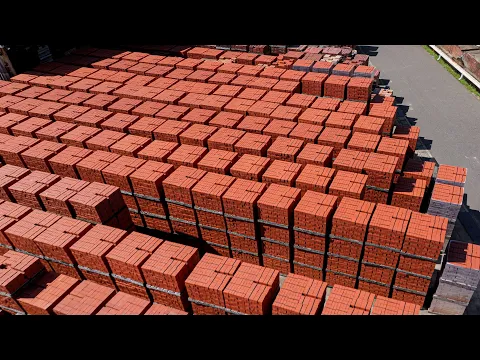

After being molded, the bricks are still wet and relatively soft. Thus, they proceed to the drying room, where they are carefully spaced to allow air circulation. During this phase, they utilize the residual heat from the oven located on the ground floor, an example of energy efficiency applied to the process.
At the entrance of the drying room, the temperature is around 40 °C, with high humidity. The bricks remain in this environment for 7 to 10 days, while large mobile fans maintain a constant airflow. Along the way, the temperature gradually rises to about 80 °C, while humidity decreases.
During this process, each brick loses approximately 500 grams of weight, a direct result of water evaporation. By the end of the drying, the bricks are already rigid, smaller, and ready for firing. They are then manually unloaded and transported one by one to the ground floor.
Firing at 1,120 °C, Manual Inspection, and Century-Old Legacy
On the factory floor, the dried bricks are stacked manually on large metal carts. The arrangement is done by experienced craftsmen, ensuring that heat is distributed evenly during firing. Bricks with cracks or chips are removed and reused in the production cycle.
Before entering the oven, the bricks undergo a final drying. Then, the carts slowly advance into the oven, which is 60 meters long. Each batch holds about 24,000 bricks, moving at a speed of 2 centimeters per minute. Heating occurs from both sides, with heat rising from the base of the pieces.
The maximum temperature for producing red bricks reaches 1,120 °C, and the complete firing process takes approximately two days. After cooling, the bricks are unloaded, undergo rigorous visual inspection, and are grouped for packaging, ensuring stability during transport.
As proof of the durability of the process, historical buildings such as the Handa Red Brick Building, built in 1898, still use bricks manufactured in the early years of the Okada Brick Factory. According to the craftsmen themselves, the true charm of the bricks lies in the fact that they age gracefully, gaining aesthetic and historical value over time.
In your opinion, what plays a bigger role in a brick lasting decades without failing: the careful selection of Mikawa clay, the long drying period with thermal and moisture control, or the extreme shock of firing at 1,120 °C? And when you evaluate strength and reliability, do you tend to trust more in highly controlled industrial methods or in the manual experience passed down from generation to generation?






-

-

-

-

-

20 people reacted to this.