Portuguese
  Spanish


In Barcelona, thermal walks with sensors measured urban heat at sidewalk level, revealing how trees, shade, asphalt, and buildings change the perceived temperature and helped identify places where walking or waiting for transport becomes more difficult on hot days, a reality that resembles the routine of many Brazilian cities and reinforces the importance of more comfort for those who travel on foot.
More than 300 people participated in thermal walks in Barcelona to measure the heat where it really matters, on sidewalks, squares, streets, and passage points used every day. The summer campaign of 2024 conducted 52 walks and involved 481 participants in five areas.
The information was released by Universitat de Barcelona, a Spanish public institution of education and research. Participants used sensors to record the temperature and also reported how they felt the heat in each section of the path.
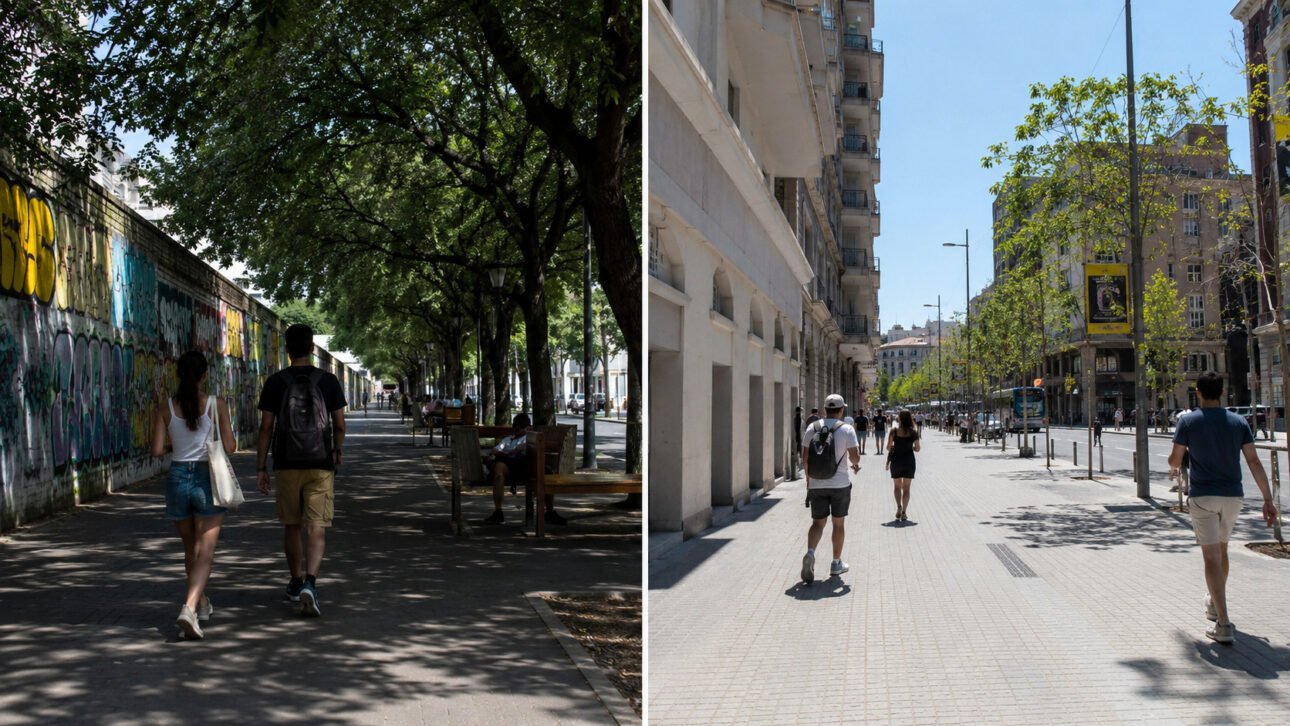
The result helps explain a common situation in cities: a sidewalk with trees can be much more comfortable, while another, just a few meters away, becomes a difficult space to cross because of the direct sun, asphalt, and lack of shade.
-
Tired of High Rent, Woman Converts Truck into Mobile Home for Travel Lifestyle

-
After Earthquakes Devastated Thousands of Homes in Nepal, Woman Uses Compressed Earth Bricks to Build Over 40 Resilient Houses
-
Wind energy company discovers 19th-century shipwreck with 615 tons of coal while surveying seabed for 150 turbines installation.

-
Scottish Village with 15 Wooden Tiny Homes Provides Shelter for the Homeless: Each Unit Includes a Private Door, Kitchen, Bathroom, and Living Room in a £3 Million Project


Thermal walks show the heat in the place where people pass
The project gathered residents to choose the spaces that are most part of the routine of each neighborhood. Streets, squares, parks, and paths used to go to work, school, or transport were included in the observations.
Then, the groups took walks with sensors. These devices recorded the temperature during the route and helped show what a weather app often cannot explain, the difference in heat between very close points.
Participants also assessed the thermal comfort, an expression used to describe if a place seems bearable or tiring to walk, wait, or stay for a few minutes.
This combination of measurement and real experience allowed us to see how urban heat affects each space. A general temperature for the entire city does not show, for example, the impact of the sun on a sidewalk without trees.
Five areas of the metropolitan region entered the urban heat map
The walks passed through Congrés i els Indians and Sant Pere, Santa Caterina i la Ribera, in Barcelona. They also included Collblanc and Torrassa, in L’Hospitalet de Llobregat, as well as Sant Vicenç dels Horts and Montcada i Reixac.
The University of Barcelona, a Spanish public teaching and research institution, recorded the participation of 481 residents during the 52 thermal walks of the summer 2024 campaign.
Each area presented different uses of streets and public spaces. Some routes involved more exposed sidewalks, while others had shaded or vegetated areas that changed the heat sensation.
The work did not just measure the number shown by the sensor. It considered how residents of different ages and profiles face heat in real life, which helps to understand which places require more attention.
Heat islands make a simple walk feel heavier
Urban heat islands arise when areas with a lot of concrete, asphalt, cars, and buildings accumulate heat. This makes the environment warmer, especially in places with little vegetation and poor air circulation.
People walking often feel this effect more directly. A person can leave a tree-lined street and soon find an avenue without shade, with a hot surface and the sun hitting their entire body.
The difference is not only in the temperature marked on a thermometer. It also appears in the feeling of fatigue, the difficulty of waiting for buses, and the discomfort of crossing open spaces during periods of intense heat.
Therefore, urban heat needs to be observed at street level. It is there that residents walk, work, shop, take children to school, and use public transport.
Trees, shade, and rest areas can reduce heat exposure
The survey helps to identify where the city can study responses to reduce discomfort. Arborization, shade structures, fountains, changes in flooring, and rest areas are possibilities that can be evaluated in each location.
A street very exposed to the sun may need more trees. A bus stop may require a shelter. A square with flooring that gets too hot may need solutions to reduce direct exposure to heat.
There is no one-size-fits-all measure for all neighborhoods. What works on a tree-lined sidewalk may not solve the problem on a wide avenue full of concrete and lacking space for shade.
Sensors help precisely because they show where the problem is greater. With data on the temperature felt by pedestrians, urban planning can address situations that are usually hidden in general climate maps.
The Brazilian summer helps to understand Barcelona’s problem
Barcelona’s experience is reminiscent of common situations in Brazil. Waiting at a bus stop without a shelter, walking to work under a strong sun, or crossing a square without trees can turn a few minutes into a tiring journey.
On hot days, mobility changes. Some people avoid walking, take longer breaks, or look for shaded routes, even if they are longer. This shows how heat and mobility are linked in the routine of those who depend on the streets.
A city prepared for high temperatures does not depend on a single change. It can offer trees, shade, water, benches, and more comfortable paths for those who need to walk.
Barcelona’s thermal walks show that heat does not spread evenly throughout the city. Two neighboring sidewalks can offer very different experiences, even under the same sunny day.
Data helps to see where the problem is and why small changes in urban space can make a difference for residents, workers, and passengers. Measuring heat at the sidewalk level also helps to think about more human-friendly cities for pedestrians.
In your city, which place becomes more difficult to cross in the heat and what could make it more bearable for those who depend on that path every day? Share your experience in the comments.