






 Portuguese
  Spanish
  6 min of reading
  0 comments


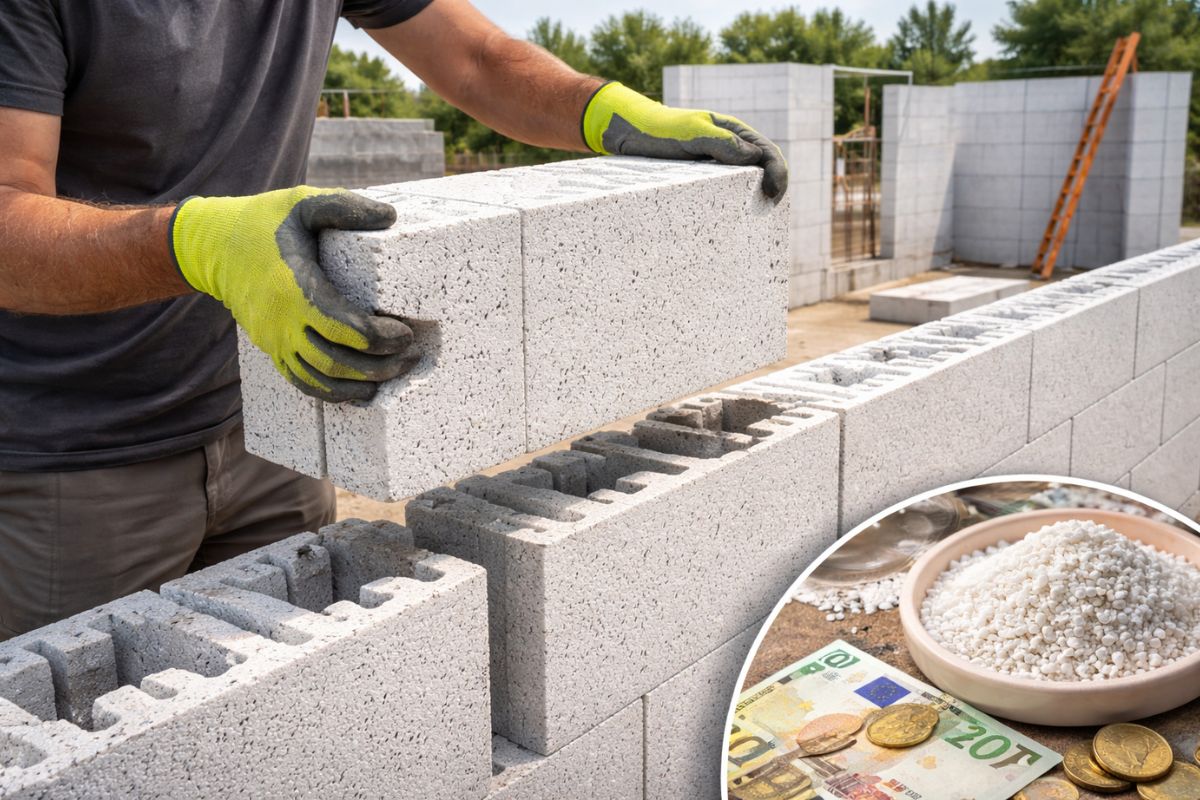
A dispersed perlite block system in Europe proposes walls without cement, without mortar, and without water, with pieces that fit and lock with a click and promise to raise the walls of a 100 m² house in 24 hours. The cost per m² and the raw materials challenge viability.
The perlite blocks seem like a construction trick because they deliver the most labor-intensive part of masonry with a fitting logic. Instead of mortar, the system relies on geometry, with pieces that fit millimetrically and lock, reducing dependence on specialized labor.
Interest has grown rapidly because the concept addresses a real problem, the lack of skilled labor and the high execution time. However, when looking at material, strength, and especially cost in euros, the promise of speed begins to compete with the reality of viability in Brazil.
From Viral Video to What Exists Behind the Click

The diffusion of the system appears as a phenomenon of repetition. The same video would have been sent by dozens of people in a few hours, signaling that the idea touches on a common anxiety, to build faster, with fewer steps and less dependence on bricklayers. This behavior is relevant because it shows social demand for direct assembly solutions.
-
She panicked when she saw her daughter fall from the crib; years later, she turned the experience into a factory generating R$ 9 million per year.

-
At 75 years old, João José de Carvalho, known as Mr. Janjão, was accepted for the second time by Sisu after overcoming distance, physical limitations, and years away from school, to fulfill his dream of studying Biological Sciences at UFPI.

-
A thrift store that started with children’s clothes and a loan from grandma turned into a network worth R$ 300 million per year: Peça Rara grew to 130 stores, sold 4 million items, and transformed used items into a national circular economy business.

-
The German fund created to compensate victims of Nazi forced labor paid billions, but the responsible parties themselves admit that the money did not come close to compensating 26 million people.




The heart of the system is composed of six types of pieces, each with a specific position, designed to fit and lock automatically. The fittings are described as cone-shaped, creating a mechanical lock when one block enters another.
The company claims that no type of mortar is needed, neither glue nor water, to set the walls.
This promise changes the logic of construction because it eliminates mixing, curing, and waiting associated with mortar. In theory, it also reduces mess and dosage errors. However, the very requirement for millimetric fitting suggests a significant dependence on precise manufacturing, undamaged transportation, and a well-leveled base to avoid accumulated misalignment along the rows.
What Is Perlite and Why Does It Change Wall Performance

The perlite blocks are made from perlite, described as a volcanic rock that expands at high temperatures and takes on an appearance similar to cellular concrete. The cited process involves heating to 900 degrees, making the material expand like popcorn, increasing volume and forming a porous structure.
This porosity explains the main declared advantage, superior thermal and acoustic insulation, along with a very low weight. The base compares typical densities, with cellular concrete between 400 and 1600 kg per m³, while perlite often appears between 30 and 200 kg per m³.
The lightness aids in handling and assembly, and the pores help reduce heat exchange and noise.
Perlite is also described as non-flammable, chemically neutral, and with low moisture absorption, important characteristics in walls. At the same time, the base indicates that perlite tends to have lower resistance than cellular concrete precisely because it is lighter and more porous, which imposes usage limits and requires project coherence with the material.
Dimensions, Strength, and the Promise of a Wall in One Day
The cited perlite blocks measure 35 cm in width, 30 cm in height, and 70 cm in length, meaning they are large pieces. The compressive strength is described as approximately 1.5 MPa, with a didactic explanation of equivalence, something like supporting 15 kg per cm² of the material’s surface area.
The company claims that the walls of a house of approximately 100 m² can be built in 24 hours. This speed relies on the size of the pieces and the click-fitting, along with the promise that even a layperson could follow the plan and assemble the rows with low qualification demands.
The proposal is to reduce execution time and labor costs, especially in places where qualified bricklayers are scarce.
This brings up a technical point little discussed in viral narratives; rapid execution depends on impeccable logistics. If the blocks arrive with dimensional variation, if the land requires correction, or if there are installation interferences, the fitting pace may slow. Still, the idea of modularity and dry assembly explains why so many see it as an enticing path.
The Brazil Problem, Raw Material, and the Euro Barrier
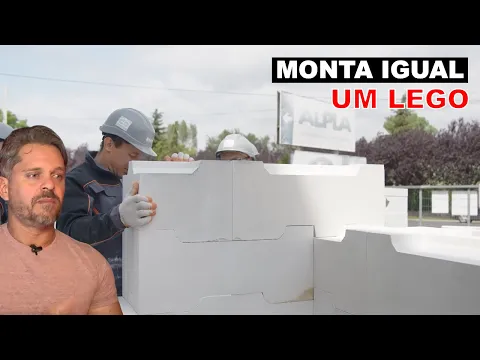

When the discussion reaches Brazil, two decisive obstacles arise. The first is the raw material. Perlite is a volcanic rock and, according to the base, would depend on extraction in environments close to volcanoes.
The implicit question is simple: where would Brazil source this material at scale and competitive price. The presented conclusion is that perlite would arrive with high added value, excessively raising manufacturing or import costs.
The second obstacle is the cost in euros. In the cited example, a modular project of 9.91 m² of built area is sold for 5,777 euros, plus variable taxes, and this includes only the blocks for the walls. Foundations, structures, beams, slabs, doors, windows, and finishes are excluded. When dividing the value by the area, the estimated cost arrives at about 582 euros per m² of built area just for wall blocks.
In the mentioned conversion for November 2025, this appears as approximately R$ 3,600 per m² built for the wall block portion, and the total value of the cited kit is around R$ 35,748 for a module of 9.9 m². Even without entering the merits of exact exchange rates, the order of magnitude is high, and this is the type of barrier that kills technology before it can scale.
The Promise of Saving 80 Percent and the Shock with Local Materials
The manufacturer claims it is possible to save up to 80 percent on the cost of executing the walls. The base, however, raises doubts about the reference of this comparison because if the comparison is made against extremely expensive solutions, savings might exist. But if the parameter is ceramic masonry or cheap cellular concrete available in Brazil, the math tends not to add up.
This is the point that separates interesting technology from viable technology.
Execution speed does not compensate for any cost, especially when the wall needs to compete in price with alternatives already established in the local market, with a ready supply chain and labor accustomed to execution.
The wall also has 35 cm in width, described as a thickness valued in countries with harsh winters, where insulation is a priority. In Brazil, the base evaluates this thickness as excessive, even in cold regions, which means more material, more weight, more volume, and less usable internal area in a country where square footage is often expensive.
The Proposed Alternative, Copy the Concept with Cellular Concrete
The discussion advances to a hypothesis of adaptation. If the central idea is assembly by click without mortar, the base suggests it would be possible to manufacture something similar using cellular concrete, a cheaper material in Brazil. This would bring two proposed advantages, lower cost and greater strength, while maintaining some level of insulation and reducing dependence on perlite.
The adaptation would also involve reducing the thickness of the block, consuming less material and making the wall more financially and functionally viable by local standards. In other words, the click could be the real innovation, not the perlite itself, provided the system is redesigned for Brazilian climate, cost, and raw material availability.
This type of path is common in applied innovation. A technology is born in a European context with labor and climate restrictions, and what arrives in Brazil needs to be tropicalized in terms of raw materials, thickness, and cost. Without this, it becomes internet curiosity, not a construction standard.
The perlite blocks attract attention because they deliver speed, dry assembly, and insulation, with walls that lock with a click and promise to be ready in a day. However, the same base that shows the engineering also points out the weak link, cost in euros and difficult raw material in Brazil, along with a thickness that may be excessive for our construction standards.
If you were building today, what would weigh more for you in this idea of perlite blocks, assembling in 24 hours without a bricklayer, having better thermal and acoustic insulation, or paying a high cost per m², and would you invest in a similar system made of cellular concrete in Brazil?





-

-

3 people reacted to this.