Portuguese
  Spanish


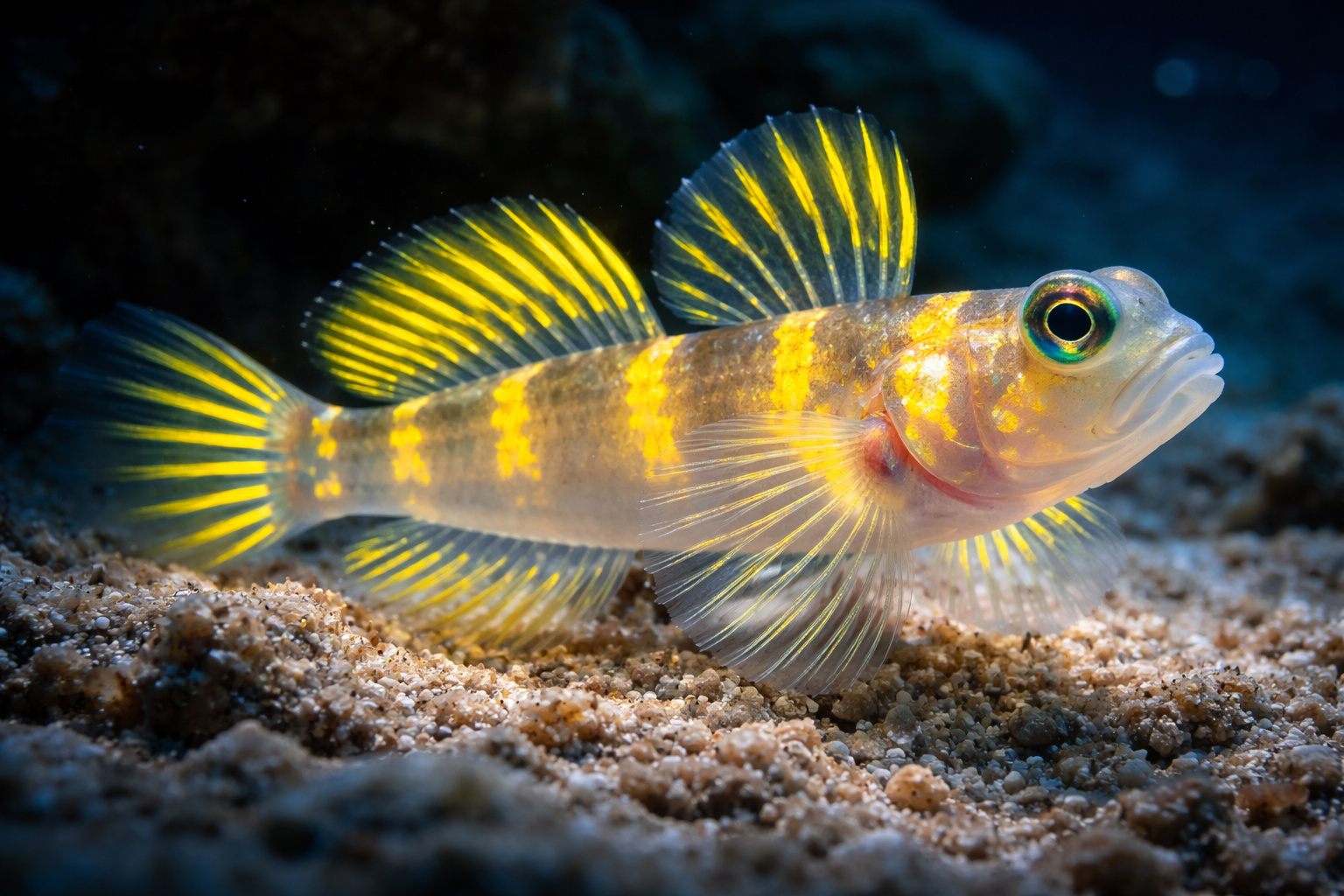


Species Identified Near Okinawa Draws Attention For Rare Coloration, Extreme Depth, And Direct Tribute To Super Saiyajin
A scientific discovery of strong visual and cultural impact was announced at the end of 2025 by Japanese researchers, garnering international attention.
A new species of fish was identified in deep waters near Okinawa, in southern Japan, and was given the scientific name Vanderhorstia supersaiyan, in direct reference to the anime Dragon Ball, created by Akira Toriyama.
Already, the animal has drawn attention for exhibiting intense yellow stripes, associated with the Super Saiyajin transformation of the character Goku, characterized by a golden aura and luminous appearance.
The identification was conducted by researchers from Ryukyus University and published at the end of 2025 in the scientific journal Springer Nature.
Discovery In Deep Waters Expands Knowledge Of The Twilight Zone
The discovery took place in a little-explored ocean environment known as the twilight zone.
The first specimen was captured at approximately 210 meters deep, off the coast of Ishigaki Island, an area marked by very low natural lighting.
This record, therefore, significantly expands the known depth limit for species of the genus.
Thus, the finding reinforces the scientific relevance of the region and highlights how deep ecosystems remain poorly understood.
Morphological Characteristics Break Goby Standard
From a biological perspective, the new species belongs to the family of gobies, a group widely distributed around the world.
Typically, these fish exhibit discreet coloration, with shades of gray, brown, or green.
However, the Vanderhorstia supersaiyan breaks this standard by displaying a nearly transparent body, along with bright yellow stripes on the fins and face.
According to researchers, no other species of the genus Vanderhorstia, which includes more than 30 known species, exhibits similar morphological characteristics.
-
Rare fox feared “extinct” found alive on Caribbean island after over two decades without official sightings

-
21-Year-Old Brazilian Student Turns Homemade Popsicle Hobby into $100,000-a-Month Business

-
Australia Dumps Hundreds of Thousands of Tons of Gravel into Rivers to Restore Natural Barriers and Reverse 150 Years of Erosion

-
Bird-Inspired Robot Glides on Air Currents up to 10 m/s, Balances Itself, and Aims to Save Energy in Industrial Inspections and Meteorological Balloons




Japanese Culture Influences Choice Of Scientific Name
Next, the scientists explained the choice of the adopted scientific name.
According to the team, the vibrant golden stripes directly recall the yellow aura displayed by Goku in the Super Saiyajin state.
Additionally, the researchers highlighted that manga and anime occupy a central position in Japanese culture.
As a consequence, these references influence various areas, including scientific nomenclature.
Thus, the tribute was deemed coherent, respectful, and culturally aligned with the Japanese context.
Nickname “Electric Gobi” Reinforces Species Visual Impact
In addition to the scientific name, researchers suggested the informal nickname “Electric Gobi”.
In this case, the name refers to the luminous appearance observed under artificial lighting.
Still, the scientists clarified that the fish does not emit its own light.
Therefore, the coloration results solely from a rare pigment pattern, without bioluminescent properties.
With this, the team avoided misunderstandings about the species’ behavior.
Discovery Reinforces Scientific Potential Of Ocean Depths
Finally, the identification of Vanderhorstia supersaiyan expanded knowledge about deep marine biodiversity.
At the same time, the finding demonstrated how science and culture can interact in a precise and responsible manner.
Considering that similar regions remain under-explored, how many other surprising species may still be hidden in the depths of the ocean?