Portuguese
  Spanish



A Concrete Substitute Developed With Grass, Shells, and Seawater Is Showing Structural Strength, Helping to Recover Tidal Ecosystems and Revealing Potential to Transform Both Coastal Protection and Small Constructions
The study conducted by the Royal Netherlands Institute for Sea Research presents a concrete substitute capable of retaining carbon and stimulating the recovery of marine ecosystems.
The material, called Xiriton, demonstrated significant results in field tests that assessed its performance in both organism attachment and structural strength over time.
Field Tests Reveal Intense Marine Life Growth
The experiments took place in Yerseke, where blocks of this concrete substitute were placed on a mudflat and monitored daily during the tides. The environmental response occurred quickly.
-
UFG’s Innovative Use of Air Conditioner Drip Saves 400 Liters of Water Daily in Brazilian Public Building

-
China Builds Underwater Wall After Discovering Technology That Could Shift Military Balance in the Pacific, Study Reveals Why the Asian Power Reacted Now

-
After Over 8 Months in a Simulated Mars Habitat in Houston, 4 NASA Volunteers Communicate Almost Silently and Will Exit in October
-
Natural Phenomenon Turns Black Sea Turquoise Blue Due to Billions of Microscopic Organisms


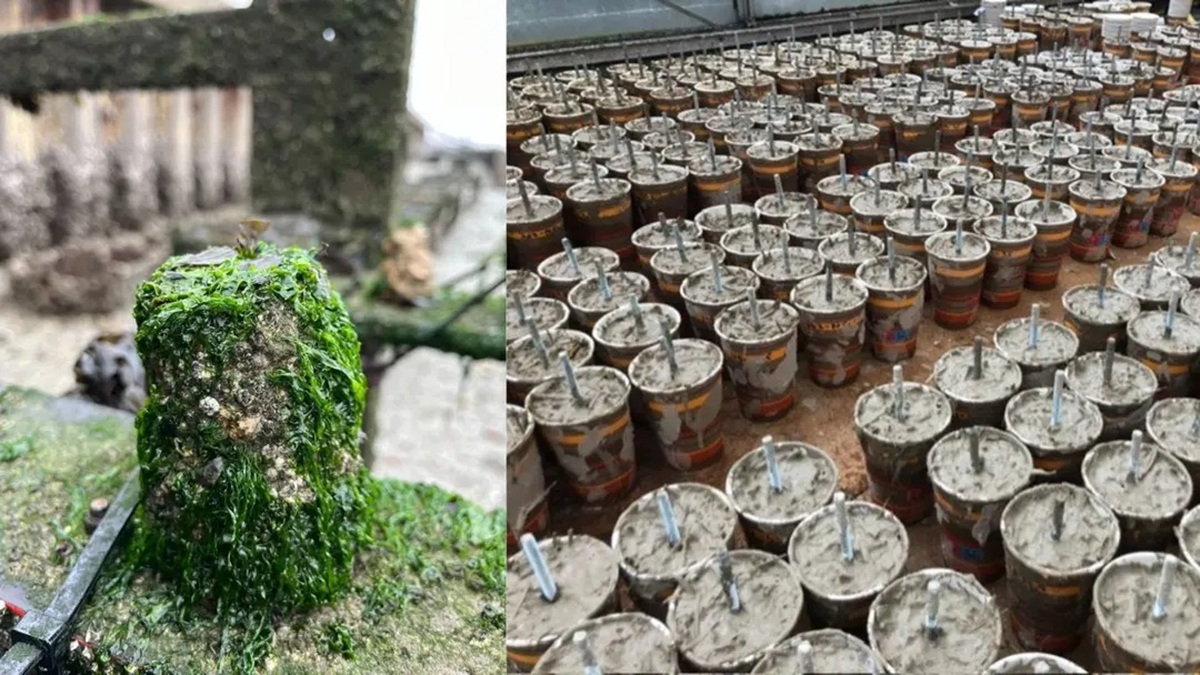
After one year, the blocks exhibited dense growth of organisms attached to their surface.
PhD student Victoria Mason details that about 70 percent of each piece was covered with oysters, mussels, and algae. The observed behavior indicates that Xiriton can directly assist in the recovery of mollusks and contribute to restoring part of the biodiversity of tidal areas.
She emphasizes that the biodegradable nature is one of the material’s differentiators. Adjusting its lifespan, this concrete substitute can naturally decompose when the reefs gain stability, turning into harmless substances and avoiding permanent waste in the ecosystem.
Influence of Grasses and pH on Material Strength
The team tested different grasses in the composition of Xiriton, such as Spartina and elephant grass. Mason identified that drying time and binder levels directly influenced the strength of the pieces. After five weeks of drying, the solidity reached maximum levels.
Another highlighted point is the more neutral pH of the material. With values between 8 and 9, Xiriton favors marine organisms, unlike conventional concrete, which tends to be more alkaline. This characteristic strengthens the compound’s potential as a concrete substitute in coastal environments.
Durability Test Shows High Performance
To analyze the strength of the material, the researchers used the Fast Flow Fume system. Pieces molded in coffee cups were subjected to an intense electric flow designed to generate stress greater than that found in standard installations.
After 63 days of continuous exposure, the material maintained strength comparable to alternatives to Roman cement. Mason highlights that materials intended for restoration should avoid long-term damage, allow for shape flexibility and lifespan, and remain accessible for large-scale projects.
She emphasizes that, especially in the intertidal zone, it is essential to work with materials that do not cause environmental impacts and that maintain viable costs.
Next Steps Include Larger Structures
The team is preparing new tests to check if Xiriton can support wave breaker structures. The intention is to understand how to adjust the durability of this concrete substitute to function as a semi-permanent support in reef formation. This next phase should expand the understanding of the material’s structural role in larger-scale scenarios.
Creator Sees Use in Small Residential Constructions
The Swiss inventor Frank Bucher presented the concept in 2009 and claims that Xiriton can replace bricks in constructions of up to three stories. He emphasizes that the compound does not require baking or clean water, as it can be produced with ditch or seawater.
Bucher also points out that the combination of wood and Xiriton opens new construction possibilities, as wood reinforces the material and Xiriton protects the wood.
Researchers Advocate Biologically Based Approaches
Senior researcher Jim van Belzen states that modern construction exceeds all global biomass and advocates for new sustainable pathways. For him, materials guided by circularity and regeneration cease to be just an alternative and become a necessity.
He assesses that ecological solutions can transform coastal protection and emphasizes that the future of water security could be greener than stone and concrete. The study compiling the results was published in the journal Frontiers in Marine Science.