Portuguese
  Spanish


International Recognition Highlights Pix as a Model of Public Financial Innovation, Expanding the Discussion About Brazil’s Role in the Global Scenario and Boosting Discussions About Digital Payments, Financial Inclusion, and New Banking Technologies.
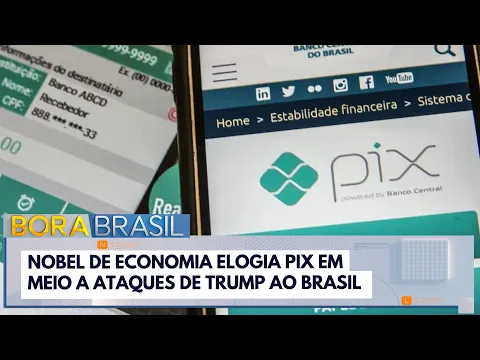
The instant payment system Pix, created and managed by the Central Bank of Brazil, received international recognition following analysis by economist Paul Krugman, Nobel Prize winner in Economics.
In his column, Krugman acknowledged Pix as a global reference in financial innovation and raised the question: “Did Brazil Invent the Future of Money?”
This response comes amid growing debate over digital currencies and new financial technologies.
-
Brazilian Executive Takes Helm of Heineken Amid Decline in Sales: 51-Year-Old Has Led Operations Across Four Continents and Managed a $7 Billion Empire

-
Brazilian Actress Turns Waxing Clinic into 400-Unit Chain with $50 Million Revenue, Sells Stake After 13 Years
-
Major Company Shuts Down 70-Year-Old Factory in Brazil, Relocating Production and Impacting Over 100 Families
-
Toyota Shuts Down Brazilian Plant After Producing Over 1 Million Vehicles, Plans Special Destination for Final Corolla Produced Following $2.1 Billion Investment and Expansion.


The information was initially published by the UOL portal and resonated among economic sector specialists this Tuesday (22).
Pix as Financial Innovation and International Recognition
According to a report published by UOL, Krugman used his weekly column to analyze payment systems in the United States and compared them to Pix, which, for him, represents the future of money.
The economist argued that Brazil has shown it is possible to create an accessible, secure, and low-cost digital payment system for the entire population.
Pix, managed publicly and free of charge for individuals, has become a symbol of financial inclusion and innovation in the global banking sector.
Krugman’s analysis gains even more relevance in the recent context, as highlighted by UOL, in which the U.S. government decided to open an investigation into the Brazilian payment system.
This decision may lead to new trade sanctions and tariffs against Brazil.

Meanwhile, the U.S. House of Representatives approved legislation that encourages the growth of stablecoins — digital currencies tied to stable assets — and prohibited the Federal Reserve, the central bank of the United States, from creating or studying a digital currency of its own, called Central Bank Digital Currency (CBDC).
Debate in the United States and Comparison with the Brazilian System
According to an investigation by the UOL portal, Krugman highlighted the contrast between the American debate and the Brazilian experience.
In the United States, the advancement of a public digital payment system faces resistance from the private financial sector and political representatives, especially from the Republican Party.
Among the opposing arguments, concerns about privacy and potential risks of state surveillance prevail.
However, according to the economist, the American government already has access to personal data in other sectors.
The American economist also explained that, while American banks already use accounts at the Federal Reserve for electronic transfers, the population still does not have access to a public system comparable to Pix.
In Brazil, the Central Bank implemented Pix for individuals and legal entities, ensuring speed, reduced costs, and ease of use.
In contrast, according to Krugman, in the United States there is strong resistance from the financial sector to the creation of a public system that competes with private products.

Data, Reach, and Costs of Pix
As UOL highlighted, Krugman compared Pix to Zelle, a payment system operated by a consortium of American private banks, and stated that Pix is more intuitive, accessible, and comprehensive.
Recent data from the Central Bank of Brazil indicates that, by 2025, about 93% of Brazilian adults already use Pix, a rate higher than the use of cryptocurrencies in the United States, where only 2% of the population used digital currencies for purchases or payments in 2024.
According to information from the International Monetary Fund (IMF), relayed by UOL, Pix allows for almost instant settlement of transactions, with an average of just three seconds per payment.
In the United States, debit card transactions can take up to two days, and credit card transactions almost a month.
Furthermore, in Brazil, individuals do not pay fees for Pix, while companies pay an average fee of 0.33% per transaction, below the rates charged for debit cards (1.13%) and credit cards (2.34%).
Financial Inclusion, Security, and Future Advances
UOL also pointed out that Krugman believes that Pix already delivers, in practice, what cryptocurrency advocates promise but have not achieved: financial inclusion and low operational costs.
The economist further emphasized that the Brazilian system provides security, practicality, and does not present the risks of losing cryptographic keys common in transactions with digital currencies.
According to a report from UOL, the international visibility of Pix is strengthening as the Central Bank of Brazil prepares to introduce Drex, the official digital currency that will be integrated into the Pix ecosystem and will expand the reach of digital payments.
For Krugman, the Brazilian experience shows that innovative solutions can emerge under state regulation, provided there is public interest and political will to overcome the resistance of established economic groups.
Barriers to International Adoption and Perspectives for Pix
The UOL portal also highlighted Krugman’s assessment of the barriers to implementing a system similar to Pix in the United States.
He points out the strong influence of the financial sector and the political view that the government should not compete with private enterprise as the main obstacles.
Thus, Brazil remains at the forefront of digital payments, while the United States remains conditioned by the interests of the financial sector and ideological debates about the role of the state.
The rise of Pix as an international example of innovation and efficiency raises new questions about the future of payment methods worldwide.
The Brazilian system has consolidated itself as an inclusive and effective alternative, attracting the interest of economists, countries, and multilateral organizations.
In light of this scenario, will other nations follow Brazil’s path and seek similar alternatives to promote financial inclusion?