






 Portuguese
  Spanish
  3 min of reading
  1 comment


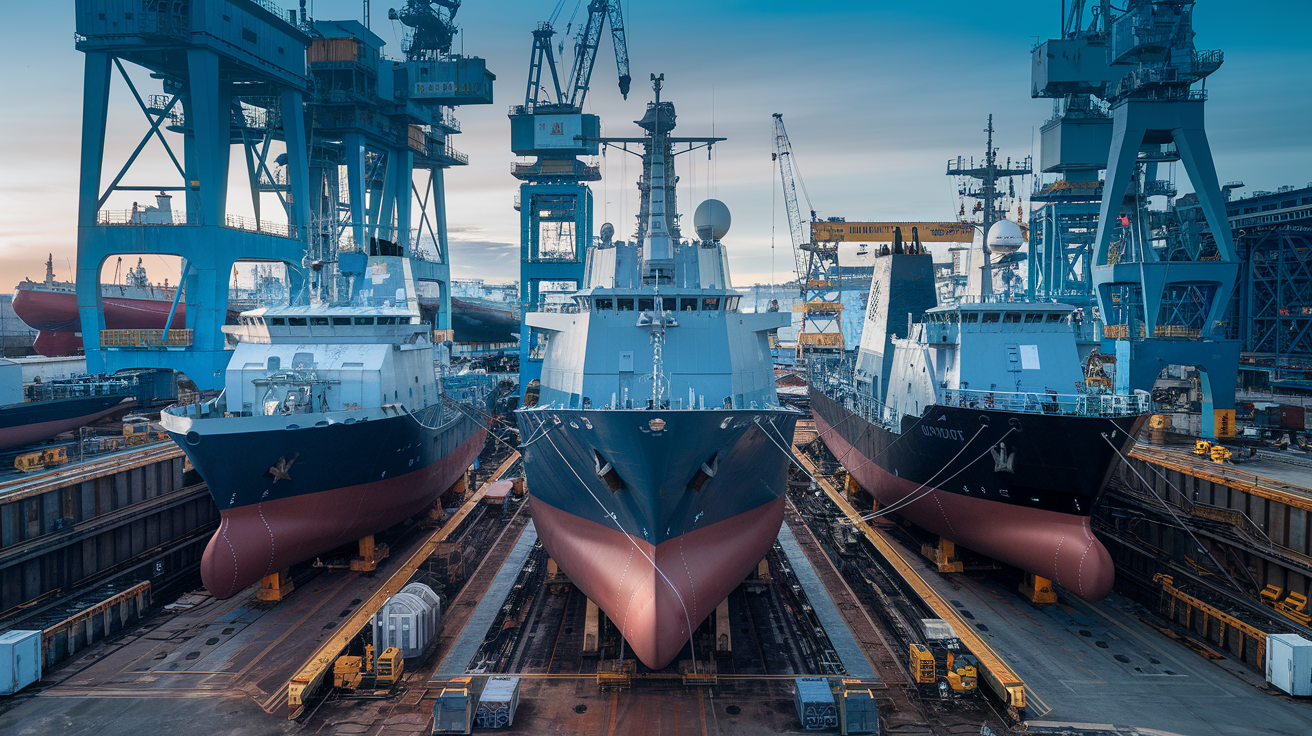


Navies Around The World Announce Billions In Investments In Frigates And Ships – Understand How Global Tensions And Conflicts Are Driving The Naval Industry.
The global climate of tensions, marked by the wars in Ukraine and the Middle East, is driving acquisitions and investments in defense, primarily in the naval industry. The Navy, a growing military sector, foresees a global annual increase of 4% from 2024 to 2034, with the construction of frigates and ships. Armed forces worldwide are planning to begin an investment of US$ 44.4 billion this year, equivalent to R$ 270 billion when converted to the current exchange rate.
Understand The Main Objectives Of The Brazilian Navy And Others In Investments In The Naval Industry
A report published by British analyst Global Data, titled “Naval Ships And Combatants By Segments, Programs, Competitive Scenarios And Forecasts Until 2034,” includes detailed estimates. This document also addresses the situation of 18 renowned naval industry builders, such as European Navantia, Naval Group, Fincantieri, and Damião.
The report focuses on 5 main segments, which are the construction of frigates, destroyers, auxiliary ships, light combat ships, and amphibious ships. Frigates, in particular, are projected to achieve the highest investment values, with expectations that they will cover more than half of the market. This focus reflects the growing importance of the Navy and Armed Forces in global military defense.
-
The military spaceplane that almost took the Cold War into orbit: Boeing X-20 Dyna-Soar was designed to re-enter above Mach 20, fly for up to 40 hours, land like a plane, and transform Titan rockets into a gateway to a new era of orbital warfare.

-
FAB bets on national drones and increases investments to strengthen the Brazilian aerospace industry

-
Ukraine launches largest drone attack on Moscow since 2022, Russia claims to have intercepted nearly 200 aircraft near the capital, Kapotnya refinery targeted again, and offensive reignites alert about war reaching the Russian energy heart just a few kilometers from the Kremlin.
-
Truck drivers, freight, and fines from 2022 take center stage in politics: Chamber approves MP with amnesty, mandatory tracking by CIOT, million-dollar penalties, and new minimum wage for those who spend more than 24 hours on the road.




The editor of the naval industry report estimates that maritime threats and territorial disputes are driving investments in the construction of frigates and warships in the coming years. Fleet modernization will fuel increased defense spending, driving global demand.
Currently, many countries around the world, including the navies of Russia, China, India, the United Kingdom, Italy, France, and Canada, have begun naval modernization programs to replace aging vessels in active service.
Modernization Of Naval Fleets And Frigate Construction In The Naval Industry
These programs are essential for the armed forces, as many of these aging fleets need replacements. The report estimates that the Asia-Pacific region will dominate the global market for warships and surface combatants during the forecast period, with a market share of 34%. Europe and North America are following closely behind.
The document also covers industry analysis, including the key drivers of the naval industry, trends, emerging technologies, and challenges faced by industry participants. It provides insights into fundamental factors and government programs that are expected to influence the demand for warships and frigates during the forecast period, according to the document’s authors.
Which Is The Most Powerful Navy In The World?
Global Firepower, a ranking that analyzes the military power of nations, evaluated the navies of 145 countries, ranking them by the number of underwater and surface naval units. The ranking takes into account warships such as submarines, aircraft carriers, amphibious vessels, corvettes, and frigates that make up each navy’s arsenal, excluding projects under development or planned for 2024.
Russia, China, and North Korea occupied the podium of the ranking. With an arsenal of 781 ships, Vladimir Putin’s navy is the largest naval force in the world. The Russian arsenal includes an aircraft carrier, 12 frigates, 14 destroyers, 47 mine warfare vessels, 65 submarines, 83 corvettes, and 122 patrol vessels. In second and third place, China and North Korea have 730 and 505 vessels, respectively.
The world’s leading power, the USA, ranked fourth in the classification, with 472 ships, according to the ranking. The country has units such as 11 aircraft carriers, nine helicopters, 75 destroyers, 23 corvettes, 64 submarines, five patrol vessels, and eight mine warfare vessels. The Brazilian Navy ranks 23rd, being the 4th largest naval force in Latin America, after Colombia (237 ships), Mexico (194), and Bolivia (173 ships).




Essa matéria é uma piada… você é um brincalhão….pura desinformação…