Portuguese
  Spanish


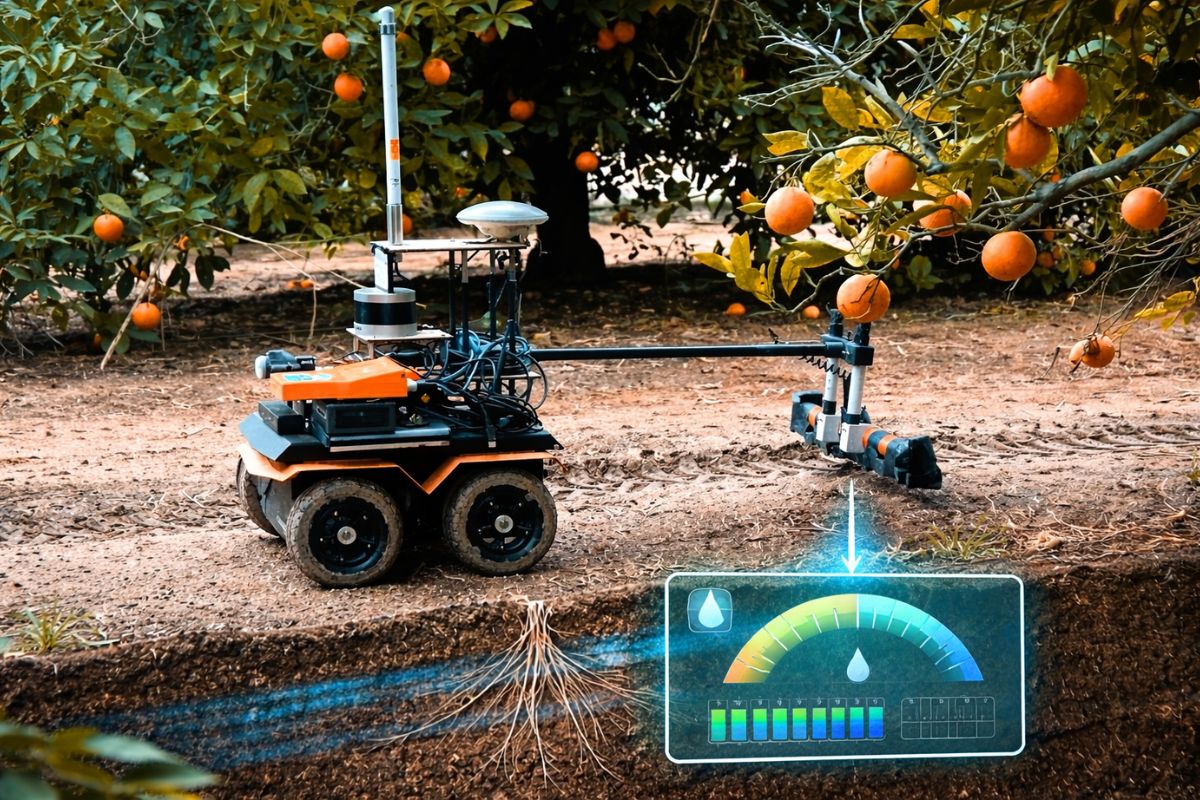

A compact robot developed by the University of California, Riverside, traverses citrus orchards measuring soil moisture tree by tree with electromagnetic sensors. The system allows for precision irrigation, reduces water waste, and prevents excess that suffocates roots and contaminates groundwater.
Researchers at the University of California, Riverside have developed a robot that could transform the way orchards are irrigated. The compact ground vehicle, about 50 centimeters long and 43 wide, travels between rows of trees measuring the electrical conductivity of the soil with an electromagnetic induction sensor weighing just 425 grams. The robot collects about one reading per second and a GNSS receiver tracks each position with an accuracy greater than 30 centimeters, generating a detailed map of soil moisture that allows the farmer to know exactly where there is too much water and where there is a lack.
The problem the robot solves is more serious than it seems. In an orchard, soil that appears uniform on the surface can vary enormously below it: thin, compacted soils retain water longer, while sandy soils drain quickly, causing two neighboring trees to grow under completely different conditions even when they receive the same amount of irrigation. Most farmers rely on a few buried moisture sensors to monitor hundreds or thousands of trees, forcing them to irrigate by average. The robot replaces this guesswork with real data, tree by tree.
Why excess water is as dangerous as lack in orchards
Intuition says that more water is always better for plants, but science shows the opposite. Professor Elia Scudiero, who led the project at UC Riverside, summarized: “There is an ideal point.” Too little water weakens trees and makes them vulnerable to pests and diseases. But excess is also destructive: too much water expels oxygen from soil pores and essentially suffocates the roots, compromising nutrient absorption and, in severe cases, killing the plant.
-
Cashew Becomes Billion-Dollar ‘Superfood’ in Ivory Coast: 1.6 Million Hectares of Monoculture Encroach on Forests as Families Trade Food for Nuts

-
In Rural Brazil, José Sirval Operates a Water-Powered Mill Grinding 125 Kilograms of Corn Daily Using His Great-Grandfather’s Century-Old Monjolo
-
From Market Stall to Agribusiness: Patagonian Fruit Grower Owns 550 Hectares and Processes 18 Million Kilos of Pears and Apples Annually, Exporting Directly to Brazil
-
At 93, Brazilian Farmer Restores 56 Hectares of Forest and Revives Spring in the Amazon, Installs First Climate Tower in the Region


For farmers in California, where chronic drought makes every drop precious, over-irrigation is a double waste. Pumping and distributing water costs money, and when the soil becomes saturated in areas that did not need additional irrigation, nutrients from fertilizers are washed into the groundwater, contaminating underground water reserves. The robot developed by UC Riverside directly addresses this problem by showing the farmer where water is in excess and where it is lacking, eliminating the need to treat the entire orchard as an average.
How the robot maps soil moisture in an entire orchard
According to the portal ecoticias, the process the robot uses is sophisticated in engineering but straightforward in logic. The electromagnetic induction sensor installed on the vehicle measures the apparent electrical conductivity of the soil, a property that varies with the amount of water, salt content, and clay proportion present. As it travels through the rows of the orchard, the robot generates thousands of readings that, combined with GPS coordinates, form a high-resolution conductivity map.
This map alone does not directly indicate how much water is in the soil. To translate conductivity into moisture, researchers combine the robot’s readings with direct moisture measurements obtained from reflectometry tools at a limited set of points. These data feed a statistical model that converts conductivity into estimates of volumetric water content throughout the orchard. The result is a practical map that shows the farmer exactly where to irrigate more and where to reduce, replacing average irrigation with need-based irrigation.
What field tests revealed about the robot’s accuracy
The fieldwork was conducted between October 2024 and March 2025 in two citrus orchards at the UC Riverside Citrus Research Center, with four inspections in each orchard. The robot measured conductivity up to approximately 0.7 meters deep, while the direct moisture measurements used for calibration captured the top 12 centimeters of soil. Researchers acknowledge that this depth difference is a limitation, but the results were promising.
Using the best statistical approaches, the average estimation error was about 0.039 m³/m³ in independent tests, which the authors classified as “good” accuracy for field mapping. One of the most relevant findings for commercial viability is that accuracy improved with more calibration points, but gains became marginal above four to six points per field. This means the robot can generate useful moisture maps for an entire orchard without requiring a dense and expensive network of buried sensors.
What the robot means for the future of irrigation and agriculture
In the two orchards studied, the trees were micro-irrigated with two micro-sprinklers per tree, applying an average of 53 liters per hour, scheduled two to three times a week for up to eight hours. When this volume is minimally deregulated, the consequences spread: some areas become dry while others become saturated, depending on soil variation across the field. The robot provides the missing information to adjust this irrigation accurately.
The transition from research orchards to commercial farms still faces challenges. Researchers state that real-world systems will need robust machines that withstand different climatic conditions, as well as partnerships with the private sector to turn prototypes into products. The team has already filed a patent related to how the robot interacts with the sensors, and other work indicates that semi-autonomous navigation is getting closer, with maximum battery autonomy around four hours. The robot was not created to replace farmers but to give them the map that has always been missing.
A robot that measures soil moisture tree by tree could revolutionize orchard irrigation and eliminate water waste. Do you think this type of technology will reach Brazil? Is precision agriculture the future or still far from the reality of producers? Leave your opinion in the comments.