Portuguese
  Spanish


In Benalmádena, Spain, a retired doctor erected an unusual construction dedicated to Christopher Columbus, with historical references, religious symbols, and a small church recognized by the Guinness World Records.
In the city of Benalmádena, in Málaga, in southern Spain, a retired doctor began in 1987 a work that combines characteristics of a historical monument, religious construction, and tourist attraction.
The Colomares Castle Monument was erected by Esteban Martín Martín as an architectural narrative about Christopher Columbus, the 1492 voyage, and the Spanish memory linked to the arrival of Europeans in America.
The complex also became known for housing the Church of Saint Elizabeth of Hungary, registered by the Guinness World Records in April 1990 with 1.96 square meters of area.
-
Faced with College Costs, Brazilian Student Lived in a Minivan for Nearly Two Years to Graduate Debt-Free

-
Tokyo Scientists Create First 18cm Biohybrid Hand Using Human Muscle, Capable of Scissor Gesture and Holding a Pipette

-
Brazil Faces Norway in World Cup at Stadium Linked to Jimmy Hoffa’s Mysterious Disappearance

-
Retired Woman Leaves French Public Housing Due to Fear, Lives in Van for Weeks, Prompting Response from Local Authorities and a Priest



The construction began when Martín, a graduate in Medicine from the University of Valladolid and with a career as a gynecologist and surgeon in the United States, had already returned to Spain.
According to information from the official site of the monument, he bought the La Carraca estate in Benalmádena and decided to transform the land into a work dedicated to the fifth centenary of Columbus’s voyage.
The project was conceived, executed, and financed by the doctor himself.
Colomares Castle in Benalmádena
Despite the name by which it became known, the Colomares Castle was not built as a military fortification.
It is a symbolic monument, created at the end of the 20th century, but with visual references associated with medieval architecture and 15th-century Spain.
The construction combines historical and contemporary elements to present, in architectural language, episodes related to European maritime expansion.
The work was started in 1987 and completed in 1994.
During this period, Esteban Martín worked with two specialists from Málaga, described by the monument as master masons and stonecutters.
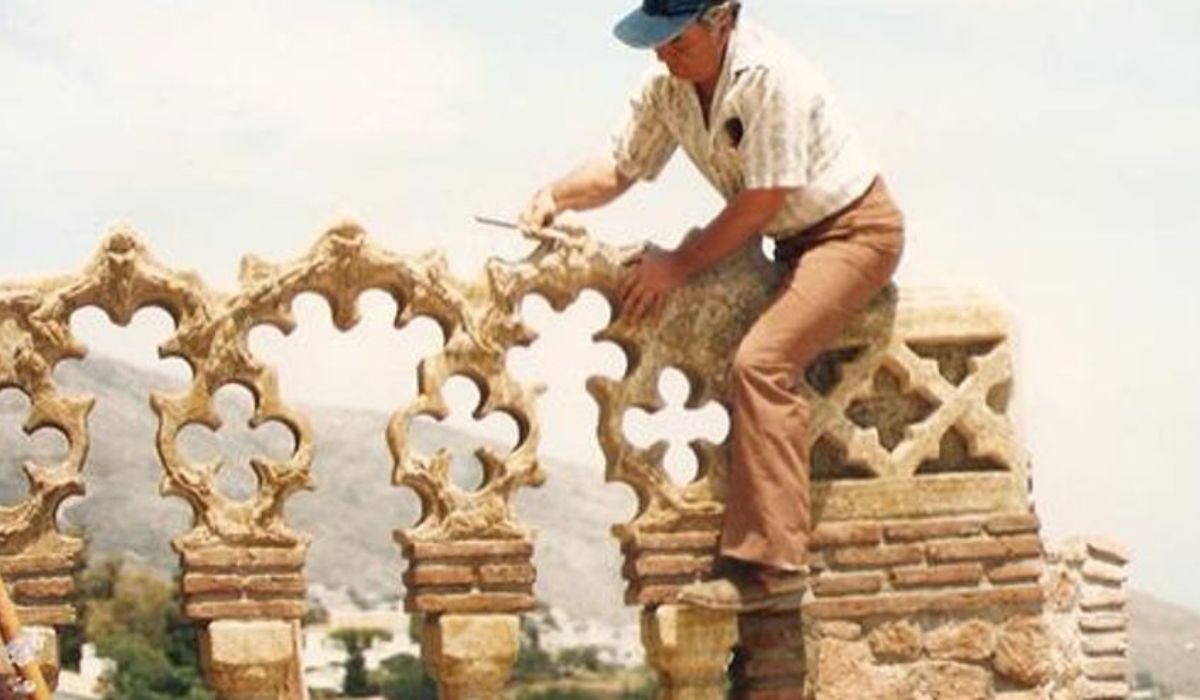
The three participated in the daily execution of a handcrafted construction made with brick, stone, and cement, without the usual structure of large public projects or ventures funded by institutions.
The ensemble combines Gothic, Romanesque, Byzantine, and Mudejar elements.
According to the official presentation of the monument, the choice of these styles aimed to gather cultural and architectural references associated with the Iberian Peninsula in the period depicted.
Therefore, the space alternates arches, stained glass, towers, staircases, religious symbols, coats of arms, and historical scenes in a composition organized to represent different layers of the Spanish past.
History of Christopher Columbus told in stone
Esteban Martín’s proposal was to create a kind of visual book.
The castle does not reproduce a specific historical construction but distributes episodes, characters, and symbols related to the 1492 voyage throughout the architecture.
Instead of organizing the narrative in museum rooms or explanatory panels, the monument uses walls, facades, sculptures, and inscriptions as part of the historical journey.
Among the references are the Catholic Monarchs, the Crown of Castile, Andalusia, and the navigators involved in the expedition.
The official site describes the work as a “book” in which dates, shapes, and decorative elements function as narrative resources.
In this case, the stone serves as a support to present events associated with the first Columbian crossing.
The three vessels linked to Columbus’s voyage were also incorporated into the structure.
The Niña appears at the top, under the arch related to the memory of the Monastery of La Rábida.
The Pinta is part of the main facade, while the Santa María appears separated from the ensemble, alluding to the shipwreck that occurred during the expedition.
Chinese pagoda and symbols of navigation
Among the elements incorporated into the construction is a Chinese pagoda, inserted amidst references of medieval European appearance.
The presence of this structure relates to the initial objective of Columbus’s voyage, which sought a route to the Indies via the west and did not set out with the intention of reaching a continent unknown to Europeans.
This detail places the monument in the context of navigation, cartography, and world interpretations at the end of the 15th century.
The Castle of Colomares not only addresses the maritime crossing but also how the 1492 voyage came to be interpreted after the European arrival in America.
The work brings together, in different parts of the construction, symbols related to navigation, religion, politics, and historical memory.
The presence of Christian, Muslim, and Jewish references is also part of this interpretation.
According to the monument’s proposal, the mix of styles and decorative elements seeks to represent cultural traditions that marked medieval Iberian Peninsula.
Thus, the castle presents a visual narrative about encounters, disputes, and influences that make up the historical period associated with the work.
Smallest church in the world in Guinness
The most well-known element inside the Castle of Colomares is the church of Saint Elizabeth of Hungary.
According to the Guinness World Records, the space has an irregular shape and a total area of 1.96 square meters.
The entity records the church, located in Colomares, Benalmádena, as the smallest in the world in its category.
The reduced size contrasts with the rest of the construction, which was planned as an architectural homage to Columbus’s voyage.
In this case, the church occupies a symbolic place within the complex and was not intended to accommodate large groups of worshippers.


The space functions as a religious element integrated into the historical narrative of the monument.
A report from HuffPost Spain states that the church was consecrated by the prior of the Monastery of La Rábida and houses figures of Christ and Saint Elizabeth molded by Esteban Martín himself.
The information reinforces the direct participation of the doctor not only in the conception of the castle but also in the production of some of the religious elements present inside the work.
The church of Saint Elizabeth of Hungary does not follow the logic of large religious constructions, such as cathedrals and basilicas.
Its reduced size concentrates the symbolic function in a minimal space, within a monument marked by towers, arches, and multiple historical references.
The construction thus brings together two distinct scales: that of the castle as an architectural narrative and that of the chapel as a point of devotion.
Who was Esteban Martín Martín
Esteban Martín died on February 8, 2001.
According to the official site of the monument, the creator’s ashes were kept by the family inside the castle itself, under the altar of the church dedicated to Saint Elizabeth of Hungary.
The information highlights the personal relationship between the doctor and the work that occupied years of labor, personal resources, and manual dedication.
Currently, the Colomares Castle remains a private property and family project, maintained with the support of visits to the site.
The official address is at the La Carraca estate, on the Costa del Sol road, in Benalmádena, Málaga.
The construction remains open to the public in a tourist and cultural format, with information presented by the monument itself about its symbols and historical references.
The significance of the place lies in how the architecture was used to organize a narrative about Columbus’s voyage and the Spanish context at the end of the 15th century.
Each part of the construction was planned to represent an episode, a historical figure, or a symbolic interpretation of that period.
The church of 1.96 square meters, in turn, adds to the ensemble a record recognized internationally by Guinness.
Among stone, cement, religious symbols, and nautical references, Colomares shows how a recent construction can resort to ancient styles to tell a historical episode.