






 Portuguese
  Spanish
  2 min of reading
  0 comments


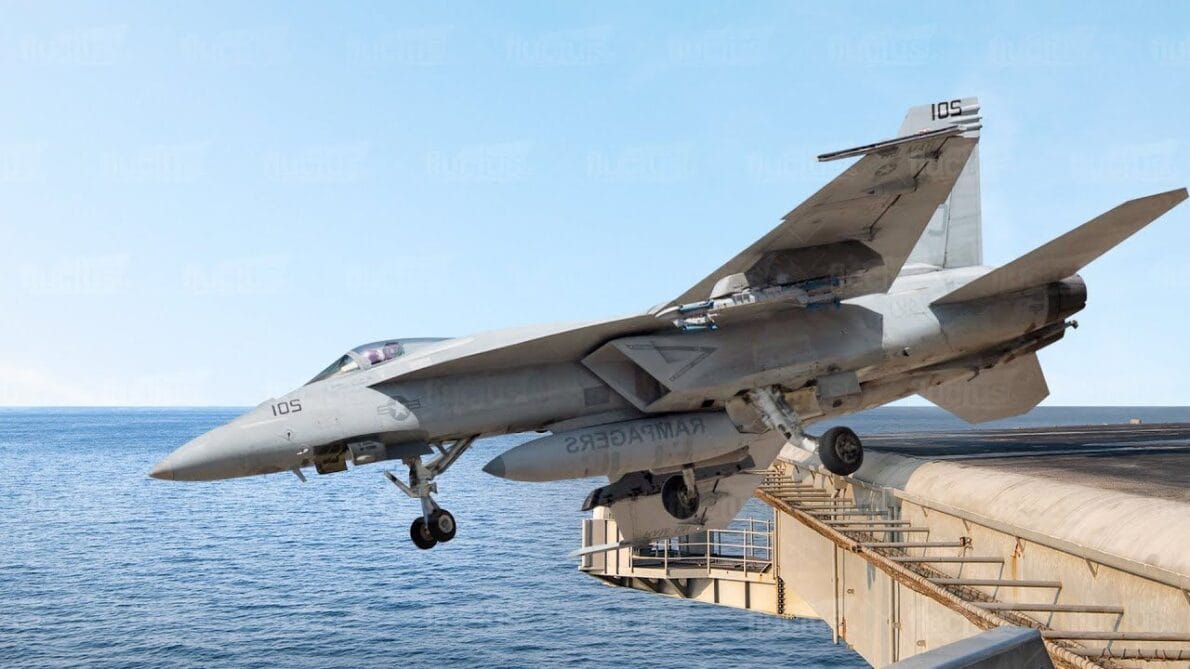
Discover What Happens When a Fighter Pilot Misses Landing on a U.S. Aircraft Carrier, the Risks Involved, and How the Navy Prepares for These Emergencies with Advanced Safety Systems and Rigorous Training.
The U.S. aircraft carriers are essential for modern military operations, functioning as mobile airbases that can house 60 to 130 airplanes and helicopters. However, landing a fighter on an aircraft carrier is a very dangerous task.
When a fighter pilot misses the landing, a serious accident can occur. Therefore, each aircraft is equipped with a hook at the tail that catches a steel cable stretched across the carrier’s landing area. This system, known as the “arresting wire”, helps the aircraft to stop quickly by transferring the energy to hydraulic buffers.
F/A-18 Super Hornet Fighter Lost the Arresting Wire on the U.S. Aircraft Carrier and the Pilots Had to Eject


Despite this advanced system, mistakes can happen. In 2015, a F/A-18 Super Hornet fighter lost the arresting wire, and the pilots had to eject, resulting in the loss of the aircraft but no injuries. These accidents are rare due to the coordination between the pilots, the control tower, and the deck crew.
-
Long before sustainable construction became a trend, China built earthen fortresses with multiple floors, a central courtyard, and the capacity to house up to 800 people living in a community.

-
He got tired of renting, bought an old school bus, removed the seats, modified the roof, reinforced everything with steel, and created a two-story mobile home that looks small on the outside but houses two bedrooms inside.
-
A mother of four sought a safer family environment, watched tutorials on the internet, built a 325 m² house with her family, and learned foundation, walls, plumbing, and electrical work without any professional experience.
-
Iron ore falls to 762 yuan in China as real estate sales decline and steel production hits lowest level since 2018




To prepare the crew for emergencies, the U.S. Navy conducts regular accident simulation exercises. Rapid response teams wear fire-resistant suits and practice rescue and firefighting procedures. All fighters are equipped with ejection seats that allow pilots to escape quickly in case of failure.
Flight Simulators Are Also Used to Train Fighter Pilots
The ejection seat technology is extensively tested at locations such as the Holloman high-speed test track in New Mexico. These tests ensure that the seats are safe and effective, using mannequins equipped with sensors to measure impact and G-force.
Flight simulators are also used to train pilots, allowing them to learn how to operate and maintain their aircraft without the risks and costs of real flights. These simulators are so realistic that they replicate almost all possible situations a pilot might face.
Training of the Best U.S. Navy Pilots Takes Place in the Top Gun Program
The training of the best U.S. Navy pilots takes place in the Top Gun program, where they sharpen their air combat skills. Founded in 1969, after heavy losses during the Vietnam War, the program continues to be a unique opportunity for pilots. Landing errors on aircraft carriers are serious, but the U.S. Navy is well-prepared to handle them, ensuring the safety of the crew and the pilots.


Be the first to react!