






 Portuguese
  Spanish


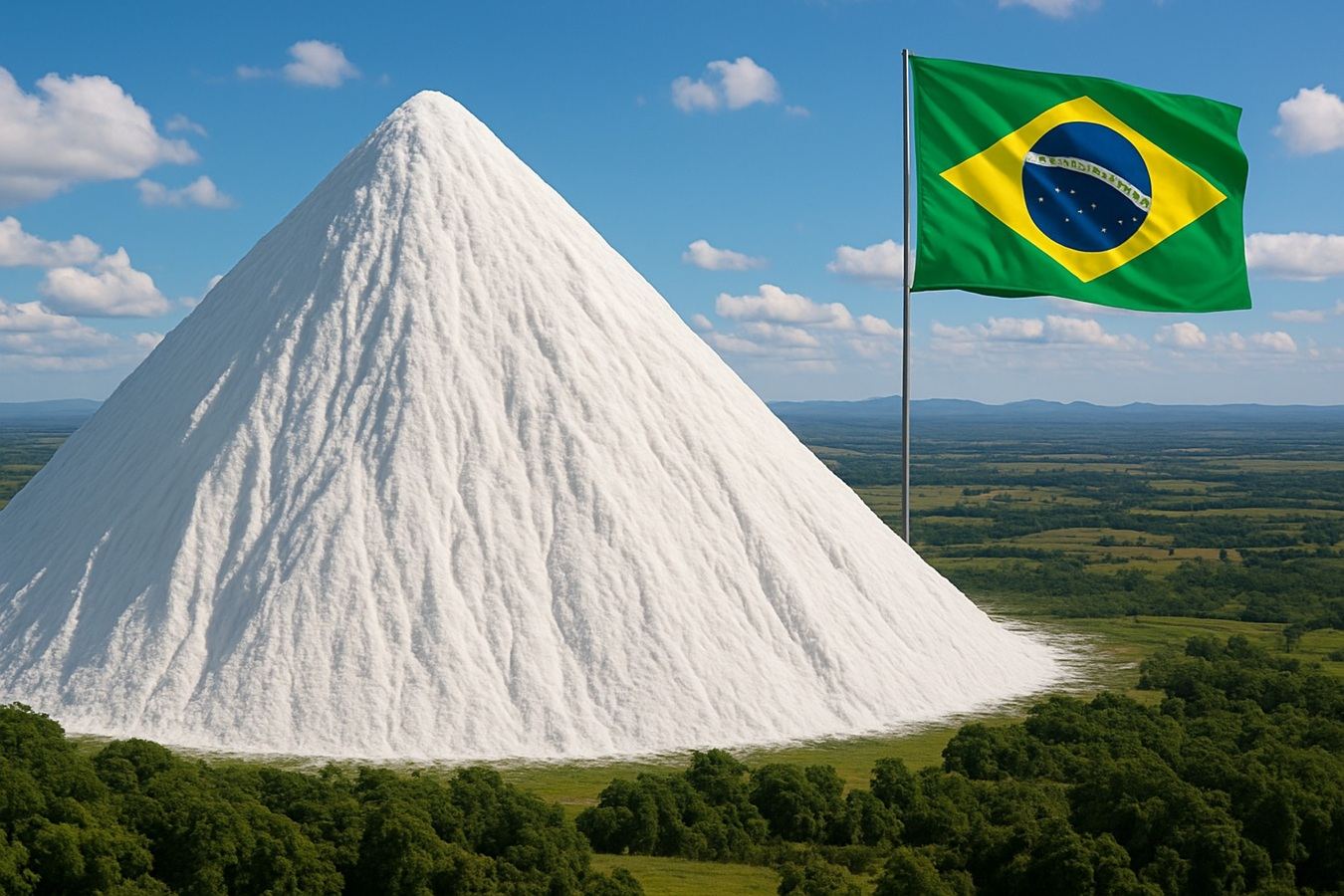


Sea Salt Is More Than Just a Simple Natural Seasoning. It Represents a Huge Mineral Reserve Spread Across the Earth’s Oceans. Now, Imagine Gathering All of This in One Place. The Result? A Mountain of Surprising Proportions That Would Almost Completely Cover Brazil.
The sea has a strong and unmistakable taste. Anyone who has swallowed a bit of salt water knows what we are talking about. But the most important thing is to understand the real scale of this.
For every liter of seawater, there are about 35 grams of dissolved salts. Sounds like a little?
Because that small amount multiplies to absurd levels when looking at the total volume of the oceans.
-
China Develops Custom 140-Ton Electric Mining Truck with 770 kWh Swappable Battery, Deploys 290 Units in Xinjiang’s Largest Zinc Mine

-
Meta to Launch Arena, a New Prediction App Targeting 3.56 Billion Users, Competing with Polymarket and Kalshi

-
Scientist Challenges Famous Human Evolution Theory, Argues Homo Sapiens Evolved Gradually Over Thousands of Years
-
15-Year-Old American Builds Ocean Generator with PVC Pipe and 3D-Printed Propeller for $12, Wins National Prize, Presents at White House, and Makes Forbes 30 Under 30 List




How Much Salt Is There in the Oceans
About 97% of the Earth’s water is in the oceans. This means that the planet holds approximately one sextillion liters of salt water.
And, with this average concentration of 35 grams per liter, the final tally results in 50 quintillion (50,000,000,000,000,000,000) kilos of salt dissolved in the seas’ water.
So, if you thought the sea was too salty, it’s because it really is. And that’s no exaggeration.
This number is so large that it becomes difficult to visualize. But the channel Science Every Day decided to turn this into a much clearer — and even somewhat absurd — image.
Distributing Salt for Every Human
Imagine taking all this 50 quintillion kilos of salt and dividing it among all the people alive today.
Each person in the world would receive, on average, about 6 billion kilos of salt.
That would be enough to supply countless kitchens for a long time.
But, evidently, it’s just a way to illustrate the absurd amount of salt present on Earth.
The Salt Mountain Over Brazil
Now comes the most impressive part. If all this salt were taken from the oceans and dumped over Brazilian territory, the mountain formed would be approximately 2,500 meters high.
For comparison, Pico da Neblina, the highest point in Brazil, is 2,995 meters.
In other words, we would be looking at a salt mountain nearly as tall as the highest peak in the country.
Of course, this idea is purely hypothetical, but it helps visualize the absurd volume of salt that exists dissolved in the planet’s oceans.
So, the next time you dive into the sea and taste that salty flavor in your mouth, think of this. It may not just be salt.
It could be a small sample of an entire mountain — one that, if gathered, would cover Brazil almost up to the top of Pico da Neblina.
This perspective, although exaggerated, helps to better understand the scale of the natural elements around us.








HAJA SAL PARA COZINHAR.
naturally like your web site however you need to take a look at the spelling on several of your posts. A number of them are rife with spelling problems and I find it very bothersome to tell the truth on the other hand I will surely come again again.