Portuguese
  Spanish


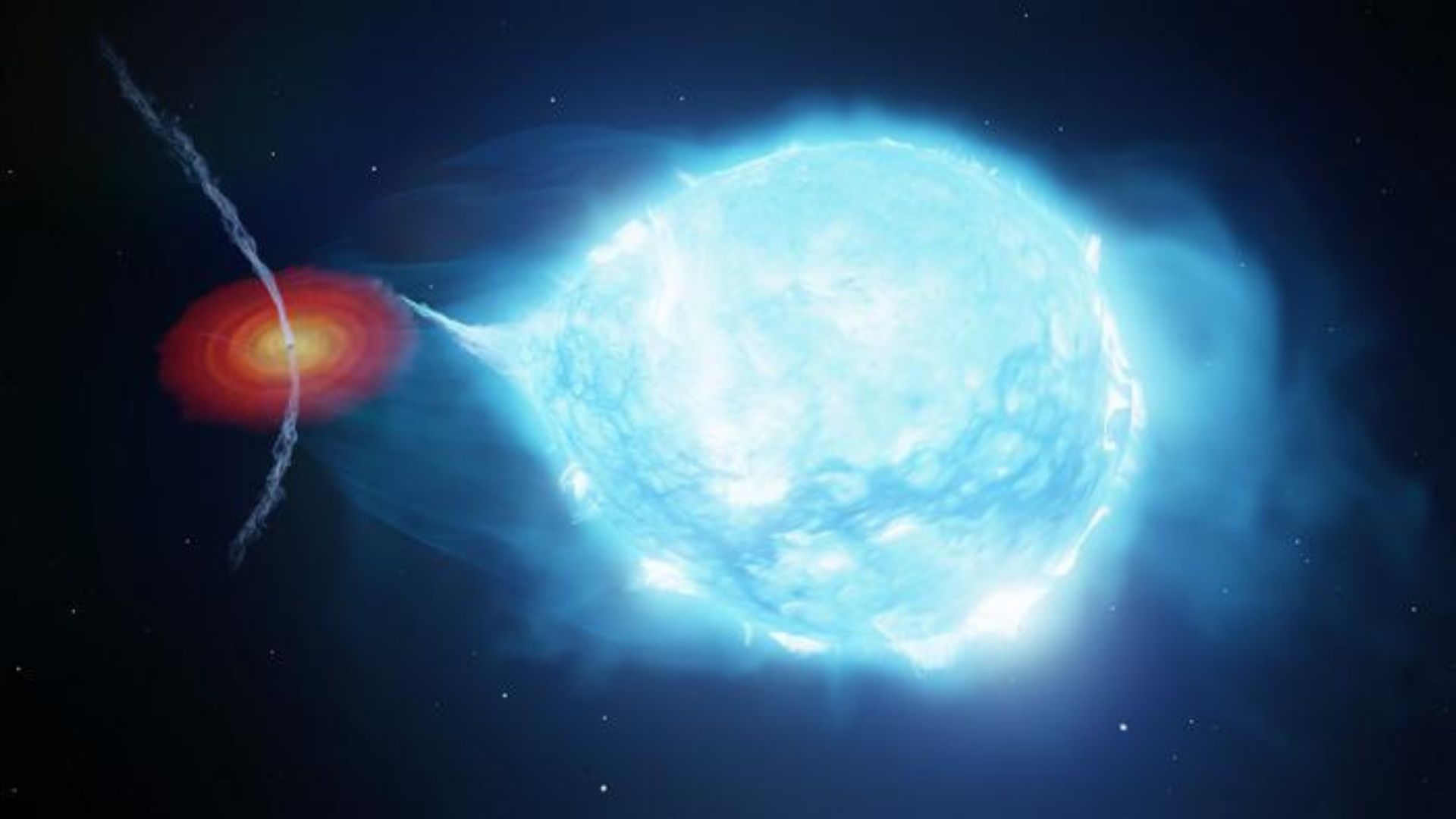

The SS 433 system reveals mechanisms of particle acceleration that transform stellar black holes into powerful galactic energy engines.
An international team of researchers has managed to measure, for the first time, the instantaneous power of black hole jets emitted by the binary system SS 433, located in the Milky Way.
The data reveal that these particle flows reach a combined energy equivalent to 10,000 times the luminosity of the Sun. This discovery redefines the understanding of the strength of relativistic jets and how they interact with the surrounding galactic environment.
The phenomenon occurs in the SS 433 system, where a stellar mass black hole consumes matter from a supergiant companion star. Due to the immense pressure, part of this material is not absorbed and ends up being expelled in two opposing beams traveling at about 26% of the speed of light. The unprecedented measurement of the instantaneous power of black hole jets was made possible by the detection of ultra-high-energy gamma rays by the HAWC observatory in Mexico.
-
Humanoid Robots Begin Replacing Workers in Repetitive Roles as Companies Accelerate Industrial Automation

-
Humanoid Robots Begin Replacing Factory Workers in China, Working 64-Hour Shifts and Driving Industrial Automation Forward

-
Miniature Nuclear Reactor to Be Installed in South Wales, Powering 20,000 Homes and Reviving UK’s Nuclear Industry After Nearly 50 Years
-
San Andreas Fault Reaches “Highest Tension in 1,000 Years,” Raising Fears of the “Big One,” but New Study Identifies Key Zone Near Los Angeles Influencing Earthquake Impact





The dynamics of dancing jets and gamma-ray emission
The jets of the SS 433 system are not static and exhibit a precession movement that makes them “dance” in space, creating complex patterns in the shape of a corkscrew.
As these beams collide with the surrounding interstellar gas, they generate shock waves that accelerate particles to extreme energy levels. It is at this impact point that the instantaneous power of black hole jets manifests through the emission of gamma-ray photons.
Detailed observations show that particles are accelerated more efficiently in the terminal lobes of the jets, located tens of light-years from the central black hole. The HAWC observatory detected photons with energies exceeding 25 tera-electronvolts, indicating a continuous and extremely vigorous acceleration process.
This energy transfer mechanism is what sustains the intense brightness observed at the edges of the nebula surrounding the system.
Impact of the instantaneous power of black hole jets on the galactic medium
The energy released by these jets is so vast that they act as engines capable of shaping the structure of the galaxy around them. By transferring the instantaneous power of black hole jets to neighboring gas clouds, the SS 433 system creates cavities and alters the density of the interstellar medium.
This process demonstrates that even stellar mass black holes can have comparable influences, on a smaller scale, to those of active galactic nuclei.
The exact quantification of this energy allows scientists to test physical models regarding the magnetohydrodynamics of accretion disks. Researchers have confirmed that the efficiency of converting matter into kinetic energy and radiation in these jets is significantly higher than previously expected. Such data is crucial for understanding how energy flows from compact objects to macroscopic scales in the universe.
Technical challenges and the importance of the HAWC observatory
The detection of these signals required years of continuous monitoring through ultra-pure water tanks that detect Cherenkov radiation. The HAWC observatory, located at an altitude of 4,100 meters, was essential for isolating the radiation specifically coming from the jets of the SS 433 system. Without this extreme sensitivity, it would be impossible to distinguish the instantaneous power of black hole jets from the background noise of cosmic radiation.
The study concludes that the energy measured in the jets is stable enough to be considered an intrinsic characteristic of the central engine of the system. This stability allows SS 433 to be used as a natural laboratory for the study of high-energy astrophysics.
Mapping these energy flows paves the way for the discovery of other similar systems that may be silently influencing the evolution of the Milky Way.
With information from Interesting Engineering