






 Portuguese
  Spanish
  4 min of reading
  0 comments


Discovery in Wijk bij Duurstede exposes rare naval beam and expands the mystery about medieval European trade
A routine sewer system project in Wijk bij Duurstede, Netherlands, recently revealed a large crafted wooden beam, attracting the attention of experts and local residents. The structure appeared during improvements to the stormwater network of a public road and has since been analyzed as a possible part of an ancient medieval vessel. The find occurred in the historic region of Dorestad, a significant commercial center between the 7th and 9th centuries. This context increased scientific interest, as the piece may help explain how trade routes connecting Europe’s interior areas to the North Sea functioned.
Archaeological find reveals rare naval clue
The discovery began when workers identified an unusual wooden piece underground. Local volunteers were called in, and experts then began to assess the material more closely. The beam is about 3 meters long and nearly 30 centimeters thick, dimensions compatible with a robust naval support structure. The cuts and carvings observed on the wood suggest it may have been part of one of the hull’s caves, an essential element for the resilience of ancient vessels. Therefore, the piece has been treated as a fragment of high archaeological value.
Dorestad enhances the significance of the discovery
The point where the beam was located is not just any area. The ancient Dorestad was one of the main trading posts in northwestern Europe between the 7th and 9th centuries. During that period, rivers functioned as major transportation routes, allowing the circulation of goods, tributes, people, and political influences. The strategic position of the region connected interior areas to the North Sea and strengthened medieval trade. Thus, any naval vestige found at the site can offer important information about the economic and maritime infrastructure of that time.
-
Federal Police involved in the case to identify the person responsible for hacking the Civil Defense system, which sent ten false alerts, frightened residents of different capitals, and turned messages about real risks into notifications with “misanthropy” and even alien attacks.

-
Extreme drought causes ghost village to reappear at the bottom of the reservoir that supplies Athens, revealing houses, a school, and ruins swallowed since the 1980s as the lake shrinks and exposes the water crisis threatening the capital of Greece.

-
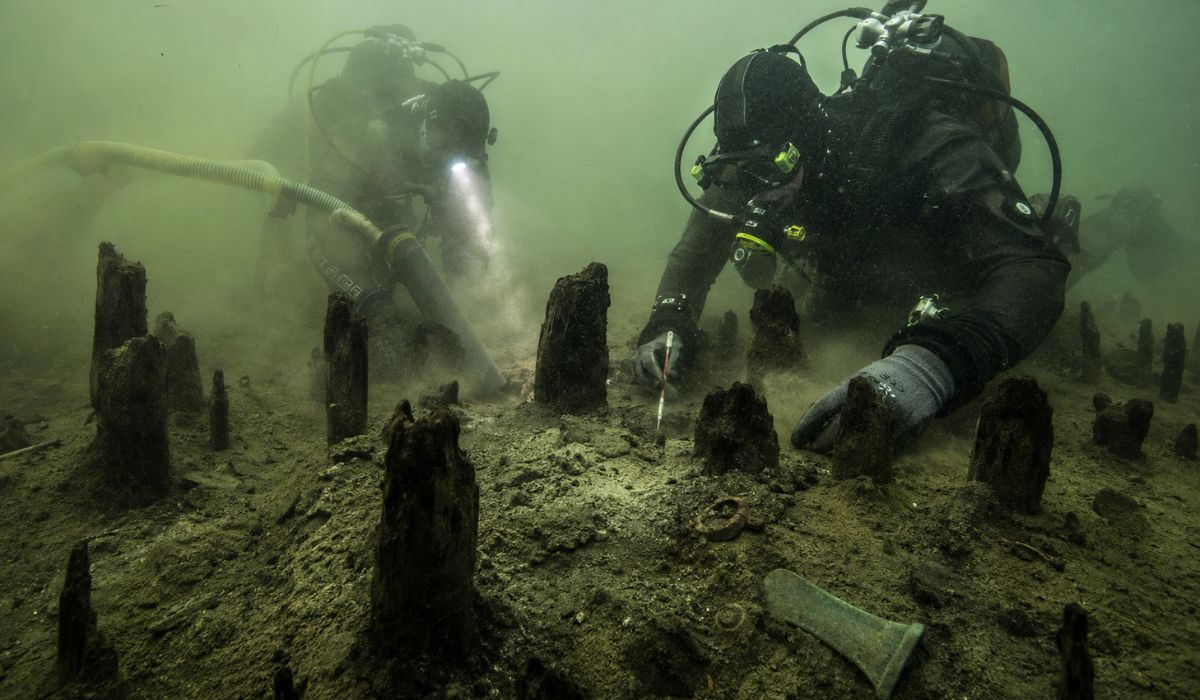
An entire village lay asleep at the bottom of a lake for 3,000 years: divers suction sediments in Italy and reveal more than 600 wooden stakes, bronze tools, and traces of a Bronze Age settlement hidden underwater.
-
They call it the “Shopee house” and even cardboard, but the R$ 20,000 house is a certified Wood Frame from Alea, financed by Minha Casa Minha Vida: understand if it’s worth more than masonry.




Hypotheses about the origin of the vessel
Researchers are currently working with different possibilities to explain the origin of the piece. One hypothesis points to the Carolingian era, between the years 700 and 800, especially due to the proximity of ancient ceramic fragments found in the same soil. Another possibility indicates that the beam could have belonged to a cog, a medieval cargo ship used around the year 1300, in a later phase of mercantile expansion. There is also the possibility of a connection with Scandinavian naval traditions, as navigators of this origin circulated along the coastal region. The divergence between the hypotheses reinforces the need for laboratory tests before any definitive conclusion.
Science must decipher the period of the wood
The main technique planned to analyze the fragment is dendrochronology, a method that studies the growth rings of wood. This procedure can indicate when the tree was felled and, consequently, approximate the date of the vessel’s construction. The piece needs to remain moist during the initial conservation phase, as rapid drying can cause irreversible cracks. Careful surface cleaning, humidity control, and comparison with soil and ceramic samples should guide the next steps of the archaeological investigation.

Discovery reinforces the value of the hidden past
The beam found under the modern pavement shows how current cities still hold important traces of ancient periods. Even if the analysis indicates an origin later than the Carolingian era, the fragment may reveal details about naval technology, river transport, and medieval trade. The discovery also reinforces the importance of Dorestad as an economic connection point in ancient Europe. As the examinations progress, the piece removed from a routine construction remains a rare clue of a maritime past preserved under the footsteps of modern life.
The future of archaeological investigations
Experts still need to confirm the exact date of the wood and the original function of the structure. The answer could indicate whether the fragment belonged to a ship from the Carolingian era, a vessel of Scandinavian tradition, or a more recent medieval cargo ship. This definition will help to better understand the role of vessels in the trade routes that crossed the region.
In light of this unexpected find, how many other traces of European medieval trade might still be hidden under modern streets?





Be the first to react!