Portuguese
  Spanish


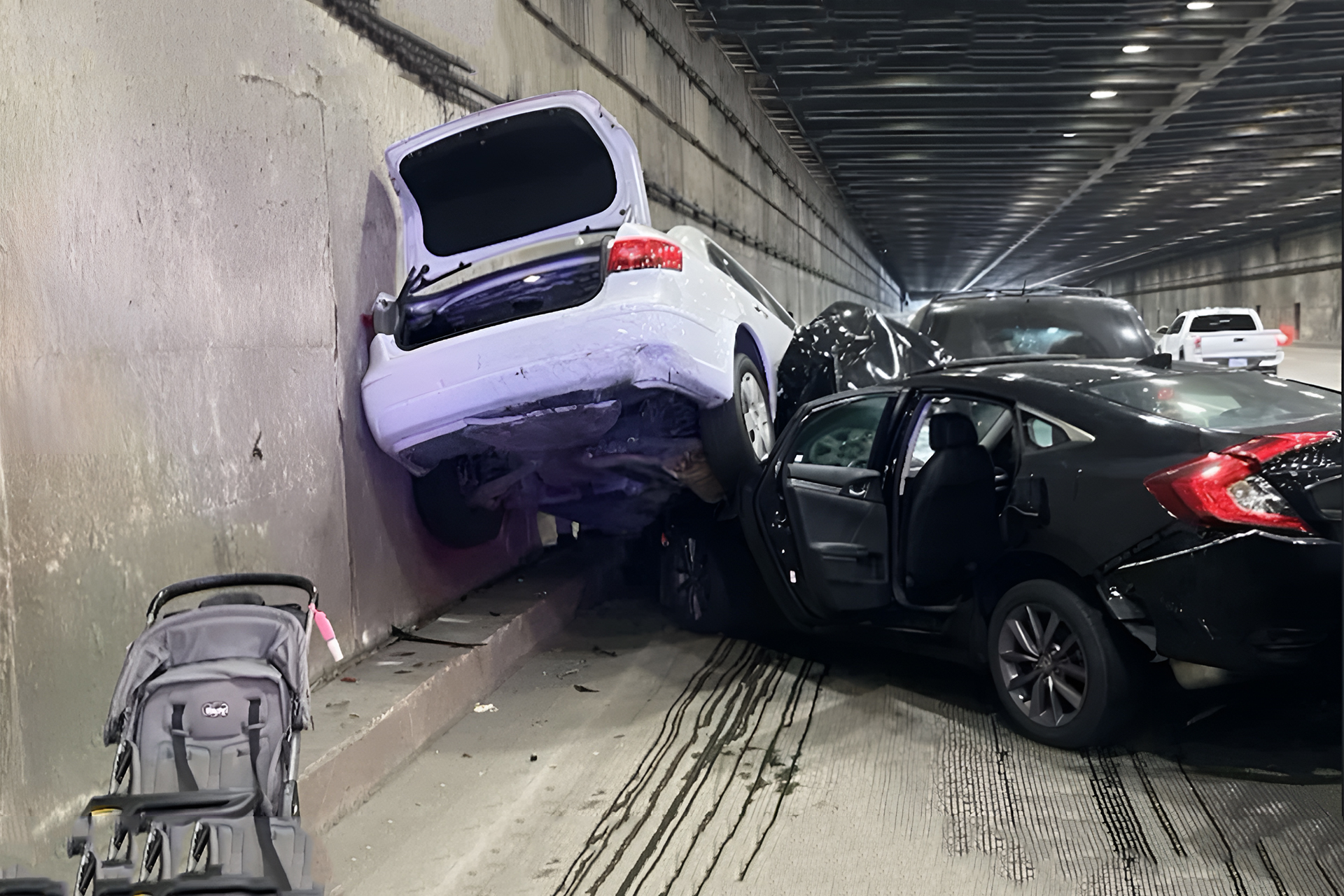

The Video Shows The Moment When The Tesla Model S Enters The Fast Lane And Stops On Its Own Soon After, Causing The Accident
A crash recorded by surveillance cameras in San Francisco, California, sparked yet another controversy surrounding the semi-autonomous driving technology of electric cars from Tesla. According to the driver, the Tesla Model S’s autopilot brakes and stops the vehicle on its own in the middle of the road.
The Tesla Model S unexpectedly stopped on the road, leading to a pile-up involving eight vehicles and injuring 18 people. The driver places the blame for the chaos on the vehicle’s autopilot system (also known as FSD, or “Full Self-Driving”).
The footage from the security camera reveals more details of the collision, as well as the dangers of the so-called “phantom braking,” which occurs when the autonomous driving feature stops the car for no apparent reason. According to Autoevolution, this issue, where Tesla’s Autopilot stops on its own, has been identified in several isolated cases, but Elon Musk’s car manufacturer has yet to find a solution.
-
British Factory Transitions from Mechanical Parts to Producing 420,000 Electric Power Units Annually, Supplying 70% of Ford’s Electric Cars Sold in Europe

-
BYD’s Dolphin Mini Becomes Electric Vehicle Sensation in Brazil, Surpassing 300,000 Sales with Major Factory and Retail Leadership
-
Toyota Shifts from Hybrid Cars to Electric Air Taxis with Joby’s 6-Rotor Aircraft, Capable of 322 km/h, Aiming for Mass Production to Electrify Urban Skies

-
Ferrari Unveils Limited Edition 12Cilindri Manuale: 6.5-Liter V12, 830 HP, 0-100 km/h in 2.9 Seconds, Top Speed Over 340 km/h, Only 1,499 Units Available




The following video demonstrates how, as soon as it enters the fast lane, the car immediately brakes and stops. A pickup managed to swerve, but several cars coming right behind ended up crashing into the rear of the Tesla, causing the pile-up.
In the end, according to the police, 18 people were injured, although none of them died from their injuries. One of the injured was a two-year-old child who was taken to the hospital with a scrape on the left side of the skull, as reported by CNN.
The police are conducting an investigation into more details of the pile-up and are expected to provide updates soon. Watch the video that shows the moment when the Tesla Model S stops on its own and causes the pile-up below.
Tesla Model S Stops On Its Own And Causes Pile-Up On The Same Day That Elon Musk Announced A New Feature Of The System In Beta Version
The accident occurred on the same day that the creator of Tesla announced the beta version of the FSD feature, which was designed to bring Tesla cars closer to 100% autonomous driving. This decision raised concerns among traffic safety experts, as they foresee new cases of reckless driving using Tesla vehicles as a result of this decision.
Tesla’s autopilot system, or Autopilot, is a set of advanced driving assistance features that help keep the car in its lane, adjust speed and following distance, and change lanes automatically. It can also be used to park the car automatically in parallel or perpendicular parking spaces.
It is worth noting that autopilot features do not make the car fully autonomous, and the driver is still responsible for monitoring the car and being ready to take control if necessary, as was the case with the Tesla Model S that stopped on its own.
Furthermore, the system may require certain visibility conditions and good road geometry to function, as well as needing regular updates to continue improving its performance. For this reason, depending on the investigations, the driver may also be held accountable.