






 Portuguese
  Spanish


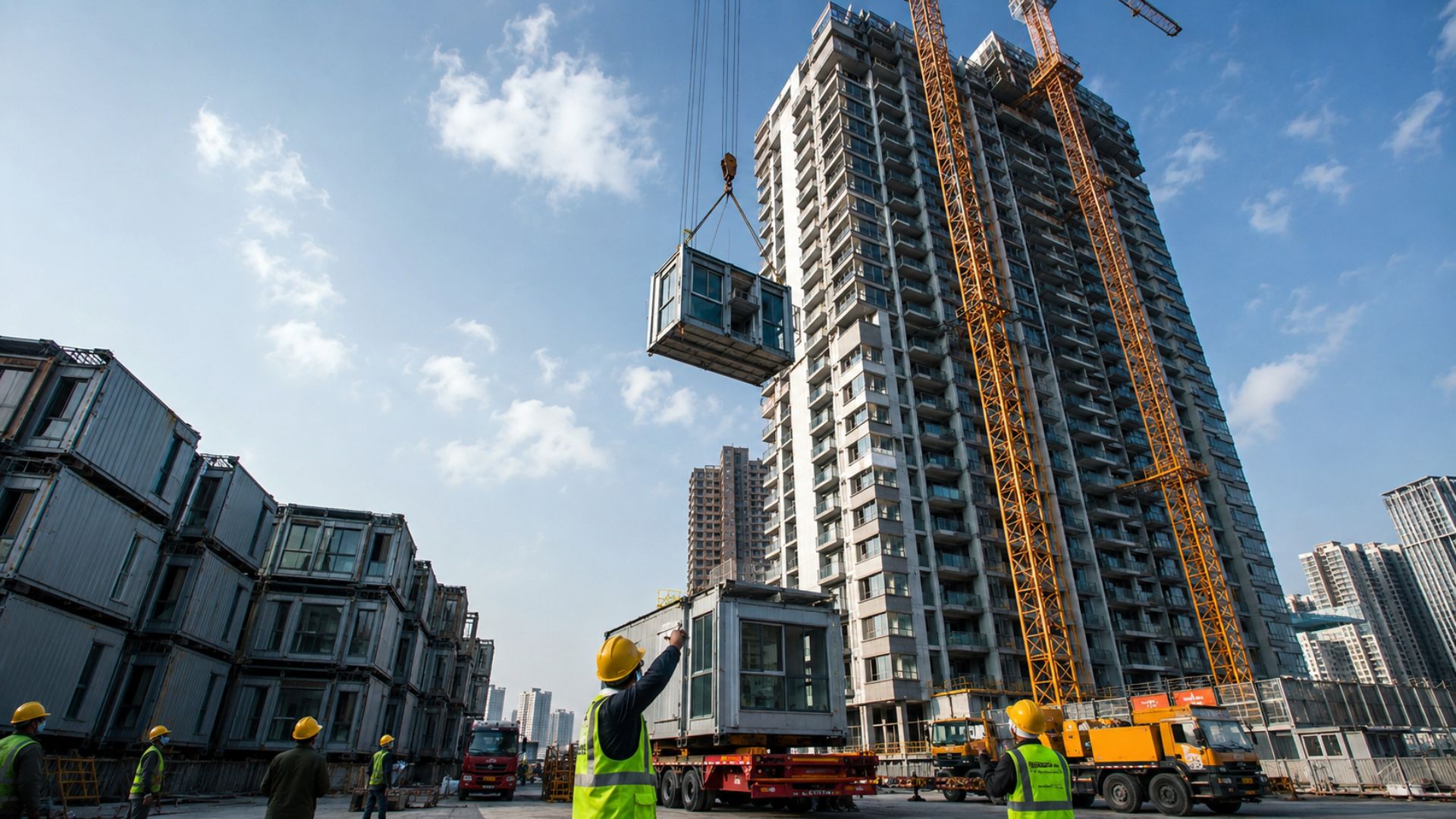

After the 2008 Sichuan earthquake, Chinese entrepreneur Zhang Yue, owner of an air-conditioning manufacturing company, created a modular construction method that stacks entire buildings like building blocks. His company assembled a 57-story tower in 19 days on site, with 90% made in the factory before the construction began.
In February 2015, in the city of Changsha, the capital of Hunan province, China, the company Broad Sustainable Building (BSB), led by entrepreneur Zhang Yue, completed the assembly of the Mini Sky City tower, also known as J57, a mixed-use skyscraper with 57 floors and 204 meters in height, in just 19 working days on site. The achievement gained worldwide attention not for its height, but for the speed of the modular construction method adopted by the company, which erected an average of three floors per day by stacking prefabricated modules like pieces of a building toy.
The detail that many reports omit, however, is crucial to understanding what really happened. The 19 days refer only to the assembly on the construction site. Before that, Broad Sustainable Building spent about four and a half months manufacturing, within its factory, the 2,736 modules that would be fitted on site. In other words, it was not a building erected from scratch in less than three weeks, but rather a quick assembly of ready-made pieces that took months to produce. This distinction is what separates the concrete fact from the exaggeration circulating in videos about the topic in Chinese construction.
Who is Zhang Yue, the former air-conditioning manufacturer

He made his fortune as the founder of Broad Group, one of the largest manufacturers of central air-conditioning systems in China, with a focus on the so-called absorption chillers, industrial refrigeration equipment. It was in this sector that he built his name and accumulated the capital that, years later, would be redirected to a bold experiment in the construction industry.
-
Tarcísio Opens New São Paulo Metro Line After 18-Year Wait, Offering Free Rides at 6 Stations and Aiming to Cut Commute to 23 Minutes for 633,000 Daily Passengers

-
Facing a housing shortage, Hong Kong uses prefabricated concrete modules to construct a 12-story public building with the help of massive cranes and trucks.

-
Amsterdam Repurposes Retired Boats and Plants to Restore Contaminated Industrial Land Instead of Removing All Polluted Soil
-
Saudi Arabia to Build 33,000-Seat Desert Arena with Retractable Roof and Clay Courts for 2028 Masters 1000 Tournament


The turning point came after a tragic event. On May 12, 2008, an earthquake with an estimated magnitude between 7.9 and 8.0 hit Sichuan province in southwest China, leaving nearly 70,000 confirmed dead, according to official data, and tens of thousands of concrete buildings destroyed, including schools, hospitals, and housing complexes. Zhang Yue observed the mass collapse of these structures and began to question why the industry still relied so heavily on concrete, a heavy and rigid material that, according to him, tends to break rather than flex during a seismic event. It was this questioning that led him to fully enter into construction.
How the modular construction method of Broad Sustainable Building works

In a facility of about 230,000 square meters, the company produces modules approximately the size of shipping containers. Each module leaves the factory with flooring, electrical wiring, plumbing, and ducts installed internally. Walls fold and become floors, windows and balconies open outwards, all prepared before the module leaves the production line.
On-site, trucks transport the modules and cranes lift them into the correct position, where they are joined by high-strength steel bolts, without the need for lengthy concreting or curing time. The result is a process that resembles assembling a prefabricated piece of furniture on a giant scale, where the construction site looks more like an assembly area than a traditional site. It is this industrial logic applied to construction of buildings that allows the speed observed in the company’s projects, with the caveat that most of the work happens far from there, inside the factory.
The real numbers of the 57-story tower assembled in 19 days

A Mini Sky City, the main showcase of the method, gathers impressive data even when analyzed rigorously. It has 57 floors, 204 meters in height, and about 180,000 square meters of built area, with 800 apartments and office space for 4,000 people. More than 90% of the structure came ready from the factory, with finished flooring and embedded installations. The structure is entirely steel, without a concrete core, and used about 10,345 tons of steel beams supplied by ArcelorMittal.
The method earned the company the innovation award from the Council on Tall Buildings and Urban Habitat (CTBUH) in 2013 and, according to the company itself, eliminated the use of approximately 15,000 trucks of wet concrete, drastically reducing dust and gas emissions associated with traditional construction. A conventional construction of this size would take about two years to complete. BSB claims that its system reduces construction costs by 20% to 40%, and that Mini Sky City cost about 700 dollars per square meter. These numbers place the company at the center of the global debate on the future of construction.
Separating Fact from Exaggeration in Chinese Projects


It is important to treat with caution some claims circulating about these buildings. The Broad Group advertises that its modules are up to 100 times more resistant under load than conventional concrete panels, that each structure withstands an earthquake of magnitude 9, and that the buildings’ lifespan reaches a thousand years. However, these data come from the company’s own institutional material and have not been independently confirmed in publicly accessible technical sources, which is why they should be treated as manufacturer claims, not consolidated facts.
The same goes for the company’s most ambitious project, Sky City, which would be a 202-story tower surpassing the Burj Khalifa as the tallest building in the world. Construction began with the foundation in July 2013 but was quickly halted due to regulatory and logistical issues, and the project was never completed. The episode shows that even with a revolutionary construction method, factors such as public agency approval and supply chain remain real barriers to scaling this type of technology.
3D Printing of Houses as a Parallel Technology
While the Broad Group stacks modules, another Chinese company has taken a different path: printing buildings. WinSun, operating in the Shanghai region, developed an industrial 3D printing method where giant nozzles deposit, in layers, a mixture of recycled construction waste and quick-drying cement. In 2014, the company announced it had produced 10 complete houses in 24 hours, each structurally solid and habitable, in a demonstration that also resonated worldwide.
According to WinSun, the method reduces material usage by 30% to 60% compared to traditional construction, in addition to drastically reducing the need for labor. The applications mentioned include affordable housing, emergency shelters for disaster victims, and rural development projects in Southeast Asia and Africa. Although the technique is completely different from the Broad Group’s modular stacking, the underlying logic is the same: take construction off the open site and transfer it to automated, controlled, and repeatable systems.
The global modular construction market and government support
This movement is neither isolated nor restricted to China. The global modular construction market was estimated at around 95 billion dollars in 2025, with projections to exceed 175 billion dollars by 2034, according to market surveys. The Asia-Pacific region accounts for approximately 45% of this total, and China leads the growth rate in the region, driven by massive public investments in housing and infrastructure.
Other countries are also moving in this direction. Singapore requires modular methods in part of its public housing, the United Kingdom has injected billions into off-site construction projects, and Japan and South Korea have been scaling up prefabricated systems in the residential and commercial sectors. This scenario shows that industrialized construction has ceased to be a niche experiment to become an institutional bet, supported by public policy and large-scale capital across several continents.
Why the rest of the world still builds the old way
Faced with so many apparent advantages, the question arises: why does most of the world still build as it did half a century ago? The answer largely involves regulation. The building codes of most countries were written around concrete and wood, not prefabricated steel modules joined by bolts. Adapting standards, tests, and certifications to this new paradigm is a slow process, involving structural safety, insurance, and civil liability.
There is also market inertia. Developers already have supply chains established around the traditional model, and scaling up threatens entire sectors of the industry, from cement production to site labor. Add to this the aging construction workforce in developed countries and the global housing shortage, estimated at around 100 million units, and it becomes clear that there is demand. The technology exists, the capital exists, but the spread of modular construction still faces regulatory and cultural barriers that take time to overcome.
The story of Zhang Yue and Broad Sustainable Building is both inspiring and a caution against exaggeration. It is true that a former air conditioner manufacturer helped redefine the possible speed in skyscraper construction, with an award-winning method and verifiable results. But it is equally true that the famous 19 days hide months of prior fabrication, that several spectacular numbers are claims by the company itself, and that the company’s most ambitious project never got off the ground. The future of construction likely follows this industrialized path, but with more caution than viral videos often suggest.
Would you live in a building erected with prefabricated modules stacked like building blocks, or do you still trust more in traditional concrete construction? Do you think this model could work in Brazil, considering our regulation and climate? Leave your comment, tell us what you think about modular construction, and share the article with engineers, architects, and those who follow innovation in the construction sector.


