






 Portuguese
  Spanish


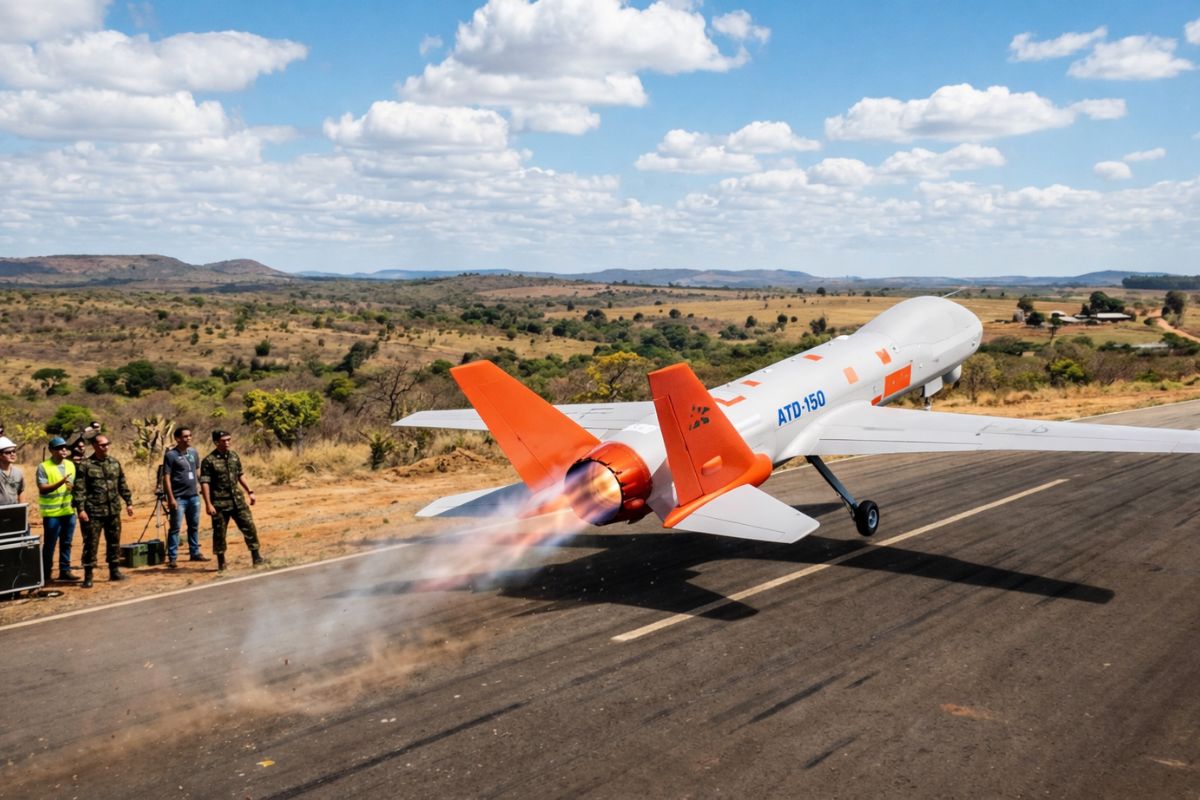


The ATD-150 jet drone from Nest Design Aerospace made its first flight in June 2025 and positioned the TJ200 engine as a national option for air defense training, reducing dependence on imported technology.
The ATD-150 jet drone challenges an idea that has lingered too long: that Brazil could not develop jet propulsion for military use domestically. In June 2025, on a runway in the interior of the country, the sharp sound of a turbojet marked the first flight of a system described as 100% national, weighing 150 kg and powered by a Brazilian TJ200 engine.
And the impact is not just in the “flew.” It is in what this represents in practice. The country has always needed aerial targets to train air defense, radars, and operators, and for a long time this meant relying on expensive imported technology subject to embargoes. With the ATD-150, an alternative built within the Brazilian industrial ecosystem comes into play.
What is the ATD-150 and why did this flight attract attention

The ATD-150 is presented as a jet aerial target developed by Nest Design Aerospace. The base describes speeds above 600 km/h and also mentions performance exceeding 700 km/h in another section, as well as altitudes in the range of 15,000 feet and an operational ceiling cited at 20,000 feet.
-
ChatGPT Alerts FBI to Prevent Planned Murder of 8-Year-Old in Brazil’s Espírito Santo

-
Scientists Discover 125-Million-Year-Old “Pregnant Fossil” with Preserved Embryos and Microscopic Larvae Inside Mollusk in England

-
17-Year-Old Justin Bernstein Develops Bacteria to Produce Glass on Arctic Ice to Reflect Sunlight, Wins $50,000 U.S. Scholarship

-
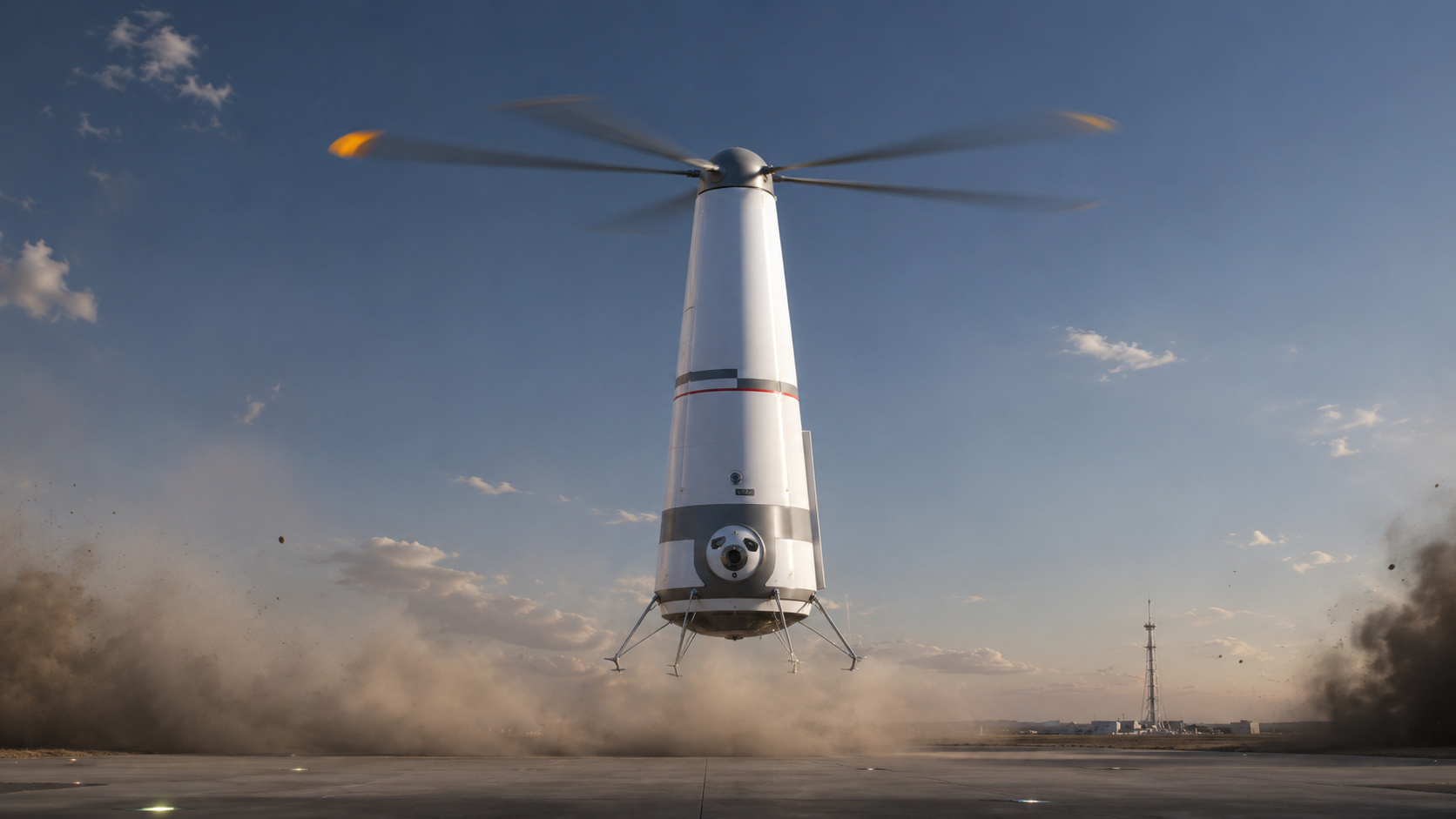
The 19-Meter Rocket-Helicopter: A Private Industry Prototype That Challenged Space Race Logic



This set of numbers is important, but the point that changes the story is another: the engine. The system uses the TJ200 from the Brazilian company Turbo Machine. This removes the “heart” of the project from external dependence.
Why a jet drone makes a difference in air defense training
Training for air defense is not just about pressing buttons. For radars, systems, and teams to evolve, a target that behaves like a real threat is needed. A target that is too slow turns the exercise into something artificial.
This is where the jet drone comes in: it allows for the simulation of faster targets at high altitudes, bringing training closer to a more realistic scenario. For a country with a large territory, extensive borders, and a long coastline, having a tool of this type ready for use makes a difference.
The TJ200 engine and what it changes in the game

The TJ200 appears as the component that gives weight to the ATD-150. It is not just a part: it is a demonstration of capability. Developing and putting a turbojet into operation within the country means that the most sensitive part of the system does not depend on external purchases.
This changes the type of risk involved. Instead of being tied to export windows, sanctions, or the political mood of another country, the project becomes supported by a local supply chain and accumulated knowledge here.
From announcement to first flight in a few months: fast and, therefore, full of tests ahead
The base states that the ATD-150 was revealed in March 2025 and that the first flight took place in June 2025. For aerospace development, this is very fast and, at the same time, raises the most difficult part that comes after the “first flight”: validating, testing, proving reliability, and integrating into routine.
An inaugural flight is a milestone, but it is not the finish line. What defines the future is what happens next: continuity, large-scale testing, maturation, and adoption.
The numbers that help understand the role of the ATD-150


The specifications mentioned in the base build the portrait of an aerial target designed for demanding training:
Speed above 600 km/h, with mention of over 700 km/h
Altitudes cited at 15,000 feet and also a ceiling of 20,000 feet
Operational weight of 150 kg
What stands out is not an isolated number. It is the package: speed, altitude, and national propulsion in the same system, with Brazilian integration.
What changes when the jet drone is “made at home”
With a national jet drone, part of the anti-air training no longer depends on an external supplier. And the project is presented as more than just equipment: it would be the beginning of an industrial chain that includes engine, structure, integration, and a real delivery history.
And there is an effect that is difficult to measure but easy to perceive: when a team proves that it can get something like this in the air, the knowledge remains and opens the door for future projects.
And now, speaking as someone who follows this without romanticizing: do you think the ATD-150 is just an isolated case that will make headlines and disappear, or can we see a real line of continuity from here?


