Portuguese
  Spanish


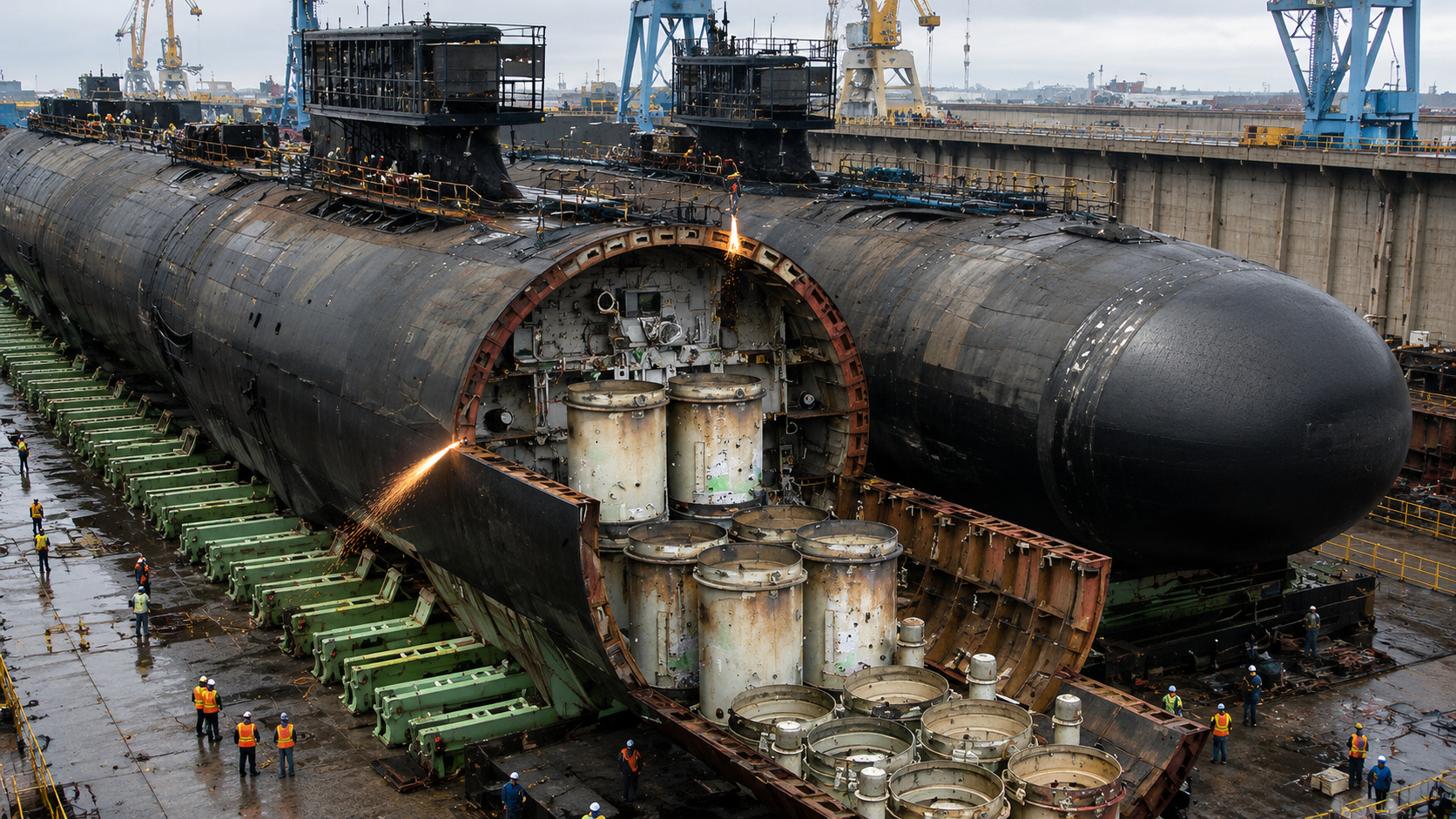


United Kingdom advances in the dismantling of 27 retired nuclear submarines, uses HMS Swiftsure as a model and plans to recycle about 90% of the materials.
The United Kingdom has fully entered a delicate and strategic phase of its naval history: the dismantling of 27 retired nuclear submarines. According to the British Ministry of Defence, the Submarine Dismantling Project, the SDP, has been approved to deliver a dismantling and final disposal solution for this decommissioned fleet, creating an industrial operation that combines heavy engineering, radioactive waste management, military steel recycling, and nuclear safety.
The most important case at the moment is that of the HMS Swiftsure, treated by the British government as the vessel that will practically demonstrate how the country intends to dismantle the rest of the fleet. According to the Submarine Delivery Agency, the dismantling of the Swiftsure continues in Rosyth and is on track to be completed by the end of 2026, when it is expected to become the first fully dismantled British nuclear submarine under this model.
United Kingdom accumulated retired nuclear submarines for decades before starting large-scale dismantling
According to the British Ministry of Defence, the problem accumulated over the years. While awaiting a definitive dismantling solution, the decommissioned submarines were stored in specialized bases. Today, the government reports that 22 submarines already out of service remain safely stored, with seven in Rosyth, Scotland, and 15 in Devonport, Plymouth.
-
Tokyo Scientists Create First 18cm Biohybrid Hand Using Human Muscle, Capable of Scissor Gesture and Holding a Pipette

-
Brazil Faces Norway in World Cup at Stadium Linked to Jimmy Hoffa’s Mysterious Disappearance

-
Retired Woman Leaves French Public Housing Due to Fear, Lives in Van for Weeks, Prompting Response from Local Authorities and a Priest
-
9-Year-Old Fabio Isaac Wins Gold at Copernicus Math Olympiad in Singapore, Representing Peru Against Global Young Talents





This liability shows why the issue has ceased to be merely technical and has become strategic. Nuclear submarines cannot simply be cut like ordinary ships. Each unit requires preparation, inspection, safety maintenance, and a much slower, more expensive, and regulated dismantling process.
The result was the formation of a queue of decommissioned vessels awaiting final destination, something that pressured docks, infrastructure, budget, and long-term planning of British defense. The SDP emerged precisely to transform this accumulated liability into a continuous industrial process.
Dismantling a nuclear submarine requires removing fuel, reactor, and radioactive waste before cutting the hull
According to the Ministry of Defense, dismantling a nuclear submarine follows a step-by-step logic. The central point is that the greatest difficulty is not in the metal hull, but in the presence of previously removed fuel, residual radioactivity in parts of the propulsion system, and classified components associated with the reactor.
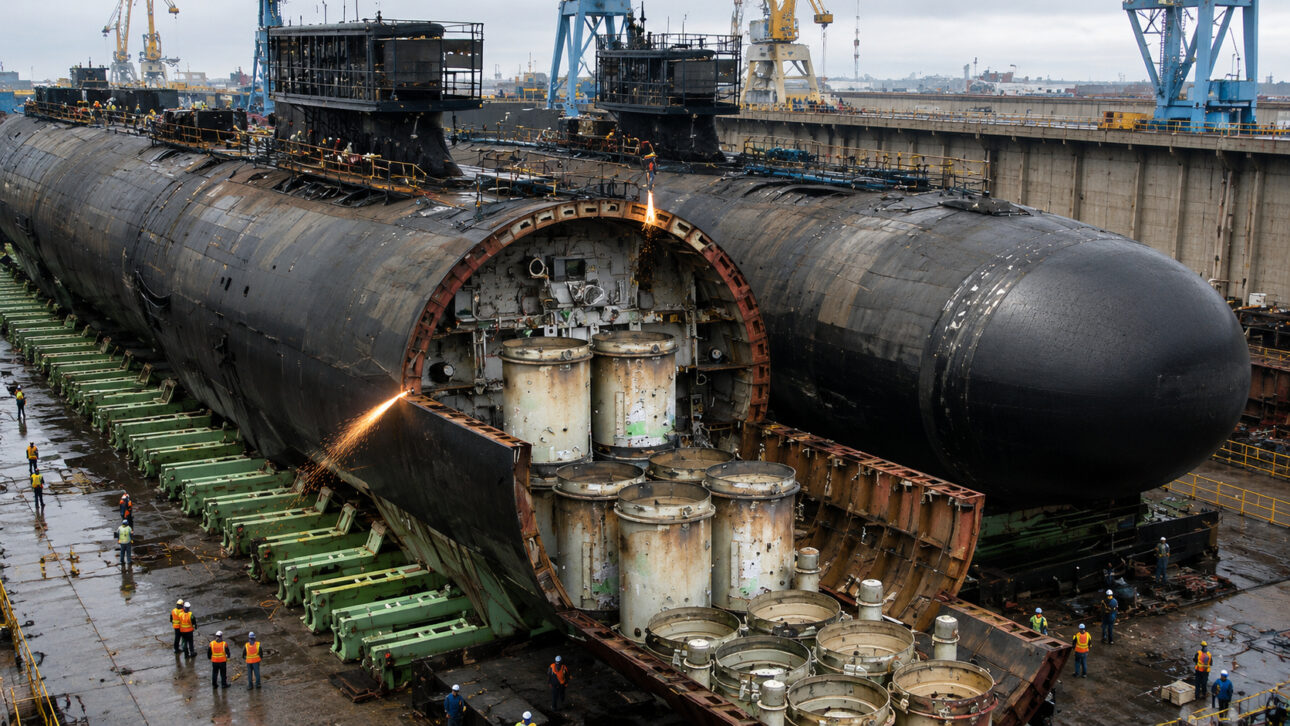
The British government explains that parts of the nuclear propulsion system remain radioactive even after the fuel is removed, which requires specific management.
The process adopted by the United Kingdom follows a three-phase approach, starting with the removal of the least radioactive materials, then the removal of the Reactor Pressure Vessel, classified as intermediate-level radioactive waste, and only then reaching the final stage of recycling the rest of the vessel.
This helps to understand why the program is so complex. Before considering reusing steel or dismantling large sections of the hull, the government needs to ensure that the submarine is completely free of radioactivity and materials associated with its nuclear operational life.
About 90% of the submarine can be reused or recycled after the nuclear part is removed
Despite the public image associating nuclear submarines with radioactive risk throughout the structure, the British government states that this does not correspond to the reality of most of the vessel.
According to the Ministry of Defence, after the removal of radioactive waste, about 90% of the remaining materials, mainly steel and other metals, can be reused or recycled through conventional means.

According to the Ministry of Defence and the Submarine Delivery Agency, in the official UK nuclear submarine dismantling project, the agency seeks to reuse components that can be safely repurposed in the operational fleet, while the remaining metals and non-hazardous materials are recycled whenever possible.
The British government also states that, after the removal of radioactive waste, about 90% of the remaining materials, mainly steel and other metals, can be reused or recycled. Meanwhile, Forces News reported on June 4, 2025, that part of the high-quality steel recovered from HMS Swiftsure is expected to be transformed into components for future Royal Navy submarines.
HMS Swiftsure became the laboratory submarine that will define the dismantling of the entire fleet
According to the Ministry of Defence, the HMS Swiftsure was chosen as a demonstrator project for the new British dismantling model. It entered the dock on July 27, 2023, in Rosyth, to undergo the final phase of dismantling and recycling, serving as a real test for the methods that will later be applied to the rest of the fleet.
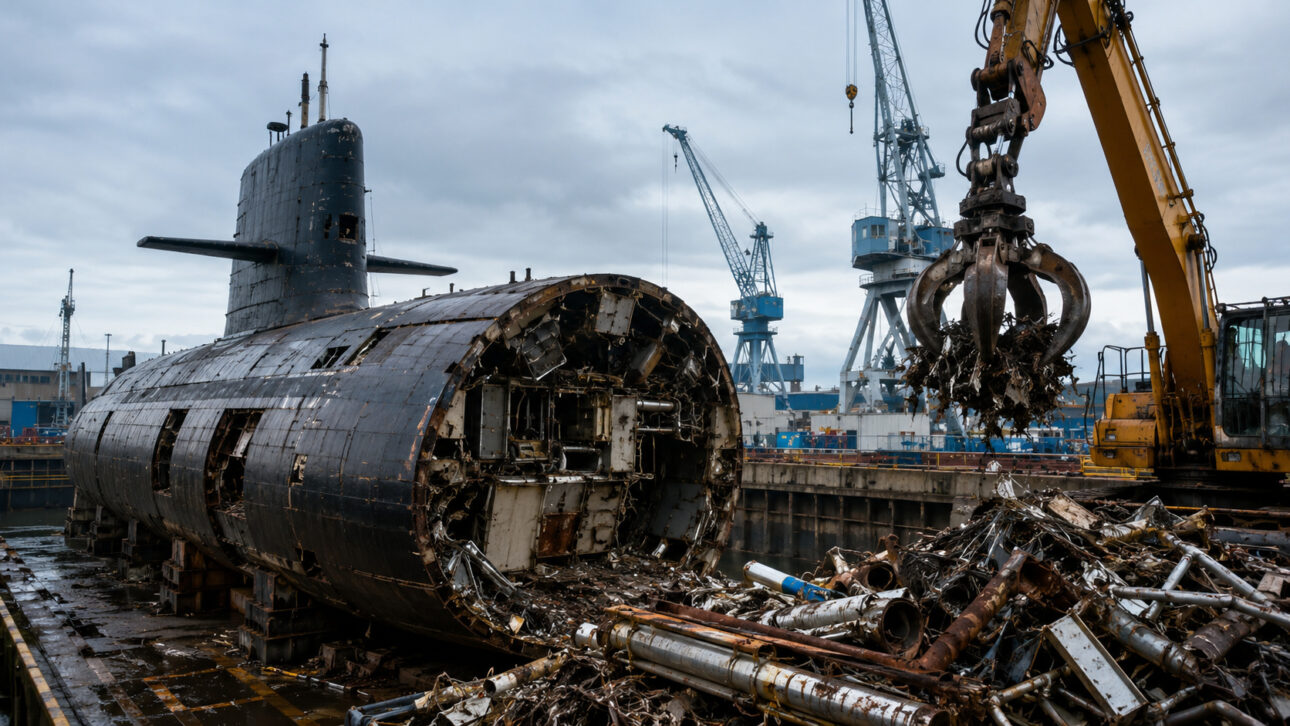
The Submarine Delivery Agency states that the Swiftsure continues to be dismantled at the Babcock International shipyard and that the program remains on track for completion by the end of 2026.
When this happens, it will become the first complete proof that the United Kingdom has managed to transform a retired nuclear submarine into a replicable recycling and disposal process.
The British government sees this case as fundamental because the learning from Swiftsure will serve to “industrialize” the dismantling of other submarines, especially the currently stored PWR1 reactor models. In other words, the Swiftsure is not just the first. It is the operational prototype of the British nuclear naval dismantling policy.
A new British nuclear naval dismantling industry begins to emerge in Rosyth and Devonport
The British program does not rely solely on the Navy. According to the Submarine Delivery Agency, the agency’s mission includes managing the entire lifecycle of submarines, from construction to maintenance and final disposal. This means that dismantling now requires its own supply chain, shipyards, radioactive waste specialists, large structure cutting, logistics, and recycling.

Rosyth and Devonport have become central hubs of this transition. Instead of serving only as storage locations, these bases are now part of a permanent structure for dismantling, removing nuclear materials, and industrial repurposing.
The United Kingdom is, in practice, setting up a specialized industry for dismantling retired nuclear submarines.
This transformation also has strategic value. Each submarine removed from the water and safely processed reduces pressure on storage infrastructure, frees up space, and creates a model that can influence other similar programs in the future.
After decades at the bottom of the sea, the final destination of British submarines has become recycling in dry docks
Few military equipment are as complex as a nuclear submarine. They were designed to withstand extreme pressure, operate silently for long periods, and carry out strategic missions underwater. They were not designed for quick dismantling. Therefore, the advancement of the British program carries industrial and historical weight.
The United Kingdom now tries to turn this accumulated problem into a new management standard: safely removing radioactive components, dismantling the hull in a controlled manner, and returning a large part of the materials to the industry. The case of the HMS Swiftsure will be the decisive test of this strategy.
After decades patrolling oceans and serving in one of the most strategic navies of the West, these submarines are entering a new phase. The silence of the seabed is giving way to the noise of cranes, industrial cutting, and heavy recycling within the British dry docks. a new life.