






 Portuguese
  Spanish


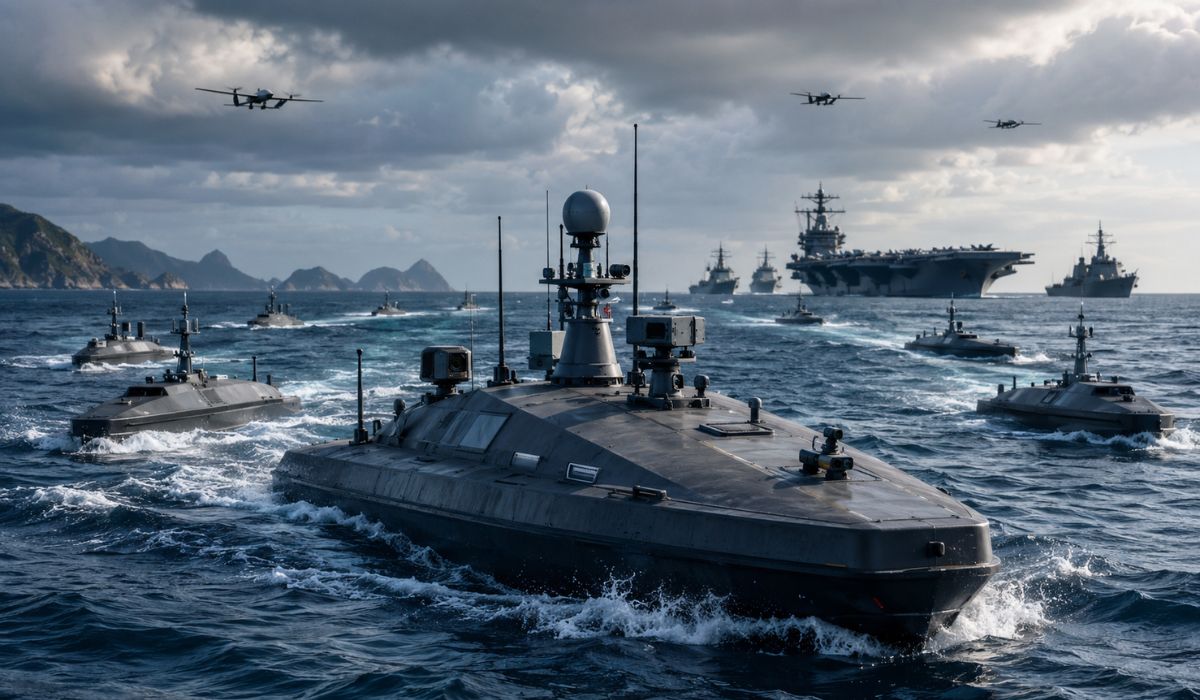

The US Navy prepares an expansion of autonomous vessels in the Indo-Pacific, in a plan that combines naval robotics, advanced sensors, and new forms of military presence in strategic ocean areas.
The United States Navy plans to deploy thousands of unmanned surface vessels in the Indo-Pacific by 2030, in a move that expands the use of autonomous systems in naval missions.
The projection includes more than 30 medium unmanned vehicles, known by the acronym MUSV, in addition to thousands of smaller vessels and unmanned aircraft operating from manned or autonomous ships, according to Captain Garrett Miller, commander of the Surface Development Group One.
The forecast was presented during the Sea-Air-Space symposium, an event linked to the naval community in the United States.
-
Teen Invents Biodegradable Material from Shrimp Shells That Decomposes 1.5 Million Times Faster Than Regular Plastic

-
Scientists Develop Diving Suit for Cyborg Cockroaches to Survive Underwater for 3 Hours, Navigate Flooded Tunnels, and Aid in Disaster Rescue Missions, with Potential for Mars Exploration
-
Xiaomi Unveils Ultra-Slim Washer-Dryer with Over 30 Programs, Hygienic Steam, Smart Drying, 15-Minute Quick Wash, App Control, and Space-Saving Design

-
Brazilian Researchers Develop Ultrasound-Based Breast Scanner Using Warm Water, Currently Undergoing Clinical Validation


According to Miller, the numbers specifically refer to the projected needs for the Indo-Pacific and were calculated based on surface force studies aimed at 2045.
Robot-boats advance for operational use
The unmanned surface vehicles, called USVs, are vessels capable of navigating, collecting data, and supporting naval operations without the permanent presence of crew on board.
In practice, they can function as sensor platforms, enhance maritime surveillance, and operate in conjunction with conventional ships.
The US Navy already uses the Sea Hunter and Seahawk models as its first medium autonomous surface vehicles.
According to the official naval force sheet, the two vessels are approximately 41 meters long and have a displacement of 142.3 metric tons at full load.
Initially developed with the participation of DARPA and the US Office of Naval Research, Sea Hunter and Seahawk were transferred to the Navy as prototypes aimed at research, experimentation, and fleet integration.
The force itself states that the two ships are used to evaluate the best way to employ USVs in operations and to connect them to manned units.
These vessels are not treated merely as smaller versions of conventional ships.
According to the Navy’s official description, they act as distributed sensor platforms to enhance the operational view of manned ships and support maritime situational awareness and anti-submarine warfare missions.
Indo-Pacific concentrates routes, bases, and maritime disputes
The Indo-Pacific brings together trade routes, archipelagos, military bases, and disputed areas involving China, Taiwan, the Philippines, Japan, Australia, and the United States.
In this environment, unmanned systems appear in American military plans as a way to expand presence in vast areas without relying solely on large crewed ships.
According to a report by USNI News, the projection of thousands of USVs is linked to demands from the U.S. Indo-Pacific Command.
The region has also been associated by American authorities with the concept called “hellscape,” which envisions the use of large quantities of autonomous systems to hinder Chinese military actions in a potential regional crisis.
The Replicator program, announced by the U.S. Department of Defense in 2023, also fits into this context.
The initiative was created to accelerate the adoption of autonomous systems in different domains, including surface vessels, unmanned aircraft, and underwater drones.
In the naval case, the stated goal is to deploy autonomous platforms on a larger scale and in shorter timeframes.
The expansion of the autonomous fleet occurs in parallel with the growing American attention on the Chinese Navy.
The original text from USNI News states that Chinese forces have moved from a more coastal posture to operations in open waters, which increases Beijing’s maritime reach and expands operational possibilities in the region.
Naval technology combines sensors, autonomy, and logistics
The use of autonomous vessels on the high seas involves different technical challenges than those faced by aerial drones or land vehicles.
In the ocean, systems need to operate with waves, wind, corrosion, maritime traffic, long-distance communication, and the need for maintenance away from fixed bases.
For this reason, naval autonomy depends on more than automatic navigation.
USVs need to integrate sensors, command systems, decision-making software, communication with control centers, and the ability to operate alongside crewed ships.
This combination brings the topic closer to areas such as naval engineering, robotics, applied artificial intelligence, and military logistics.
The Navy has already conducted exercises to test the integration of these systems in the Pacific.
In the Integrated Battle Problem 23.2, initiated in August 2023, four USV prototypes — Mariner, Ranger, Seahawk, and Sea Hunter — traveled 46,651 nautical miles, with predominantly autonomous navigation and stops in Japan and Australia.
The experience helped gather data on prolonged operation, integration with crewed units, and the use of sensors over long distances.
Even so, American naval authorities state that turning prototypes into regular-use systems requires resolving issues of maintenance, command, supply, and integration with strike groups.
Pacific Distances Challenge Autonomous Vessels
Recent experiences with maritime drones in Ukraine and the Middle East have influenced discussions on the use of unmanned vessels.
However, US Navy officials have emphasized that the scenarios of the Black Sea and the Red Sea do not automatically repeat in the Indo-Pacific.
Rear Admiral Douglas Sasse, director of the N81 assessment division in the office of the Chief of Naval Operations, stated that these cases show possibilities of employment in more restricted seas, where the distance to the coast is shorter.
Comparing this environment with the Pacific, he said that in the region, “there are no trees to hide behind,” referring to the exposure of vessels on long oceanic journeys.
The statement indicates a significant operational limitation.
In closed seas or near land, unmanned vessels can be launched and recovered more quickly.
In the Pacific, on the other hand, the routes between islands, archipelagos, and operational areas require greater autonomy, stable communication, and ways of refueling at sea.
This point explains part of the recent logistical tests.
The Military Sealift Command announced in April 2026 a stern refueling involving the tanker USNS Guadalupe and the MUSV Seahawk off the southern coast of California.
According to USNI News, the demonstration was described by the logistics command as proof of concept and a capability milestone for MUSV operations with carrier strike groups.
Maritime Drones Should Operate with Manned Ships
The information released by the Navy indicates that USVs should not replace manned ships in the short term.
The model being tested envisions a combined fleet, in which autonomous vessels, aerial drones, and submarine platforms extend sensor reach and support operations conducted by conventional ships.
Miller told USNI News that these systems provide flexibility to the fleet commander.
According to him, the vessels can perform maritime domain awareness tasks for strike groups and use camera systems in different missions.
Defense News reported that the American fleet of medium USVs in the Indo-Pacific could increase from about four units to more than 30 by 2030.
The same report noted that Sea Hunter, Seahawk, Mariner, and Ranger had already been deployed in the region and continue to be used to develop the Navy’s autonomous vessel program.
For the US Navy, the next step does not only depend on building new robot boats.
The expansion requires defining where these systems will be based, how they will be maintained, who will handle operational control, and how they will exchange information with ships, aircraft, and land commands.
In technological terms, the goal of operating thousands of unmanned vessels by 2030 shows how maritime autonomy has moved from being an isolated experiment to becoming part of American naval planning.
Even so, the scale, the distances of the Indo-Pacific, and the need for coordination in a real environment remain central points for these systems to be used regularly.


