Portuguese
  Spanish


Faced with the housing crisis, the team of UBC students in Canada, led by engineers Isabella Ma and Veronica Ehrensperger, builds an off-grid microhouse on a trailer the size of a school bus, with rainwater collection, wind turbine, and solar panel. And they promise to publish the step-by-step for free.
A group of university students decided to tackle the housing crisis with engineering and generosity. At UBC, the University of British Columbia in Canada, a team of students is building an off-grid microhouse on a trailer, capable of supplying itself with water and energy. The case was reported by the network CBC.
The project is called SMRT and has a bold mission. The idea is to create a compact, sustainable, and affordable housing the size of a school bus, which any community can replicate. To achieve this, the group intends to publish the construction step-by-step for free, in an open blueprint for everyone.
Behind the initiative is a concern: seeing housing become a luxury item. Tired of witnessing rising rents and the difficulty of buying a house, the engineers leading the team are betting on an accessible microhouse as a possible solution. Next, see who they are and how the house works.
-
Historic Brazilian Championship Stadium Demolished for New Supermarket and Shopping Center Development

-
Workers excavate one of the world’s longest railway tunnels beneath the Alps between France and Italy, stretching nearly 60 km, 600 meters deep, with an investment of 11 billion euros.
-
Japanese Company Constructs 100m² 3D-Printed House Using Earth Instead of Concrete, Generating Its Own Energy and Reducing Costs and Emissions

-
In Southern Brazil, a couple builds a Russian-style stove with 430 bricks that heats their 90 m² home all night using just 15 kg of wood.



Who is behind the microhouse: the UBC team
(Dannielle Piper/CBC)
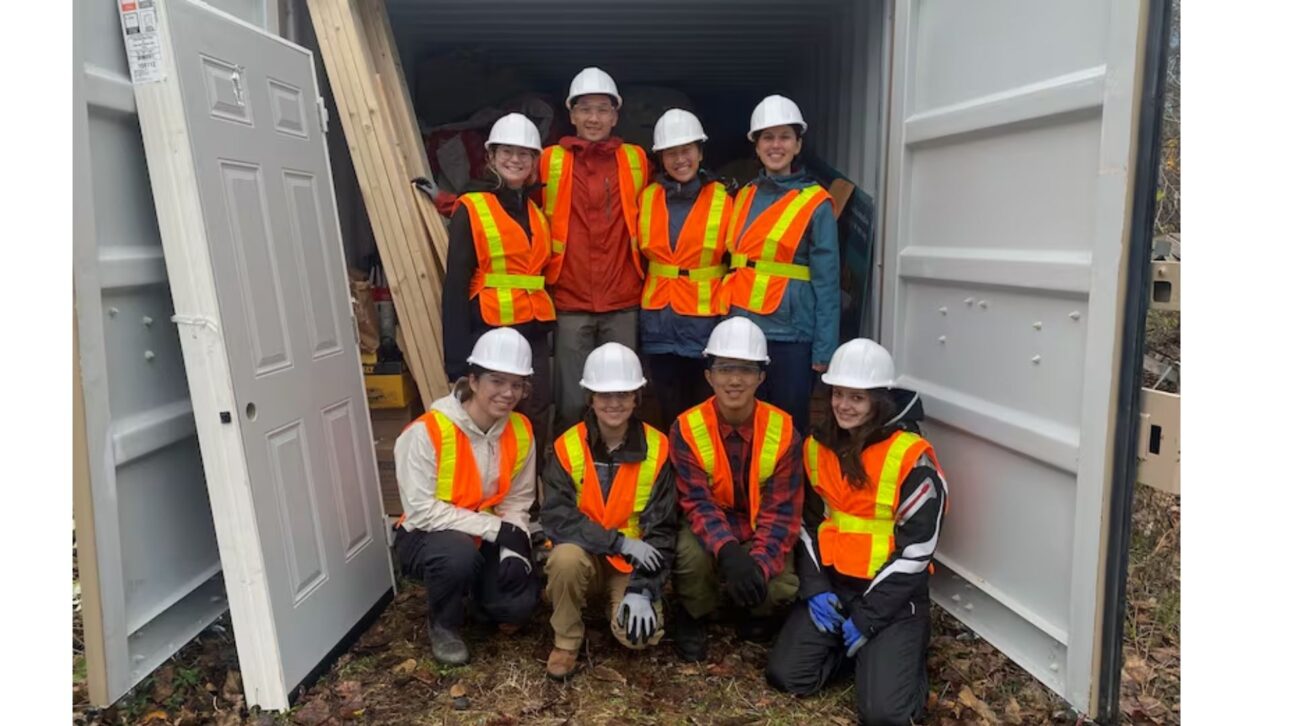
Contrary to what it may seem, it is not just two people working alone. The microhouse is the work of UBC Sustaingineering, a clean energy technology team composed of dozens of students from different areas of the university. The group gathers between 40 and 60 members.
Leading the team are two engineers. Isabella Ma and Veronica Ehrensperger act as co-captains of Sustaingineering and help coordinate the project, with support from the supervising professor Martin Ordonez. It is this combination of hands and minds that makes the housing come to life.
The group’s motivation is quite concrete. According to CBC, the project addresses the climate and housing crises by proposing an affordable and modular housing option. In a scenario of expensive rents and houses out of reach, the off-grid microhouse emerges as an attempt at a solution.
Working as a team is also part of the learning process. Bringing together so many students from different courses, from electrical to mechanical engineering, turns the microhouse into a large practical laboratory. Each stage becomes a lesson in how to apply theory to build something real and useful.
Project teams like this are common in large universities. Bringing together volunteer students around a real goal, they function like small engineering companies on campus. At UBC, Sustaingineering uses the microhouse to train future professionals in clean energy and sustainable construction.
What is SMRT, the off-grid microhouse on a trailer
(Dannielle Piper/CBC)
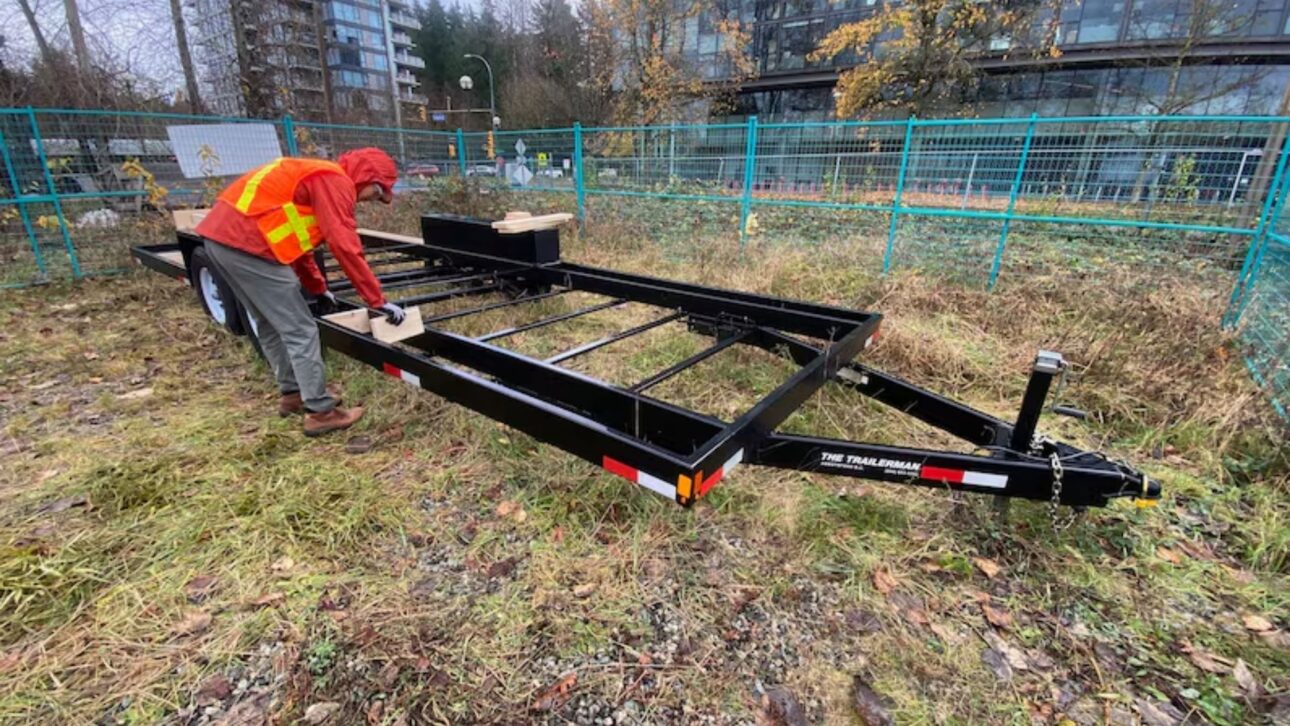
The project’s name summarizes its proposal. SMRT is the English acronym for “sustainable mobile research testbed,” meaning a microhouse designed to function as a prototype that can move. Therefore, it is built on the base of a trailer, not on a fixed plot of land.
The dimensions reflect the boldness. The housing occupies an area of about 8 by 22 feet, equivalent to roughly 2.4 meters wide by 6.7 meters long. In practice, it’s the size of a short school bus, transformed into a complete house.
Being mounted on a trailer brings clear advantages. The microhouse can be towed and installed in different locations, making it flexible and ideal for field testing. This mobility is precisely what sets it apart from a traditional construction fixed to the ground.
The modular nature is also at the heart of the project. The idea is that the off-grid microhouse functions as a replicable model, not as a unique piece. If successful, the same design can be copied and adapted by others in different places.
Calling the project a “test bench” is not by chance. The microhouse serves to practically measure the performance of water collection and the energy system in real conditions, something that students can only evaluate by actually building it. Each collected data helps to refine the design before opening it to the public.
Rain, wind, and sun: the house that supplies itself
(Submitted by Isabella Ma) image from the site: CBC&Magazine
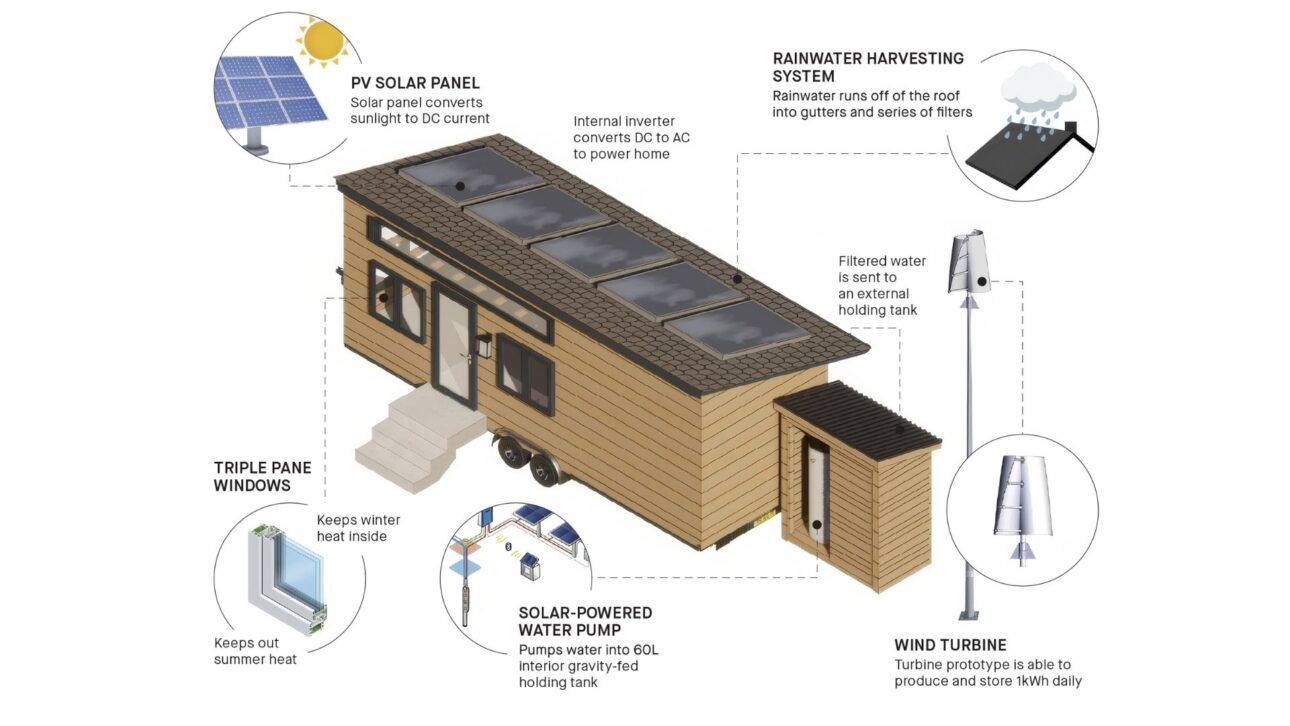
The great advantage of the microhouse is independence. Being off-grid, it was designed to operate without relying on the electrical grid or public plumbing, generating its own energy and collecting its own water. It’s self-sufficiency taken seriously.
The water comes from the sky. The microhouse features a rainwater harvesting system, which collects and stores what falls on the structure for domestic use. Instead of relying on external piping, the house takes advantage of a natural and free resource.
The energy combines two clean sources. The project uses a hybrid renewable energy system, which combines a wind turbine and solar panels to generate and store electricity. Thus, both the wind and the sun help keep the microhouse running throughout the day and night.
This electricity takes care of the essentials. With the generated energy, the dwelling can power basic day-to-day items, such as a small refrigerator and a simple electric stove. It’s not for great luxuries, but to ensure the necessary comfort in a compact and sustainable house.
Combining wind and sun in a small house is quite a technical challenge. The two sources are not always available at the same time, so the off-grid system needs to store energy well in batteries and balance the generation. This is where the electrical engineering knowledge of the UBC team comes in.
The size of a school bus: what the project is like
Despite being small, the microhouse was planned to be functional. In the compact space, the main environment combines living room and kitchen in an integrated area, with space for a bed. Everything is designed to make the most of every centimeter of the structure on the trailer.
The logic is to do a lot with little. Instead of separate rooms, the housing bets on a multipurpose space, typical of the so-called tiny houses, the mini-houses that have become a global trend. The engineering challenge is to fit comfort and utility into a few square meters.
Mobility expands the possibilities of use. By fitting on a trailer, the off-grid microhouse can serve as temporary housing, shelter in emergencies, or even a remote work space in isolated areas. The same structure gains various functions as needed.
It is worth remembering that this is a test model. More than a house to live in immediately, the SMRT is a prototype that serves to study, in practice, what works and what needs improvement. The lessons learned there will feed the project open to the public.
Mini-houses have become a global phenomenon in the last decade. Driven by the high cost of real estate and the search for a simpler life, they prove that it is possible to live well in a small space. The UBC microhouse takes this idea further by adding off-grid autonomy to the reduced size.
The free step-by-step: the open-source blueprint
The most generous point of the project is the commitment to share everything. When the microhouse is ready, the UBC team intends to freely share the blueprint, that is, the plans and the step-by-step construction guide, so that anyone can reproduce the idea.
The proposal is clearly inspired by free culture. According to CBC, the students want other communities to copy the design and build their own sustainable houses. Instead of patenting and selling, the group bets on spreading the knowledge without charging for it.
This model has enormous potential for impact. An open project allows community groups, NGOs, and low-income families in various countries to adapt the microhouse to their reality, using local materials. The idea ceases to be exclusive and becomes collective heritage.
This philosophy gives meaning to the effort. By opening the project, the students transform a university housing into a tool against the global housing crisis. The free blueprint is perhaps the most valuable part of the entire invention.
The open-source logic has already transformed technology. From free software to shared hardware projects, the idea of opening up knowledge accelerates innovation worldwide. Applying this to housing, with the free blueprint of the microhouse, could have a similar effect in the housing area.
Against housing that has become luxury
The backdrop of everything is the housing crisis. In many cities around the world, including Canada, the price of rents and houses has skyrocketed, pushing the dream of owning a home out of reach for many people. It was this reality that motivated the team.
Canada is experiencing one of the worst housing crises in its recent history. In cities like Vancouver, home to UBC, buying or renting has become prohibitive for many people, which helps explain why students decided to tackle the problem themselves.
The aim is to make it as cheap as possible. An off-grid microhouse, designed to be simple and replicable, attempts to reduce housing costs, both in construction and use, as it eliminates electricity and water bills. Less fixed expenses mean more people can afford a roof over their heads.
Regarding the price, it’s important to be cautious with the numbers. According to an estimate released by CBC in 2025, the construction of the microhouse would range between 20,000 and 30,000 Canadian dollars. This is a value that can vary depending on materials and labor and should be seen as a reference, not a fixed price.
Even so, the message is powerful. Demonstrating that it is possible to build a sustainable housing for a fraction of the price of a regular house already changes the conversation. The UBC microhouse serves as proof of concept that decent housing doesn’t have to be synonymous with luxury.
It is worth noting that the idea is not only of interest to those with little. An off-grid microhouse also attracts those seeking a sustainable retreat, an extra office, or a second cheap housing, which broadens the project’s reach beyond the housing crisis.
A prototype still under construction
It is important to clarify that the house is not yet ready. It is an ongoing project, managed by students who divide their time between classes and construction. The construction began in November 2024, with meetings often taking place only once a week.
The pace reflects the university routine. Due to a schedule full of exams and assignments, the team progresses slowly, not at the speed of a construction company. Even so, the microhouse is taking shape step by step, from the trailer to the structure.
According to UBC, in 2026 the team was still erecting the structure of the microhouse, assembling the base and the skeleton of the house before the finishes. The project is also expected to change location within the campus as it progresses, reinforcing the mobile nature of the housing.
The engineers themselves face the obstacles with good humor. “But we always find a way,” summarized Isabella Ma about solving problems. Veronica Ehrensperger compared the construction to a pastime: “It’s kind of like a puzzle, and I really like puzzles.” The team spirit moves the off-grid microhouse forward.
Mistakes and corrections are part of the process. By building for real, the students discover flaws that no calculation on paper would reveal, and it is precisely this experience that adds value to the project. When the blueprint comes out, it will be seasoned with real successes and setbacks from the microhouse construction.
What does this have to do with Brazil
The housing crisis that motivated the project is well known in Brazil. The country has a housing deficit of millions of homes, with many people living in precarious conditions or spending a large portion of their income on rent. Cheap and creative solutions generate great interest here.
Tiny houses and off-grid homes are already gaining ground in the country. The number of Brazilians investing in microhouses, houses on wheels, and solar energy and rainwater harvesting systems is growing, whether for economy or for a more sustainable lifestyle. UBC’s model aligns with this movement.
There are already Brazilian initiatives in this direction. Universities and collectives are testing affordable homes, rainwater harvesting, and solar energy systems in communities, often in partnership with the residents themselves. What is often lacking is the scale and open dissemination that UBC’s off-grid microhouse project proposes.
The idea of an open project also has special appeal. In an unequal country, providing free step-by-step instructions for accessible housing could help communities, mutual aid groups, and families build with technical guidance. Free knowledge is a concrete way to democratize housing.
Finally, there is inspiration for young Brazilian engineering. Just like the UBC students, university students in Brazil could turn college projects into real responses to social problems. The off-grid microhouse shows that classroom and social impact can go hand in hand.
And you, would you live in an off-grid microhouse like this?
UBC’s project proves that engineering and solidarity can walk side by side. A team of students, led by two engineers tired of seeing housing become a luxury, is building an off-grid microhouse the size of a school bus, with rain, wind, and sun, and promises to deliver the step-by-step instructions for free for the world to copy.
And you, would you live in a sustainable microhouse that generates its own energy and captures its own water? Share your thoughts in the comments about the students‘ idea and whether you believe open projects like this could help tackle the housing crisis in Brazil.