Portuguese
  Spanish


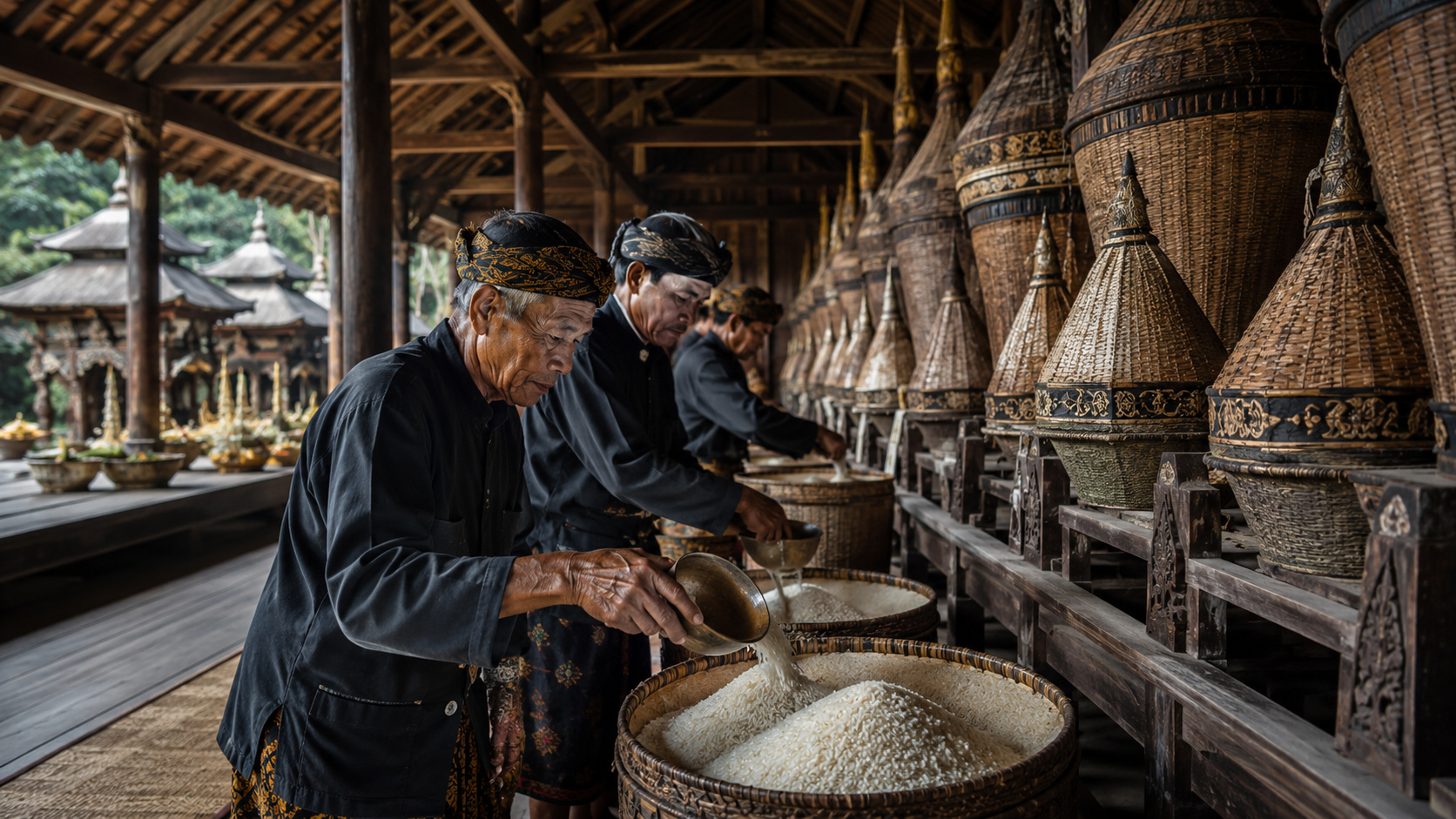

Kasepuhan Gelar Alam Community in Indonesia stores rice for almost 100 years in a sacred tradition that unites faith, food, and security.
In Indonesia, an indigenous community in West Java maintains a tradition that seems unlikely in the modern era: planting rice every year, storing the harvest in traditional barns, and preserving enough reserves to feed generations. According to a report by Channel NewsAsia published on March 7, 2026 and updated on April 2, the Kasepuhan Gelar Alam community maintains a stockpile of rice capable of lasting almost 100 years.
For this village, rice is not just food. It is treated as a sacred obligation, a community heritage, and a symbol of security against hunger. The practice, maintained for more than six centuries, shows a radically different logic from commercial agriculture: planting to live, storing to protect, and not turning every grain into a commodity.
The Kasepuhan Gelar Alam community has turned rice into a sacred reserve against hunger
Kasepuhan Gelar Alam is located in West Java, one of the most populous and culturally diverse regions of Indonesia. According to Channel NewsAsia, the community has preserved for more than 600 years an agricultural system where food security is at the center of social, religious, and economic life.
-
California Teacher Converts Moving Truck into Spacious, Light-Filled Mobile Home to Overcome Zoning Restrictions and Cut Costs

-
Daughter of a Construction Worker and a Baker, Bruna Achieves Dream of Studying Medicine at Brazil’s Prestigious USP at 21

-
City Provides Disposable Cameras to Residents to Capture Downtown, Uncovering Hidden Value Beyond Appearances
-
São Paulo Expands Healthcare and Housing in Southern Region with New Health Center, 374 Apartments, and Over 2,300 Property Titles




The most impressive fact is the size of the reserve. Using agricultural methods passed down from generation to generation, the community has managed to accumulate enough rice to last almost 100 years, according to the report.


This stockpile is not treated as a commercial surplus to be sold on the market, but as a collective guarantee against periods of crisis, scarcity, crop failure, or future need.
This vision contrasts with the dominant agricultural model in many countries, where production is often measured by volume, productivity, export, and profit. In Gelar Alam, rice carries a spiritual and community function. Planting is a duty, storing is protection, and preserving the food is a form of respect for the ancestors.
Planting rice is everyone’s duty, not just an economic activity
According to Channel NewsAsia, for the Kasepuhan Gelar Alam, planting rice is a sacred obligation that must be fulfilled by all community members. This means that agriculture is not seen just as a profession, but as part of the collective identity of the village.
This organization helps explain why the system has survived for so long. When rice cultivation is incorporated into tradition, it no longer depends solely on prices, commercial opportunities, or individual decisions. The annual planting becomes part of the social calendar, cultural transmission, and the very continuity of the community.
In traditional societies of West Java, rice barns known as leuit play a central role in agricultural life. They are vernacular structures used to store rice after harvest and are linked to harvest and thanksgiving ceremonies, such as the Seren Taun, an important Sundanese agricultural celebration.
The wooden barns function as vaults of food and collective memory
The leuit are not just storage spaces. In Sundanese tradition, they symbolize sustenance, continuity, and protection of life. These structures are usually built on stilts, with woven bamboo walls and roofs made of plant fibers or leaves, an architecture designed to store rice in an elevated and protected environment.
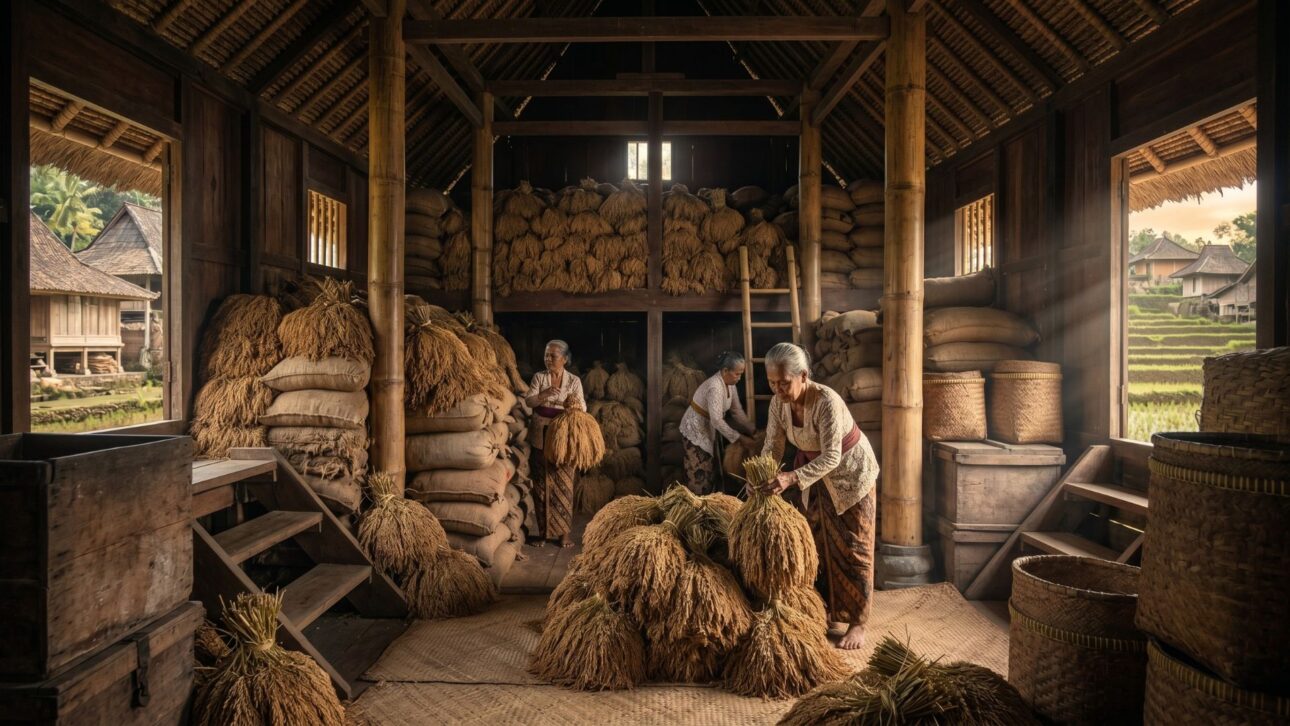
The practical function is evident: to store food for long periods. But the symbolic function is even deeper. The barn represents the community’s ability to withstand time without relying entirely on external markets, governments, imports, or price fluctuations.
In many places, food stored for a long time may seem wasteful. In Gelar Alam’s logic, the opposite occurs. Storing rice is an act of prudence. The accumulated food does not exist to enrich someone, but to prevent the community from becoming vulnerable in the face of the unexpected.
The tradition of not selling rice completely changes the logic of production
One of the most curious points of this topic is the relationship with the market. In Kasepuhan communities of West Java, there are records of traditional norms that restrict the sale of rice and preserve production for consumption, rituals, and food security.
In Ciptagelar, another Kasepuhan community in the region, sources on cultural tourism and local studies describe the practice of planting rice once a year, avoiding chemical fertilizers, not using tractors or industrial mills, and preserving food self-sufficiency.
This logic does not mean the absence of an economy. It means an economy organized by other values. Rice is a food priority before being a commercial product. What is left over is not automatically sold. Part is stored to last for years, decades, and, in the case reported by Channel NewsAsia, almost a century.
In a world marked by food inflation, climate shocks, wars, import dependency, and food insecurity, the practice draws attention precisely because it seems to go in the opposite direction of modern haste. While large global chains work with lean inventories and rapid circulation, Gelar Alam preserves a model of deep reserve.
Rice has spiritual value within Sundanese agricultural culture
The strength of this tradition is also linked to the place of rice in local culture. Studies on Kasepuhan communities in West Java indicate that rice is treated with a strong symbolic dimension, linked to rituals, ancestry, and respect for nature. In research on Kasepuhan Sinarresmi, also in Sukabumi, authors analyze how agricultural rituals reveal a vision in which rice is associated with life, fertility, and self-sufficiency.

This reading helps to understand why rice storage cannot be explained solely by economic efficiency.
For these communities, the grain is within a cultural system that involves obligation, gratitude, balance with nature, and continuity of ancestors.
The Seren Taun ceremony, for example, marks the transition from one agricultural cycle to another and expresses gratitude for the past harvest, as well as requests for a successful next crop.
In some traditions, part of the harvest is given to community leaders and stored in communal barns considered important or sacred.
The model shows an ancestral response to a modern problem: food security
Food security is often discussed today in terms of technology, logistics, productivity, international trade, and public policies. The Kasepuhan Gelar Alam community shows another dimension: food security as culture.
Channel NewsAsia summarizes the logic of this community by stating that, for more than six centuries, it has made food security the foundation of its traditions. The stockpile of nearly 100 years is the strongest expression of this choice.
This does not mean that the model can simply be copied by large cities or entire countries. The scale, territory, social organization, and cultural rules are very specific.
Even so, the practice reveals a powerful question: how much of modern food vulnerability comes from the loss of stockpiles, dependence on distant markets, and the complete transformation of food into a commodity?
A 600-year-old tradition survives in modern Indonesia
Indonesia is one of the most populous countries in the world and has rice as a central food. The country discusses production, importation, price stability, and food security on a national scale.
Within this scenario, Gelar Alam draws attention for preserving an ancient community solution based on annual planting, storage, and transmission of traditional practices.
According to Channel NewsAsia, the agricultural methods used by the community have been passed down from generation to generation. This continuity is decisive.
The system does not rely solely on a good harvest but on an entire culture aimed at maintaining production and stock over time.
The persistence of this tradition also shows that modernity and ancestral practices do not need to be seen as absolute opposites. In some cases, ancient knowledge can offer important answers to contemporary problems, especially when it comes to food, climate, and community resilience.
Rice stored for generations reveals a different way of thinking about wealth
In modern financial logic, wealth is usually measured in money, assets, holdings, and consumption capacity. In Gelar Alam, one of the most concrete forms of wealth is stored in grains.
Rice stored for decades represents something that does not disappear with market crises. It also carries family and community memory. Each stored harvest speaks not only of the present but of the ancestors who planted, the descendants who will be able to eat, and the responsibility to keep the cycle alive.
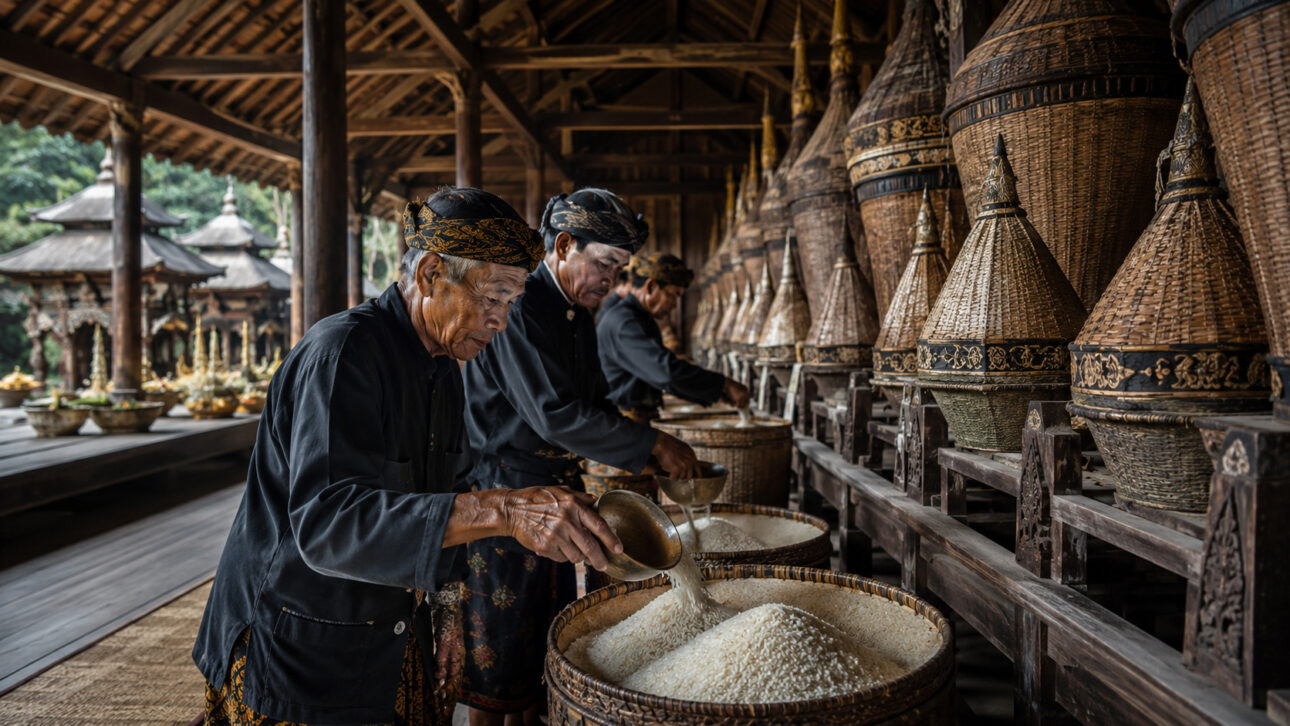
This is the strongest part of the story: the community does not store rice just because there might be a food shortage tomorrow. They store it because the food is part of their worldview. The barn does not just hold grains. It holds time, faith, discipline, history, and a form of silent resistance against insecurity.