Portuguese
  Spanish


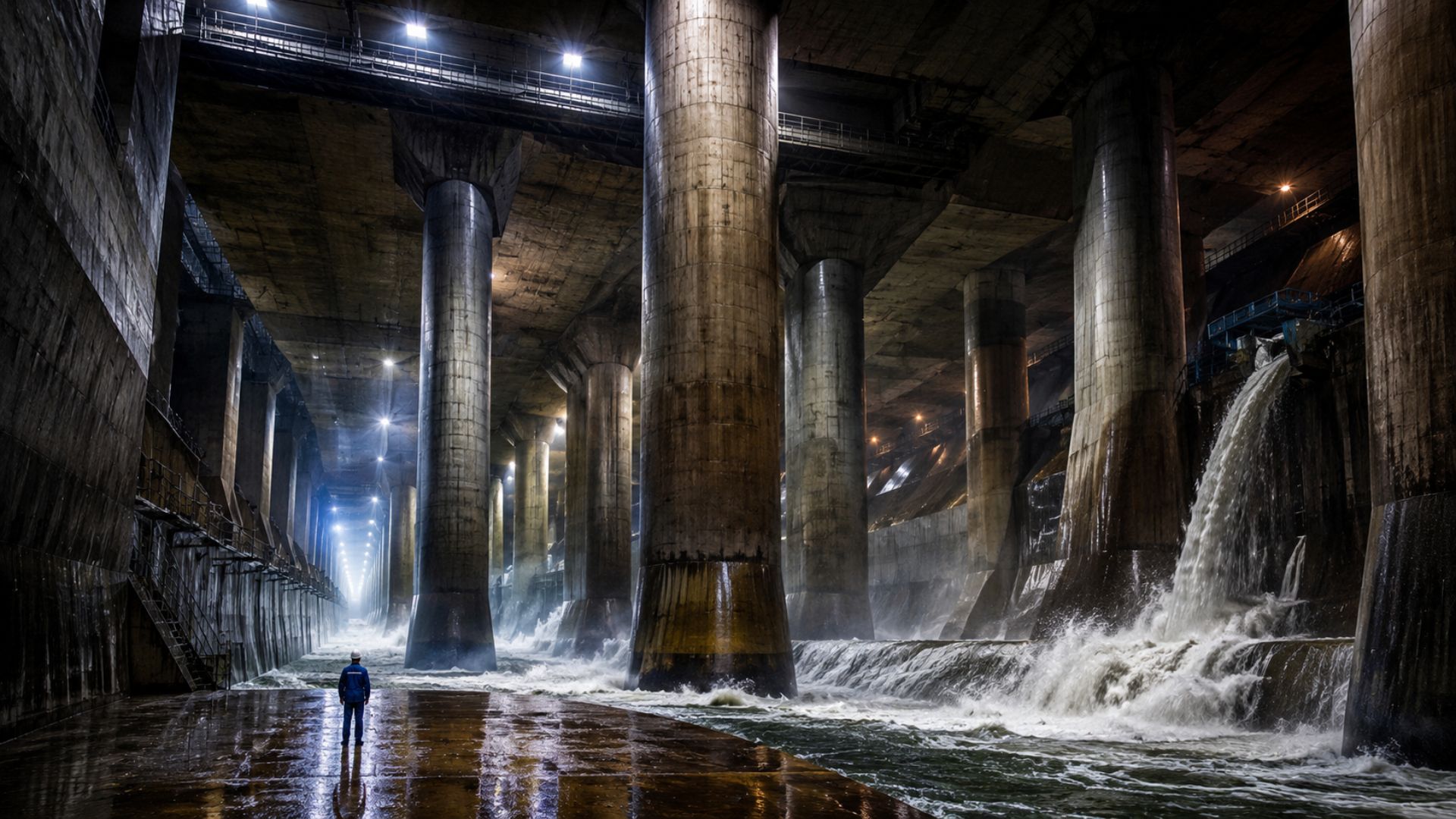

Tokyo houses the world’s largest underground tunnel system against floods, an underground concrete cathedral with 500-ton pillars and 70-meter deep silos that cost 2 billion dollars and took 13 years to build. According to Bloomberg, the structure, called G-Cans (Metropolitan Area Outer Underground Discharge Channel) began construction in 1992, the grand engineering project was completed and officially inaugurated in 2009, diverting rainwater underground through five colossal silos connected to a 6.3-kilometer tunnel 50 meters below the ground. Since completion, the underground cathedral has reduced flood damage to homes in the Saitama region by 90%.
Tokyo spent 2 billion dollars and 13 years of construction to create an underground cathedral that outsmarts floods. The system, built in Saitama Prefecture, on the outskirts of the Japanese capital, works by capturing excess river water during heavy rains and channeling it all underground before the surface is hit. The underground cathedral is tall enough to fit a space shuttle standing up, and its 500-ton pillars support the ceiling of a pressure chamber that the engineers themselves have nicknamed “Underground Temple,” a reverence justified by the scale of a project that deals directly with the forces of nature.
The result is concrete: since the completion of the underground cathedral, flood damage to homes in the region has dropped by 90%. Japan is considered the most advanced country in the world in natural disaster preparedness, with investments in protective infrastructure that reach all layers of society, from governments and companies to schools and community groups. This culture of prevention has been shaped by more than a century of catastrophes, from the 1923 earthquake that devastated Tokyo to the annual typhoons that threaten a metropolitan economy of 37 million inhabitants responsible for 20% of Japan’s GDP.
How the underground cathedral works in practice

During heavy rains, five vertical concrete silos, each 70 meters deep, capture the excess water from the rivers around the Saitama region. The captured water is channeled into a 6.3-kilometer-long underground storage tunnel, built approximately 50 meters below ground level, where it remains until high-capacity pumps push it back into the Edo River in a controlled manner.
-
Giant Robots Build Entire Neighborhood of 100 3D-Printed Homes in the U.S., Showcasing Technology’s Impact on Construction Industry

-
Helsinki Residents Receive Water That Travels 120 Kilometers Through a Hidden Rock Tunnel from a Lake Before Treatment

-
Brazil’s Sertão Region Nears Completion of Latin America’s Longest Artificial River, Transforming Water Access in Drought-Prone Ceará
-
Pre-mixed stabilized mortar set to revolutionize construction in 2026: extends usability to 36 or 72 hours, boosts productivity, and minimizes waste in building projects.



The underground cathedral itself is the pressure control chamber at the end of the tunnel, a monumental space 177 meters long, 78 meters wide, and 25 meters high. The 59 pillars, each weighing 500 tons, support the ceiling and regulate the flow of water that arrives forcefully from the tunnels. By keeping the entire system underground, the surface remains functional for housing and commerce, without the protective infrastructure occupying urban space.
Why Japan invests billions in underground cathedral and dikes

Japan is located in the so-called “Pacific Ring of Fire,” a zone of frequent earthquakes and volcanic eruptions, which adds to the constant threat of typhoons and torrential rains. Tokyo launched the Resilience Project in 2022, a program that foresees spending 110 billion dollars by the 2040s to raise sea walls, move infrastructure to higher ground, and add more protective dikes.

The 2 billion dollar underground cathedral in Saitama is just one piece of this broader system. The cost of not investing is clear: reinsurer Munich Re calculated that, in 2024, the global cost of natural disasters reached 320 billion dollars, of which 90% were related to climate risks like typhoons, hurricanes, and floods. For a city like Tokyo, whose economy rivals that of New York, every dollar invested in prevention saves dozens in reconstruction.
The billion-dollar market born from climate adaptation


Climate adaptation has moved from being an environmental agenda to entering Wall Street’s radar. Climate economists estimate that the global adaptation market could reach 1.3 trillion dollars, and figures like Bill Gates publicly advocate for investments in climate resilience as an economic opportunity, not just as loss prevention.
The logic is simple: each disaster generates billions in destruction but also moves billions in reconstruction, debris removal, and infrastructure rebuilding. The difference is that investing before the disaster costs less and saves lives. The Netherlands, which built dikes along its entire coast, estimates that the benefits already far exceed the costs, with avoided losses of up to 21 billion dollars from projected coastal floods by 2100. The Dutch have become so specialized that they export their protection engineering to other countries, including Jakarta, the fastest sinking megacity in the world.
What other cities can learn from the underground cathedral

Tokyo’s underground cathedral demonstrates that flood protection does not require visible solutions on the surface. The concept of moving protection infrastructure underground preserves urban space and allows densely populated cities to continue functioning even during extreme weather events, without barriers blocking access to rivers and coasts.
But megaprojects are not the only answer. Sponge cities, a concept born in China, use urban green spaces to absorb and store rainwater at a much lower cost. In Nairobi, black soldier fly farms process organic waste that clogs drains and causes flooding in informal settlements, costing only 78 thousand dollars.
The lesson from the 2-billion-dollar underground cathedral, with its 90% reduction in damage, and these smaller solutions is the same: adaptation works when investment comes before the disaster, not after.
Did you know that Tokyo has a 2-billion-dollar underground cathedral that reduces floods by 90%? Do you think Brazil should invest in similar infrastructure or do our cities need different solutions? Share in the comments.