






 Portuguese
  Spanish




Toyota, recognized worldwide as one of the most reliable brands, continues to be a reference in the automotive industry. Its vehicles are highly sought after globally, and in Brazil, this reality is no different. The Hilux, the most desired mid-size pickup truck, stands out in this scenario.
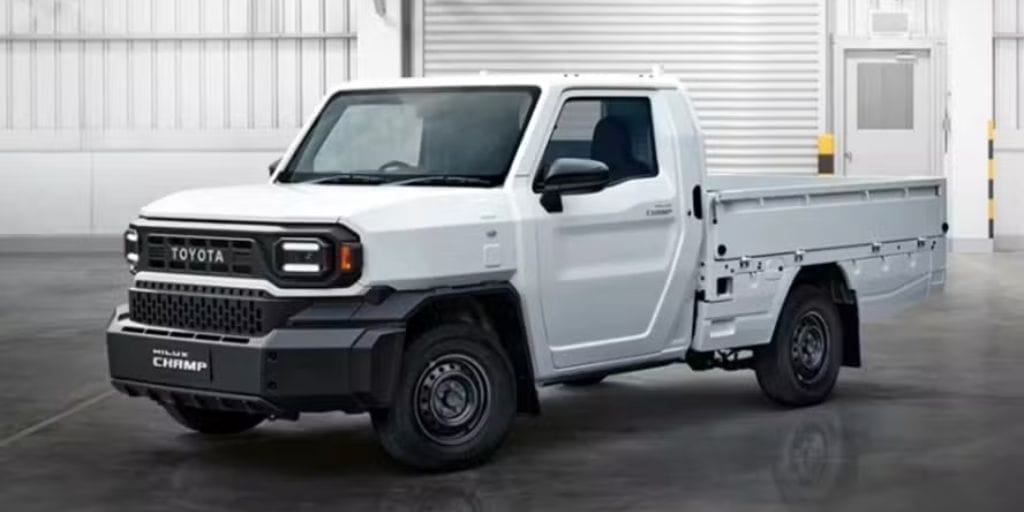
Now, the Japanese automaker seeks to expand its reach by entering the sub-medium pickup segment to compete directly with the Fiat Toro. In this sense, a novelty that has attracted much attention is the Hilux Champ, which is a more economical version launched in Thailand and recently registered in Brazil.
This model promises to capture the market with its affordable price and functional design, ideal for daily work. Abroad, the model is sold for less than R$ 70,000. In Brazil, the price will not be the same, but the expectation is that it will be quite competitive compared to similar models.
Hilux Champ: Design and Functionality
According to information from the YouTube channel Garagem 2.0, the Hilux Champ retains the dimensions of a conventional Hilux with a double cab, measuring 5.30 meters in length, three meters in wheelbase, 1.80 meters in width, and 1.75 meters in height. Its bed is impressive, measuring 2.64 meters in length and capable of carrying up to one ton.
-
Volkswagen to Cut Production by 1 Million Cars by 2030, Reducing Jobs and Platforms, Focusing on More Profitable Models

-
Toyota Launches First 100% Electric Car in Brazil: bZ4X with 343 HP, All-Wheel Drive, 361 km Range, Priced at $419,990 BRL, Limited to 99 Units

-
Chinese SUV Achieves 24.4 km/l, Outperforms Toyota Yaris Cross in Real-World Tests with 224 hp Hybrid System, Offers 51-Liter Tank for Greater Range, and Costs Up to R$ 5,000 Less.
-
Uber Black Revamps Fleet, Drops Ten Car Models and Sets Deadline for Electric BYD Dolphin


The pickup’s appearance is simple and practical, with black bumpers and a full LED optical set. However, the highlight is the numerous engine options, including six-speed manual and automatic transmissions, with rear-wheel drive or 4×4.
Interior and Equipment
Inside, according to the mentioned channel, the Hilux Champ follows the external line of practicality and simplicity. The finish is predominantly made of hard plastic, and most versions offer two seats, with an option for an extra cab. The equipment list is basic, comparable to a base Renault Kwid.
In terms of safety, the pickup is equipped with disc brakes with ABS at the front, traction and stability controls, anti-roll control, and dual airbags. The turbodiesel versions include descent control, useful on steep terrains with full load.
Price Is the Big Attraction
The main attraction of the Hilux Champ is undoubtedly its extremely affordable price. In Thailand, for example, the pickup starts at 459,000 baht (approximately R$ 69,000) and can reach up to 577,000 baht (around R$ 80,000).
In Brazil, it is estimated that the turbodiesel version will cost around R$ 150,000, a value that would be unprecedented for the segment. Compared to current models, a Fiat Strada varies between R$ 113,490 and R$ 136,990, while the Volkswagen Saveiro costs between R$ 98,670 and R$ 111,690.
The conventional Hilux starts at R$ 219,000 and can reach R$ 372,890. With these prices, the Hilux Champ stands out as a highly competitive option.
Next Steps for Toyota in Brazil
In addition to the Hilux Champ, Toyota plans to launch a new compact pickup based on the Corolla Cross, aimed at competing with models like Ram Rampage, Ford Maverick, and Fiat Toro. With this strategy, the automaker aims to diversify its portfolio and attract an increasingly broad audience.
The Toyota Hilux Champ, with its combination of simplicity, robustness, and affordability, has all the ingredients to become a success in Brazil. This economical pickup promises to attract both workers and brand enthusiasts, further consolidating Toyota’s presence in the Brazilian market.
What do you think the new low-cost Hilux from Toyota should be priced at in Brazil? Leave your opinion in the comments! Until next time.





Na mesma faixa de preço da strada e similares