






 Portuguese
  Spanish


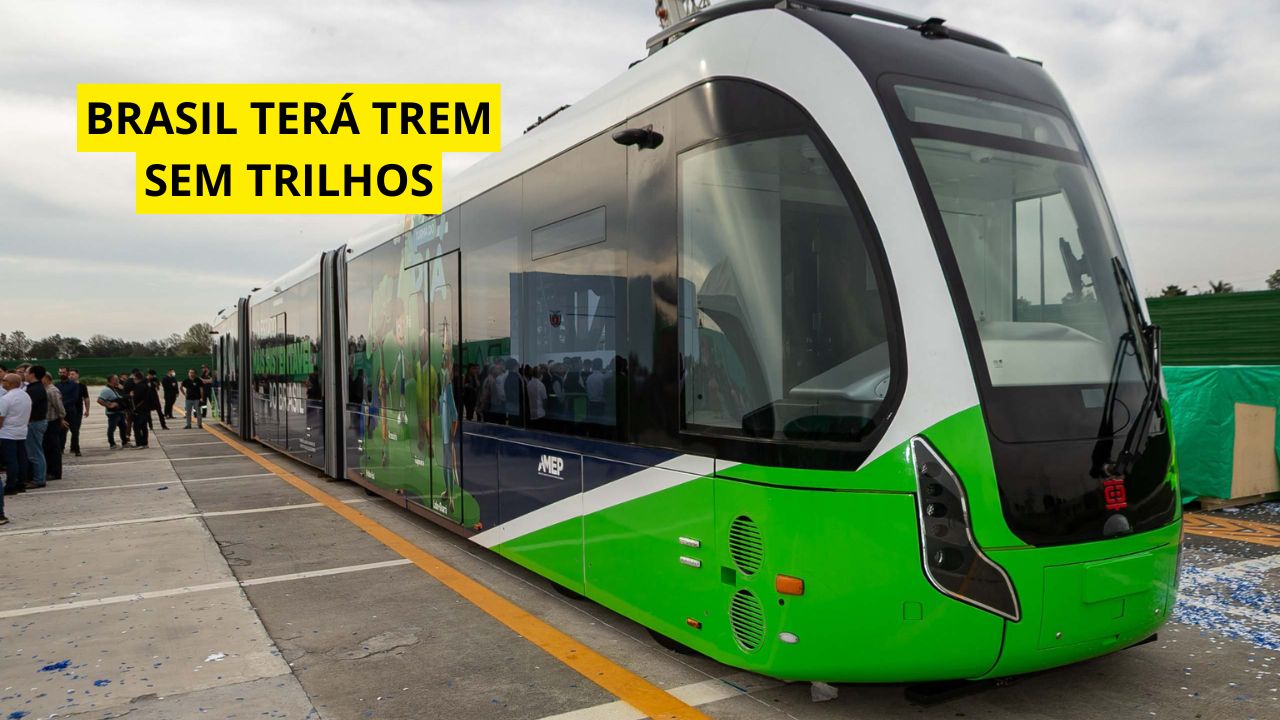

The Technology of Trackless Trains Sparks Interest in 7 Brazilian Capitals, with the “Digital Urban Tram” System Being Tested in Paraná. Understand What It Is, How It Works, and Why It Could Revolutionize Public Transport.
An innovative trackless train system will be tested by the Paraná Metropolitan Affairs Agency (Amep) between the cities of Pinhais and Piraquara, in the Metropolitan Region of Curitiba, starting in the coming months.
The technology has attracted interest from at least seven Brazilian capitals, which have already expressed a desire to adopt the system.
The vehicle, known as the “digital urban tram,” operates without tracks and was presented by the State Government of Paraná.
-
Latin America’s Largest Port Invests $400 Million in Rail System with Trains Up to 2.4 Kilometers Long
-
New Smart Radar Begins Issuing Fines to Solo Drivers in Carpool Lanes, Uses Cameras to Count Occupants, Changing Traffic Enforcement Rules on Busy European Roads

-
Why can the crane operator only obey the correct signalman on the construction site: among dozens of workers, a hand raised by the wrong person can confuse the maneuver and turn a load of tons into an immediate risk.
-
What changes with the new public transportation rules that can reduce pressure on fares and pave the way for zero fare in Brazil?

The expectation is that this new alternative will improve urban mobility, reduce costs, and make public transport more efficient.
About the Trackless Train System
The trackless train system is also referred to as the “Digital Urban Tram” (BUD) and uses tires instead of wheels on tracks.
It combines sensor-guided driving and digital markings on the pavement, eliminating the traditional structure of metal tracks.
The alternative positions itself as a middle ground between conventional buses and light rail vehicles (VLT), offering agility and lower construction impact.
Where and When the Project Will Be Implemented
In the state of Paraná, the trackless train test is scheduled to operate on a line of about 13 km between Pinhais and Piraquara, with operation expected to begin in November 2025.
The Chinese company CRRC Nanjing Puzhen provides the technology for the vehicle that will be used in the trial.
In addition to Paraná, at least seven Brazilian capitals — including São Paulo, Belo Horizonte, and Porto Alegre — have expressed interest in the trackless train.
The model is not limited to the country: Argentina and Chile have also shown curiosity about the innovation.
How the Trackless Train Technology Works
The trackless train involves a tire system, magnetic or digital guidance embedded in the asphalt, and sensors that ensure stability and precise routing.
The BUD would eliminate physical tracks, which reduces heavy construction and initial infrastructure investment.
Still, the vehicle delivers a “train-like sensation,” according to its creators.
Why the Trackless Train Could Represent a Turning Point in Mobility?
While public transport faces challenges regarding speed and cost, the trackless train presents itself as a solution to high-cost tracks and congested buses.
Thus, the adoption of this system could improve urban efficiency, reduce travel times, and provide a new option for users.
Moreover, the flexibility of the technology allows for quicker implementation, encouraging cities to consider the model.
Challenges and Criticisms of the New System
Although promising, the trackless train still faces questions about durability, adaptation to existing infrastructure, and integration with other modes.
Some experts point out that tires, pavements, and sensors require maintenance different from traditional tracks.
Still, the fact that it has already attracted capitals and states shows that the debate on urban mobility is undergoing transformation.
For cities that adopt this trackless train system, there will be a direct impact on urban planning, investment attraction, and improvement in public transportation.
For the everyday user, this means more comfort, predictability, and the possibility of new routes between municipalities.
Additionally, the adoption could favor intercity travel and reduce car use, contributing to less congestion and emissions.
In summary, the trackless train, in the form of a digital urban tram, presents itself as a promising alternative for mobility in Brazil.
With tests underway in Paraná and interest from seven capitals, the model could transform the way we think about public transport.
Thus, what once seemed futuristic is beginning to become a reality — and it is worth following how cities respond to this innovation.
With information from the website ND Mais.








Tem algo errado. Se a velociadade é 70 km por hora, não tem como ele fazer 5 km em 30 segundos.
5 km em 30 segundos é uma velocidade de 600 km/h. Nem o trem-bala mais rápido consegue essa velocidade. Acho que não há pneu que suporte essa velocidade; os pneus de Fórmula 1, por exemplo, não conseguem fazer a prova inteira com o mesmo jogo e percorrem cerca de 300 km de distância.
Colocaram a fonte ND+ e não trouxeram a informação correta. O BUD anda 5 km com 30 segundos de carga por ser elétrico.