Portuguese
  Spanish



With an Investment of R$ 45 Million, the Federal University of Goiás Inaugurates the Research Center for Molecular Studies, Energy, and Petroleum (Cemep), a Reference in Technology and Innovation for the Oil and Energy Sector in the Country.
The Federal University of Goiás (UFG) inaugurated one of the most advanced research centers in the country focused on the oil and energy industry. The new Center for Molecular Studies, Energy and Petroleum (Cemep) received a total investment of R$ 45 million and was designed to offer cutting-edge technological solutions to the Brazilian energy sector’s production chain.
The center is located at the Samambaia Technology Park (PTS-UFG) and is the result of the expansion of the Chromatography and Mass Spectrometry Laboratory (Lacem) from the university’s Chemistry Institute. The goal of Cemep is to strengthen applied research in energy and petroleum, focusing on innovation, sustainability, and the development of new technologies.
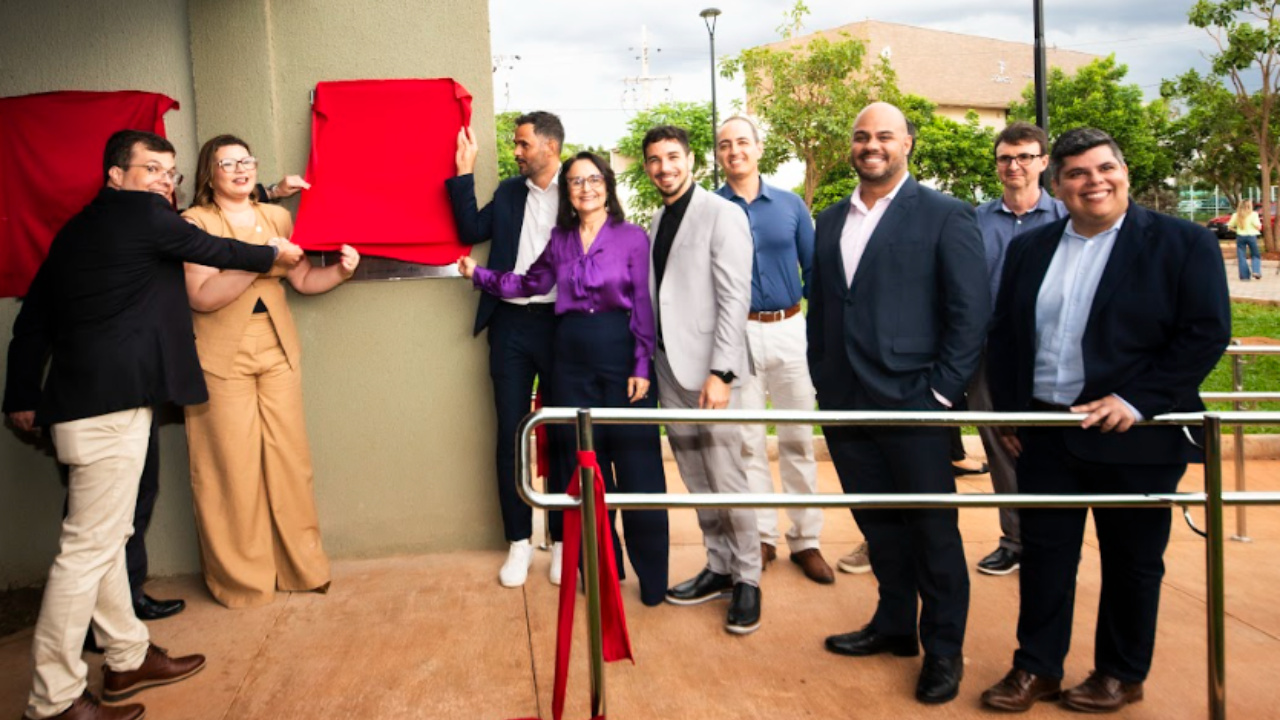
The inauguration ceremony brought together academic authorities, representatives from Petrobras, managers from the Foundation for Research Support (Funape), and researchers from various institutions.
-
Petrobras to Double Natural Gas Supply in Northeastern Brazil with New Investment

-
Petrobras Approves $1.2 Billion Refinery in Brazil to Produce Aviation Fuel and Diesel from Plants
-
Petrobras Secures $2.2 Billion Contract to Build and Operate Four Support Vessels for Brazil’s Offshore Oil Fields
-
Oil production grows in Rio, but reserve replacement raises a warning sign



Innovative Equipment and Cutting-Edge Structure
Cemep houses two highly complex, unprecedented pieces of equipment in Brazil and Latin America: the Solarix FTICR 15 Tesla and the IRMS High Resolution, Ultra 253.
The Solarix FTICR 15 Tesla is the only one with this capacity installed in the national territory. The equipment, which operates with a magnetic field of 15 Tesla, is used for ultra-detailed molecular analyses essential for studying the chemical composition of petroleum samples and their derivatives.
The IRMS Ultra 253, unique in Latin America, is aimed at determining grouped isotopes and is crucial for understanding the formation temperature of methane in petroleum reservoirs. This type of data is strategic for basin modeling and reducing risks in drilling new wells.
The physical space of Cemep covers 800 square meters, with 700 of built area. The construction cost around R$ 5 million and was designed to accommodate large-scale equipment, requiring special infrastructure for isolation and security.
Strategic Partnerships with Petrobras Strengthen Technological Advancement
Petrobras, the main financer of the project, highlighted the importance of Cemep for the future of Brazilian science applied to oil. Henrique Penteado, General Manager of Research, Development, and Innovation in Exploration and Production at the state-owned company, stated that the firm “has a long history of investment in science and technology, and Cemep represents the most modern in science development”.
Iris Medeiros, a chemist at the Research, Development, and Innovation Center Leopoldo Américo Miguez de Mello (Cenpes/Petrobras), emphasized the impact of the new center on advancing research. “All our challenges are growing, but we have always had confidence in presenting to Professors Boniek and Andréa the problems to be solved. We needed this instrumental help to overcome our limits, and that’s why the center is so important,” he declared.
Thalmo Uriel, Chemistry Manager at Cenpes, added that Cemep is a consequence of a solid innovation strategy. “This equipment is not simple, hence the need for adequate infrastructure that will take Brazil into a new era,” he affirmed.
The Journey of a Collective Dream Focused on Oil Development
The coordinator of Cemep, Professor Boniek Gontijo, opened the ceremony recalling that the project started over 20 years ago, in 2004. “We have persisted on this path with the collaboration of dozens of people, many of whom are now working in other states and countries. The dream has been built by each of you who are here,” he expressed.
His colleague and also center coordinator, Andréa Chaves Rodrigues, highlighted that this moment symbolizes a milestone for science in Goiás. “Using our modern tools and our sharp minds, we hope to present new and innovative technological solutions. What we celebrate here is the courage that made Lacem grow and transform into Cemep,” she declared.
She emphasized that the current objective is to position the center as a protagonist in Brazilian science, developing work with excellence and strengthening the bond between academia and industry.
UFG and Funape: Excellence in Management and Scientific Innovation
The rector of UFG, Angelita Pereira de Lima, celebrated the partnership results and highlighted the university’s performance in the RUF ranking, by Folha de S.Paulo, where it reached the 13th national position. “This result shows why Petrobras allocated such resources for a laboratory in the heart of Brazil. We have young, dedicated teams with the energy to make science happen,” she stated.
The executive director of Funape and elected rector for the next UFG term (2026–2030), Sandramara Matias Chaves, highlighted the foundation’s role in managing more than a thousand research projects. “Each manager is responsible for 70 to 90 projects. And I can only thank the team’s commitment, especially for this project,” she affirmed.
She recalled the care with the arrival of the Solarix FTICR 15 Tesla in the country. “Two collaborators personally went to Campinas airport to monitor the truck to Goiânia. Our goal was to ensure that it arrived in perfect condition and within technical specifications,” she revealed.
Training Talents and Scientific Impact for the Future of Oil
The director of the Chemistry Institute of UFG, Wendell Coltro, emphasized that Cemep represents the realization of years of collective effort. “There are dozens of patents and more than 100 students graduated with excellence. We are in front of professors who often took money from their own pockets to make things happen. This is love for science,” he affirmed.
Currently, more than 30 projects are being developed in partnership with Cemep, covering areas such as petroleumomics, metabolomics, lipidomics, pesticide analysis, contaminants in food, pharmaceuticals, isotopy, and forensic chemistry.
According to Gontijo, the goal is to transform the center into a multi-user laboratory, available to the entire academic and scientific community. “Cemep will serve all of UFG and also other public and private institutions seeking innovation in the oil and energy sector,” he explained.
The Role of Cemep in the New Era of Energy and Oil
With a unique structure in the country, Cemep emerges as a reference in applied research and technological innovation aimed at the energy sector. At a time when global demand for petroleum and derivatives remains high—while pressure for more sustainable sources is also growing—centers like UFG’s become essential to balance productivity, efficiency, and energy transition.
The combination of academic science, public investment, and strategic partnerships with sector giants like Petrobras reinforces Brazil’s role as a protagonist in the search for smarter and more competitive energy solutions.