Portuguese
  Spanish


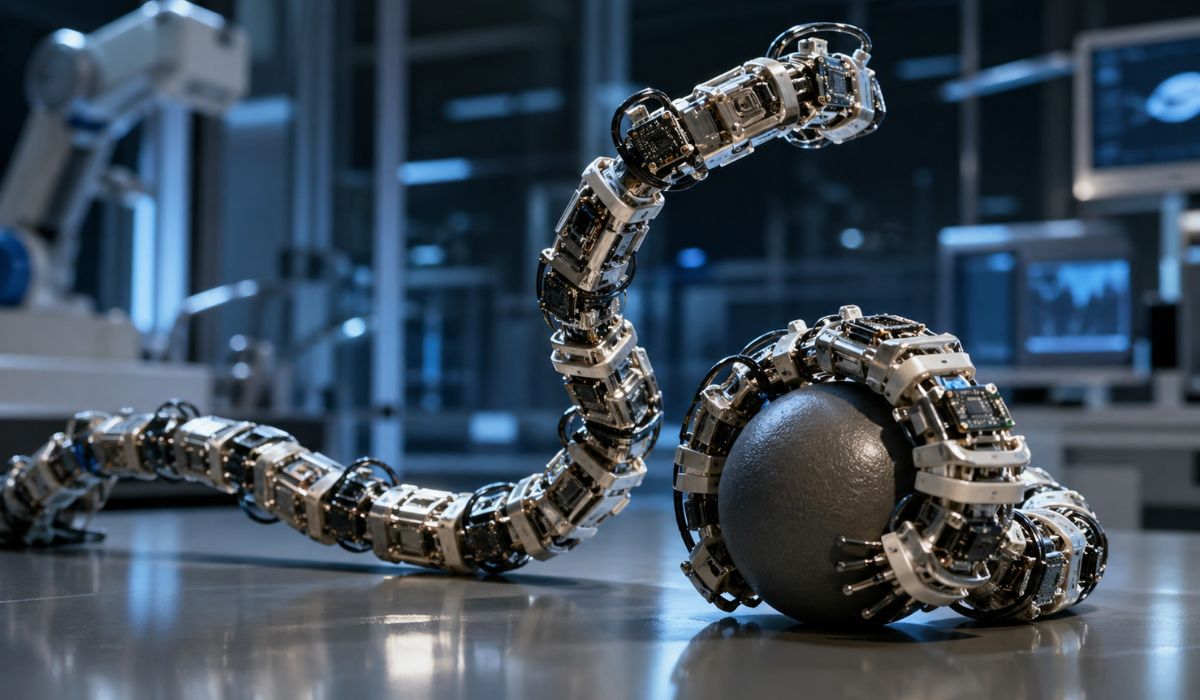

University of Amsterdam study presents trainable metamaterials that memorize shapes, adjust mechanical responses, and perform movements in the lab, in research that brings together materials science, soft robotics, and physical learning.
Researchers at the University of Amsterdam have developed metamaterials capable of learning shape changes, memorizing mechanical responses, and performing functions such as grasping objects and moving in an experimental environment.
The study was published on April 7, 2026, in the journal Nature Physics and describes synthetic chain-like structures, composed of motorized hinges, that adjust their own behavior without relying on a single central command.
The research does not claim that the material is alive.
-
Berries, Strawberries, and Blueberries Could Transform Agriculture in Northeastern Brazil, New Tests Reveal

-
Danish Resident Discovers Six Viking Gold Bracelets Weighing 762.5 Grams, Third Largest Gold Treasure in Denmark

-
Over 200 Cities in Southern Brazil on Storm Alert as Cyclone Near Uruguay Brings Heavy Rain, Hail, and Winds Up to 100 km/h

-
Archaeologists Discover 2,300-Year-Old Beer in Sealed Bronze Vessel from Ancient Chinese Tomb




The approximation to biological systems appears because simple organisms and living tissues can adapt to stimuli, while human-made materials generally have predefined responses.
According to the article’s authors, the experiment shows an artificial structure capable of modifying its physical response after undergoing training.
The prototype described by the team has a shape similar to a flexible chain.
Each unit is linked to the next by a motorized hinge, integrated with a microcontroller.
This component measures the rotation angle, records previous movements, and exchanges information with neighboring units.
Based on this data, the hinges can apply torque and alter stiffness and preferred position, allowing the assembly to assume new configurations.
The central point of the work is what is called physical learning.
Instead of training external software to command all parts, the researchers had the material itself update internal parameters.
In this way, part of the processing occurs within the mechanical structure, through interactions between sensors, motors, local memory, and connections between units.
How the metamaterial learns to change shape
Training occurs through examples.
First, researchers impose an input deformation on one or more hinges.
Next, they guide the other parts of the chain to the desired configuration and temporarily maintain that shape.
By repeating the process, the microcontrollers adjust local commands until the system begins to reproduce the expected response when it receives the same stimulus.
The method used in the study is described as contrastive learning.
In practice, the material compares two states: one where it responds freely to the stimulus and another where it is guided to the target shape.
The difference between these two situations guides the internal adjustments.
With training cycles, called epochs by the authors, the chain reduces error and begins to reach the taught configuration within the experiment’s conditions.
The demonstration goes beyond simple mechanical memory.
According to the publication, metamaterials can forget old shapes, learn new responses in sequence, and store more than one shape change at the same time.
In supplementary videos for the article, the authors show structures trained to form letters and words, such as “LEARN” in English, and “LEREN” in Dutch.

The autonomy described in the study is also distributed.
There is no central controller responsible for defining each movement of the chain.
Each hinge acts based on its own measurements, local memory, and information received from its neighbors.
Thus, the final behavior arises from the interaction between the parts, and not from a single order sent from outside.
Why researchers talk about material evolution
The word “evolution,” used by the team, appears in the context of the system’s learning.
The material does not evolve like a living organism nor does it undergo natural selection.
The term refers to the progressive change in behavior during training, as internal parameters are updated.
Yao Du, a PhD student at the Machine Materials Lab at the University of Amsterdam and the first author of the article, said in a statement from the institution that the learning gives metamaterials the ability to evolve.
In the same statement, he affirmed that the possibilities of “where the system can go” seem “almost limitless.”
His statement expresses the researcher’s assessment of the experimental platform’s reach.
From a factual point of view, the study presents trainable adaptive materials, not a form of artificial life.


The difference from conventional materials lies in the ability to change their own response after repeated examples, instead of just executing a fixed behavior at the time of design.
This type of learning allowed the team to investigate more complex responses, such as non-reciprocal changes and multiple states of stability.
In practical terms, this means that the path taken by the material can influence the outcome and that the structure can switch between more than one stable configuration.
Based on this behavior, the authors demonstrated functions such as reflexively grasping objects and performing locomotion on a surface.
The movement described in the study occurs with motorized hinges and controlled actuation.
Therefore, it is not about displacement without energy or spontaneous action outside laboratory conditions.
The result highlighted by the authors is the conversion of form learning into mechanical function, a characteristic that brings the experiment closer to research in flexible robotics and adaptive materials.
Trainable Metamaterials and Flexible Robotics
Metamaterials are structures designed to exhibit properties determined primarily by their internal architecture, and not just by their chemical composition.
This area brings together research on materials capable of manipulating waves, absorbing impacts, altering stiffness, or responding to mechanical stimuli in specific ways.
The work from the University of Amsterdam integrates a line of research focused on materials capable of learning.
According to the institution itself, previous research by the Machine Materials Lab had already shown objects without central control that could roll, crawl, or move across unpredictable terrains.
In that case, however, the materials did not learn or memorize new behaviors.
The change presented now is the incorporation of memory and training into the material.
While a traditional material responds to external forces according to its physical properties, and a robot usually relies on programmed electronic control, the prototype described in the article occupies an intermediate position.

The structure was built so that form, memory, and mechanical response act in an integrated manner.
This approach can contribute to research in soft robots, reconfigurable devices, and distributed mechanical systems.
The applications cited by the authors remain in the scientific and experimental field, with no indication of immediate commercial use.
Therefore, any projection for sectors such as medicine, aerospace, civil construction, or defense requires caution and cannot be treated as an already proven application for this specific prototype.
What the technology still needs to prove outside the lab
The next steps indicated by the team involve time-dependent behaviors, and not just changes to static forms.
According to the University of Amsterdam, researchers intend to investigate metamaterials capable of learning different modes of locomotion, such as crawling or rolling, in response to environmental stimuli.
Another front mentioned by the group involves stochastic scenarios, where learning occurs amidst noise and uncertainty.
In these cases, according to the team, the system would adapt probabilistically, not deterministically.
The stated goal is to increase robustness and flexibility in complex environments, where stimuli are not always presented in a predictable manner.
There is no indication yet, in the article or the institutional statement, of a product ready for use outside the laboratory.
For the technology to advance in this direction, it would be necessary to demonstrate scaled operation, durability, energy efficiency, safety, and performance under less controlled conditions.
These points do not appear as already resolved results in the published study.
The research, for now, shows an experimental platform to investigate materials that process physical information through their own structure.
Instead of concentrating all control in an external computer, the chain uses deformations, torques, and local interactions to adjust its behavior.