





 Portuguese
  English
  Spanish
  5 min of reading
  0 comments


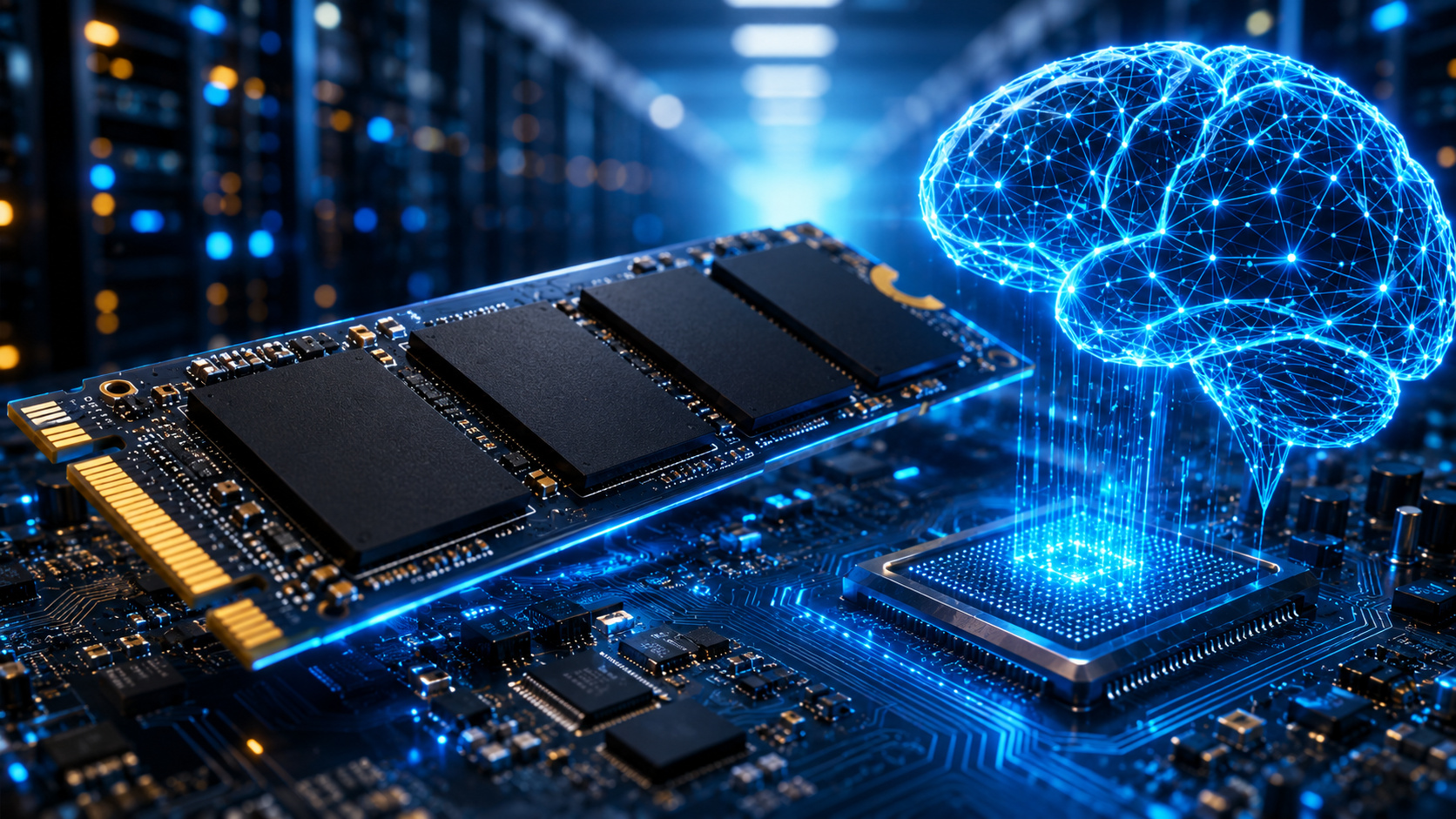
Understand how NAND became a key piece of AI, driving memory demand, causing global shortages, and transforming the tech market.
The NAND industry is experiencing a historic moment driven by the advancement of artificial intelligence. According to data released by Counterpoint Research on June 2, the global sector revenue reached $46 billion in the first quarter of 2026, a figure that already surpasses the entire annual revenue recorded in 2023.
The growth is directly linked to the expansion of AI, especially the so-called Agentic AI, which requires enormous storage capacities to process and store petabytes of information. While data centers receive billion-dollar investments, the market faces a growing shortage of memory chips, pushing prices and accelerating a new technological race among global manufacturers.
What is NAND and why has this memory become essential in the digital age
NAND is a type of non-volatile memory used to permanently store data in various electronic devices. Unlike RAM, it retains information even after the equipment is turned off.
-
While water remains limited outside of Earth, scientists are betting on plasma rays to sanitize astronauts’ clothes in future lunar and Martian missions, a technology that could revolutionize the infrastructure needed to colonize other worlds.

-
Red mud mountain in Louisiana could become a strategic U.S. mine: a $67 million project aims to extract up to 1,000 tons of rare earths per year from industrial waste and strengthen its national critical minerals supply chain.

-
End of the drought: revolution in the Atlantic is changing the way of drinking water with a plant that captures water under the ocean and produces up to 100 million liters per day using 340-meter underwater tunnels; Senegal inspires projects in Brazil and other countries.

-
Xiaomi launches 20,000 mAh power bank with integrated USB-C cable, 74Wh approved for air travel, 22.5W fast charging, and support for three devices simultaneously for 149 yuan in China.




Currently, this technology is present in virtually all sectors of the digital economy:
- SSDs for computers and servers;
- Smartphones and tablets;
- Data centers;
- Cloud computing services;
- Advanced artificial intelligence systems.
With the explosion of data generation, NAND has evolved from a common component to a strategic infrastructure of digital transformation.


How artificial intelligence multiplied the demand for storage
The growth of AI has completely changed the dynamics of the semiconductor market.
Artificial intelligence models need to store gigantic amounts of data for training, inference, and continuous operation. The more sophisticated the system, the greater the need for storage.
Counterpoint highlights that the enterprise segment alone accounted for 43% of all global NAND revenue during the first quarter of 2026. It is expected that this share will exceed 60% by the end of the year.
Among the factors explaining this expansion are:
- Growth of data centers;
- Popularization of generative AI;
- Advancement of Agentic AI;
- Expansion of cloud services;
- Need to store multiple petabytes of data.
In practice, artificial intelligence is transforming memory into one of the most valuable assets in the tech industry.
Memory shortage already affects prices and availability of components
The sharp increase in demand has created a shortage scenario that affects different technology sectors.
A large part of NAND production is being directed to servers and data centers focused on AI, reducing the available supply for computers, notebooks, and other electronic equipment.
This imbalance generates important consequences:
- Increase in SSD prices;
- Increase in manufacturing costs;
- Lower availability of components;
- Pressure on PC manufacturers.
The current shortage also highlights how the global semiconductor supply chain still struggles to keep up with the growth pace of artificial intelligence.
Revenue of US$ 46 billion places NAND at a new level
The US$ 46 billion recorded in the first quarter of 2026 represents an unprecedented milestone for the industry.
The value is particularly relevant because it surpasses the entire annual revenue of the sector in 2023, demonstrating the speed at which demand has changed in just a few years.
Analysts point out that the so-called hypercycle of AI is causing a structural transformation in the market. While smartphones and computers were previously the main drivers of growth, now it is the data centers dedicated to artificial intelligence that are driving investments.
The trend is that the demand for memory will remain high in the coming years, following the expansion of AI applications in different segments of the economy.
Samsung leads the market, but Chinese manufacturers are gaining ground
The competition for the global NAND market is also becoming more intense.
Samsung maintained its global leadership in the SSD segment, with a 29% share. Following are SK Hynix, with 18%, as well as Kioxia, Micron, and Sandisk, which recorded revenues close to 13% and 14%.
The highlight of the period was the Chinese YMTC.
According to Counterpoint’s survey, the company reached a 13% global share in the first quarter of 2026, recording an impressive annual growth of 246%.
The manufacturer’s progress shows that the technological race driven by artificial intelligence is opening space for new protagonists in the semiconductor sector.
The new global race for NAND and AI infrastructure
The growing demand for NAND is triggering a new international technological race.
Companies and governments are investing billions of dollars to expand production capacity and ensure access to the necessary components to sustain the AI revolution.
In this scenario, YMTC seeks to go public in China through an IPO, following a strategy similar to that adopted by CXMT, a manufacturer linked to the DRAM market.
The two companies are part of an industrial expansion program that foresees the construction of large production facilities to significantly increase wafer capacity.
The goal is simple: to take advantage of the growth of artificial intelligence and reduce the risks caused by the current shortage of components.
While data centers grow, the PC market shrinks
The success of NAND contrasts with the reality faced by the personal computer sector.
Data from IDC indicates that global PC shipments fell by 11.3% in 2026. Projections indicate approximately 260 million units sold, below the roughly 290 million previously recorded.
The increase in memory prices and other components is cited as one of the factors hindering the recovery of the segment.
Even in this scenario, manufacturers continue betting on new products.
Apple launched the MacBook Neo, while equipment equipped with the Intel Wildcat Lake platform is starting to hit the market in models like the Dell XPS 13. Meanwhile, Qualcomm is working on developing the Snapdragon C series, aimed at consumers seeking more affordable options.
Why the shortage may continue until the end of the decade
Although new factories are being built in various regions of the world, experts believe that the most significant relief is only expected between 2029 and 2030.
Semiconductor production projects require billion-dollar investments, highly complex equipment, and years of implementation.
Until then, the trend is that a large part of NAND and memory chips will continue to be directed to data centers linked to AI, maintaining pressure on prices and stocks.
The result is a market increasingly dependent on the expansion of global production capacity.
The future of NAND memory in the artificial intelligence revolution
The numbers from 2026 show that NAND has ceased to be just a technological component to become a strategic piece of the digital economy.
The growth of artificial intelligence, the record revenue of $46 billion, the growing participation of the business segment, and the strong global shortage demonstrate that data storage will be one of the pillars of the next phase of technological transformation.
As new AI applications emerge and demand ever-increasing volumes of data, the demand for memory will continue to advance. Companies capable of expanding their production and innovating in this segment will play a decisive role in the competition for the future of computing, data centers, and the global digital infrastructure.






Be the first to react!