Portuguese
  Spanish



Study reveals how plasma rays can eliminate bacteria without water, helping astronauts and making long-duration missions on the Moon and Mars more sustainable.
Keeping clothes, fabrics, and surfaces clean will be one of the major challenges of future manned missions to the Moon and projects aimed at life on Mars. While space exploration advances with new rockets and habitats, researchers are working to solve a less visible but fundamental problem: how to ensure space hygiene without relying on large quantities of water.
A recent study conducted by specialists from the University of Alabama and NASA and published by Olhar Digital on June 2, showed that plasma rays can efficiently eliminate bacteria present in fabrics. The tests indicate that the technology has the potential to replace, in the future, traditional cleaning methods in environments where water, space, and resources are extremely limited.
Scientists seek alternatives to wash clothes outside Earth
Cleaning clothes may seem like a simple detail, but it represents an important issue for the health of crew members on long-duration space missions.
-
Australia deploys poisoned sausages and uses traps, shooting, and fences in a battle against invasive cats that kill over 1.5 billion native animals annually, threatening more than 200 species.

-
NASA Rover Captures “Tired Face” on Mars, Highlighting Human Brain’s Tendency to See Faces in Rock Formations

-
Ancient Stone City in the Desert, Once Home to 30,000, Puzzles Scientists with Nabateans’ Water Mastery 2,000 Years Ago

-
Ancient Creature Thought Extinct Since Dinosaur Era Reappears, Baffling Scientists




Currently, astronauts on the International Space Station (ISS) wear the same clothes for several days. When the garments become too worn or dirty, they are discarded and burn up during reentry into Earth’s atmosphere.
This model works because the ISS receives frequent supply missions. However, on trips to the Moon or for life on Mars, this logistics becomes practically unfeasible.
Therefore, scientists are developing new solutions to allow the safe reuse of clothes and fabrics for much longer periods.
Among the main challenges are:
- Reducing water consumption;
- Decreasing the volume of cargo transported;
- Avoiding the accumulation of microorganisms;
- Ensuring comfort and safety for the crew.


Plasma rays show promising results in fabric tests
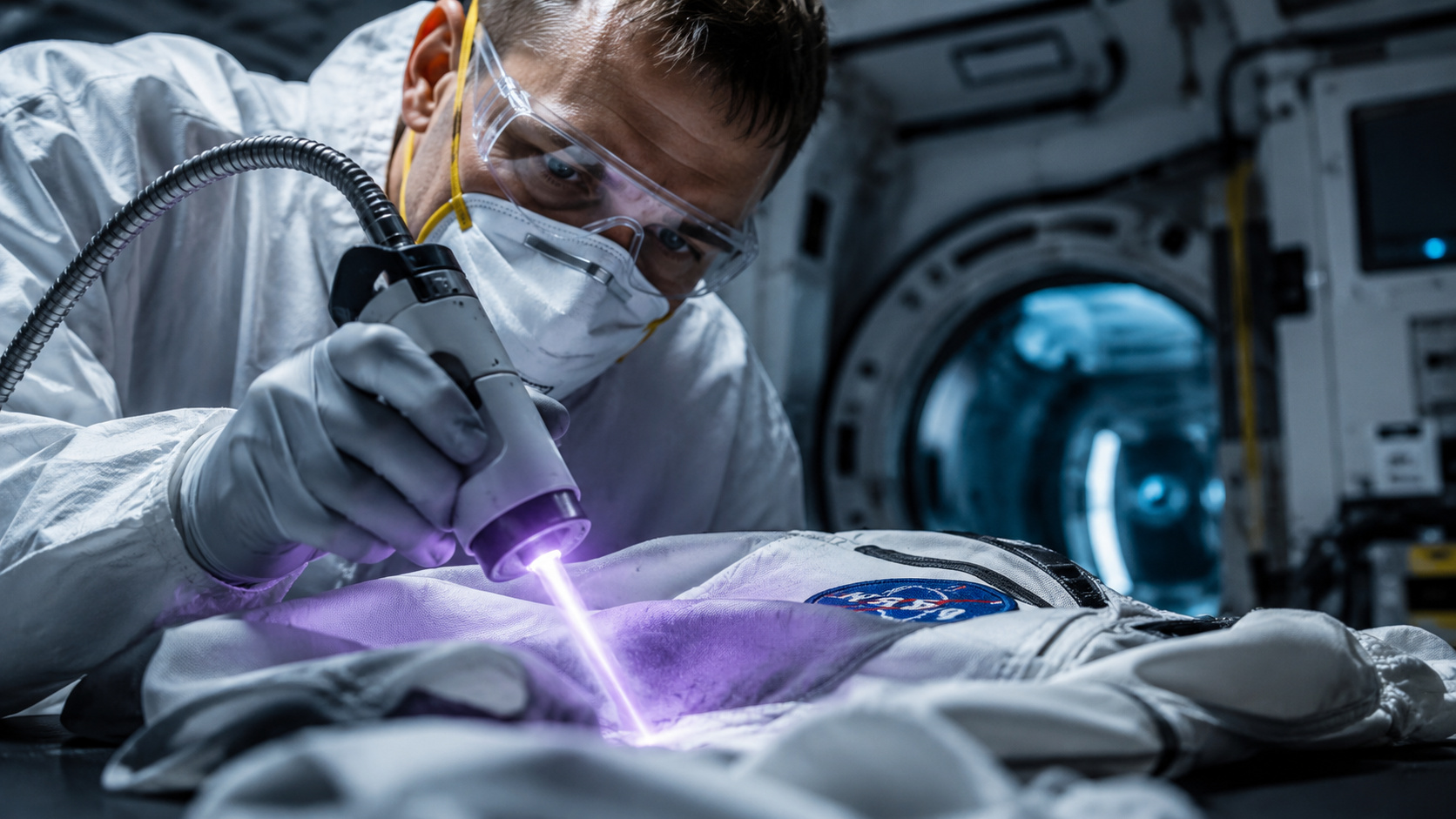
To evaluate the efficiency of the technology, researchers used pieces of cotton t-shirts contaminated with Staphylococcus caprae, a common skin bacterium that has been identified on the ISS.
The fabrics were exposed to a portable device capable of emitting plasma rays through a thin, purplish beam.
The tests lasted between 30 seconds and 5 minutes, enough time to significantly reduce the bacterial presence in the analyzed samples.
According to the researchers, the method performed better than some cleaning techniques currently used in space environments.
Besides efficiency, the equipment is notable for its compact size, similar to a cell phone, an important feature for applications in interplanetary missions.
How space plasma eliminates bacteria without using water
Plasma is considered the fourth state of matter. It occurs when a gas receives enough energy for its particles to become electrically charged.
During the cleaning process, space plasma produces reactive oxygen and nitrogen species. These substances can penetrate the fabric fibers and directly attack bacterial cells.
The result is the destruction of microorganisms through a process known as oxidative stress.
One of the most important findings was that the cotton fabrics did not show significant damage after the tests. This indicates that the technology can be used repeatedly without compromising the durability of the clothes used by astronauts.
Space hygiene gains importance with increasingly longer missions
The need to improve space hygiene goes far beyond cleaning clothes.
In closed environments, bacteria and fungi can accumulate easily. This increases the risk of infections and can affect both the crew’s health and the functioning of sensitive equipment.
Even with strict protocols, the ISS has recorded high levels of microorganisms in seemingly clean areas, including:
- Handrails;
- Ventilation systems;
- Frequently used surfaces;
- Internal compartments.
These records reinforce the need to develop more efficient methods to control microbial proliferation during long-duration missions.
Scientists observe different behaviors of microbes in space
Various studies show that some microorganisms can behave differently under microgravity conditions.
In certain cases, bacteria may exhibit greater resistance or develop distinct characteristics compared to terrestrial environments.
This concern is one of the reasons why scientists consider space hygiene a priority for the coming decades.
Besides the impacts on human health, some microorganisms can also accelerate corrosion processes in metallic components, increasing the maintenance challenges of habitats and spacecraft.
The longer the astronauts remain away from Earth, the greater the need for efficient biological control systems.
Life on Mars will require sustainable solutions for daily life
Projects aimed at life on Mars involve much more than building resilient habitats.
Future inhabitants of the planet will need systems capable of maximizing resource reuse. Water, energy, and supplies will play a strategic role in human survival.
In this context, plasma rays emerge as a particularly interesting alternative because they require only electricity and a gas to operate.
Among the potential advantages of the technology are:
- Water savings;
- Reduction in chemical use;
- Lower waste generation;
- Prolonged reuse of clothes;
- Simple and portable operation.
These characteristics can transform the system into an essential tool for future human colonies.
Plasma rays can improve comfort and safety of astronauts
As space missions become longer, concerns about the quality of life of the crew also increase.
Plans for lunar bases and for life on Mars include more comfortable environments, with beds, cushioned seats, textile coverings, and other structures that facilitate human adaptation.
However, all these materials can encourage the accumulation of bacteria.
The use of space plasma can help keep these environments clean without the need for complex washing processes or the constant use of chemical substances.
For astronauts, this represents more safety, comfort, and operational efficiency throughout the mission.
The next step to make plasma rays a space routine
The study led by Professor Gabe Xu from the University of Alabama and microbiologist Chelsi Cassilly, a NASA planetary protection specialist, represents an important advancement for the space sector.
The team intends to expand the experiments to test the effectiveness of plasma rays against other species of microorganisms frequently found in environments inhabited by humans.
The researchers also want to evaluate the behavior of different fabrics and materials when subjected to repeated treatments.
If the results continue to be positive, the technology could be integrated into the infrastructure of future lunar bases and missions aimed at life on Mars.
More than just a solution for cleaning clothes, the system could become a fundamental element to ensure space hygiene, reduce resource consumption, and support sustainable human permanence beyond Earth.