Portuguese
  Spanish


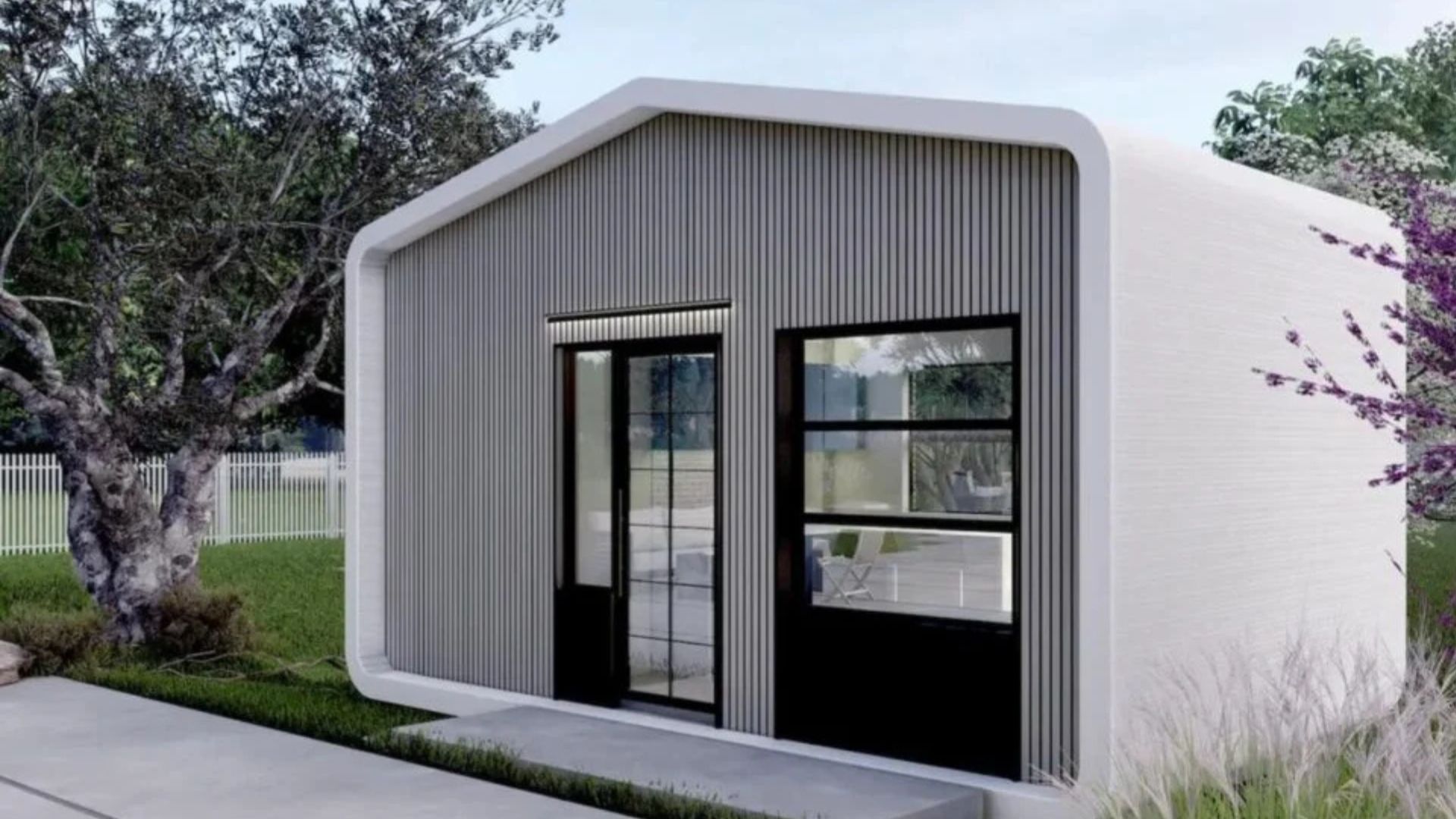

Startup prints houses with recycled plastic in about 1 day and promises ready units in up to 15 days in the USA.
In the United States, modular construction with 3D printing has gained new attention with Azure Printed Homes, a company based in Gardena, California, which claims to produce robotic residential structures with recycled plastic in about one day. According to the company’s official page, the process involves printing the unit in approximately 24 hours, followed by interior finishing, electrical, and plumbing in a period of 4 to 15 days, depending on the chosen configuration.
The model deviates from the traditional construction logic by replacing the conventional construction site with controlled industrial manufacturing. Instead of building walls brick by brick on-site, Azure prints pre-fabricated modules with recycled materials, aimed at studios, tiny houses, and ADUs, the accessory dwelling units common in the North American market.
On August 21, 2022, Business Insider highlighted that the company was working with models ranging from small studios to ADUs of up to 900 square feet, while Azure itself claims that its structures can be produced 70% faster than traditional methods.
-
Key Infrastructure Projects for Brazil’s Next President: Expanding Railways to Cut Transport Costs, Reduce Truck Traffic, Create Jobs, and Boost Industries Nationwide

-
While China Builds Undersea Rail and Mexico Connects Two Oceans, Brazil Struggles with Grain Transport Due to Lack of Railways

-
Students Build Kansas’ First Hemp-Insulated Social House for a Needy Family: 85% Less Concrete, Solar Roof Returns Energy to Grid, Carbon Negative in Under 20 Years

-
China to Drill 90 Kilometers Under the Sea to Connect Two Cities Currently Linked Only by Ferry


Azure bets on 3D printing to drastically accelerate the construction of compact houses
Azure’s proposal was born precisely from the attempt to reduce time, waste, and complexity of traditional construction.
While conventional constructions can take months between foundation, masonry, finishing, and installations, the startup uses industrial robotic arms capable of printing the main structures of the units at a much faster pace.


According to the company, some basic structures can be printed in approximately one day, something practically impossible within the traditional construction logic.
3D printed houses use recycled plastic as part of the raw material
One of the most striking aspects of the project is precisely the use of recycled materials. Azure claims to use repurposed plastic in the manufacturing of the printed structures. The goal is to transform waste that could end up in landfills or the environment into part of a new modular construction chain.

Besides the environmental factor, the company also focuses on reducing waste during the production of the units. In traditional construction, much of the work happens directly on the client’s site. This involves masons, concrete mixing, constant transportation of materials, and long execution periods.
In Azure’s model, much of the construction takes place inside a factory. The structural printing is done in a controlled environment, followed by internal installations and finishing.
When the unit arrives at its final destination, much of the work is already done, reducing on-site installation time.
Company states that complete finishing can be done in up to 15 days
Although structural printing is extremely fast, the project still requires complementary steps. According to the startup, the period between printing, internal installations, finishing, and unit preparation can vary between four and fifteen days depending on the chosen model.

This period includes electrical, plumbing, internal coatings, windows, doors, and final preparation for delivery. Azure is not alone in this sector. In recent years, several companies have started exploring 3D printing applied to residential construction.
Much of this growth occurs around so-called ADUs (“Accessory Dwelling Units”), small houses installed in backyards, compact lots, or high-density urban areas.
In the United States, this type of housing has gained ground due to rising property prices and the housing crisis in several cities.
Units can function as housing, office, or guest house
The structures produced by Azure are not limited to main houses. The company also offers models aimed at external offices, compact studios, small temporary residences, and auxiliary units installed on already occupied lots.
This greatly expands the potential audience for 3D printed constructions. Conventional civil construction usually generates a huge amount of waste.
Concrete leftovers, broken bricks, discarded wood, and packaging are part of the traditional construction process. Automated systems try to reduce some of these losses by producing structures more precisely.
In the case of Azure, the use of recycled plastic itself reinforces the discourse of reducing environmental impact.
Factory-printed houses also avoid delays caused by weather
Another important factor for this type of construction is the controlled production environment. Traditional constructions often suffer delays caused by rain, wind, extreme heat, or logistical problems on site.
By manufacturing a large part of the structure in a closed industrial environment, companies like Azure can reduce some of these interruptions. The expansion of tiny houses and compact units is also linked to the increase in real estate costs.

In many American cities, buying a traditional house has become financially unfeasible for part of the population. This opened space for smaller models, quicker to install and potentially cheaper. 3D printed houses began to emerge precisely in this scenario.
Transporting the units requires specific logistical planning
Even though they are compact, the structures produced by Azure still need to be transported to the client’s site.
This requires planning involving special trucks, access to the installation site, and proper preparation of the base where the unit will be positioned.
Depending on the project, logistics can become one of the most complex stages of the operation. Despite the sector’s growth, 3D printed houses still face significant limitations.
Each region has its own construction, licensing, and structural safety rules. Moreover, many cities still do not have specific regulations fully adapted for this type of technology.
This means that part of the sector’s growth also depends on the evolution of urban planning norms and regulatory acceptance.
Automation tries to change a historically slow and manual industry
The construction industry remains one of the least automated industries on the planet. A large part of the construction still heavily relies on manual labor, long schedules, and a large number of professionals on site.
Companies like Azure are betting precisely on the idea of transforming part of this process into an industrial production line closer to the automotive sector.
3D printed houses show how recycled plastic can gain a completely different function
The most impressive aspect may be precisely the transformation of the material used. Discarded plastic, normally associated with urban waste and environmental pollution, becomes part of housing structures produced by industrial robots.
This creates an unusual combination of recycling, automation, and residential construction. The company’s proposal shows how the real estate sector is beginning to experience profound technological changes.
Instead of relying exclusively on bricks, mortar, and months of manual labor, American startups have started betting on 3D printing, industrial manufacturing, and accelerated assembly.
In the end, Azure represents an attempt to transform houses into products manufactured almost like industrial vehicles, using robots, recycled plastic, and automated processes to accelerate an industry that has evolved slowly for decades.