






 Portuguese
  Spanish


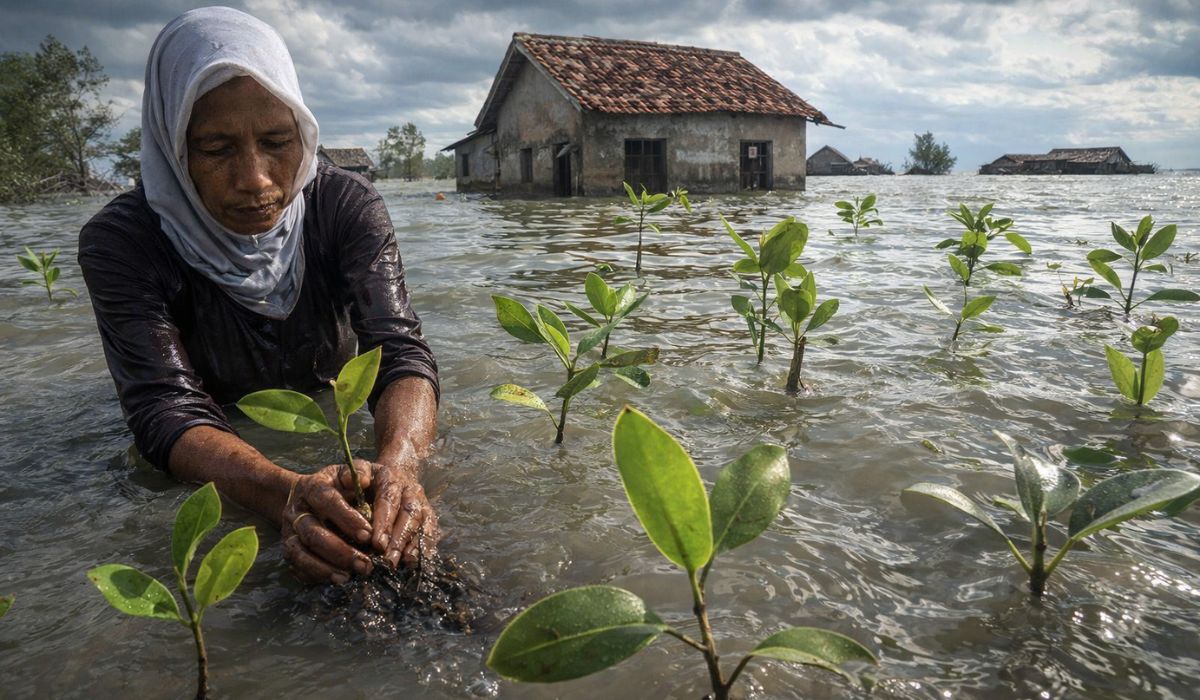

On the north coast of Java, a routine surrounded by water, roots, and isolation exposes an environmental phenomenon that has been advancing for years and transforming the landscape, housing, and the relationship between land and sea in the same scenario.
On the north coast of Java, in Indonesia, the routine of Pasijah has come to synthesize, on a domestic scale, an environmental problem that affects different areas of the country.
At 55 years old, she continues to live in Rejosari Senik, in the regency of Demak, in Central Java, where the water has advanced over the former inhabited area and left her house as the only one still occupied in that part of the village.
For about two decades, she has responded to the advance of the sea by planting approximately 15,000 mangrove seedlings per year.
-
Billionaire says the most valuable skill will help overcome job elimination caused by AI, following Bill Gates’ fears

-
A Dutchman created a ‘box’ that makes trees grow in the desert almost without water and without irrigation: the invention has already brought seedlings to dozens of countries and achieves up to 90% survival where common planting did not exceed 10%.

-
Abandoned warehouse hid a giant collection of rare computers, with over 2,000 artifacts from the 1930s to the 1980s.
-
Scientists warn that melting ice is triggering an alarming chemical transformation in preserved areas, and the first signs are already concerning researchers worldwide.




The case was reported by Reuters from the Demak region.
According to the report, the water now covers the area that was once dry land, and Pasijah’s house remains surrounded by makeshift rows of bamboo and by structures damaged by the advance of the sea.
Inside the property, the floor has been raised to reduce the effects of frequent flooding.
The distance also shows the degree of isolation.
According to Reuters, the nearest piece of dry land is about two kilometers away, while the city of Demak is 19 kilometers away.
The journey can only be made by boat, which has become the family’s main means of transportation.
Despite the departure of neighbors, Pasijah decided to stay.
In a statement to Reuters, she said she intended to remain in the location and that she maintained her connection to the house where she has lived for 35 years.
Around her, former farmland, gardens, and rice fields have been abandoned as the water advanced over the community.

What mangroves do at the seaside
The strategy adopted by Pasijah is based on studies about coastal protection.
Mangroves help reduce wave force, contribute to preventing erosion, and stabilize the soil through their roots.
International organizations such as the FAO and agencies linked to the UN point to these ecosystems as part of the so-called nature-based solutions for coastal areas exposed to flooding and storm surges.
In addition to their function as a natural barrier, mangroves also have climate relevance.
These environments store large amounts of carbon and provide shelter for marine and coastal species, which enhances their environmental role.
In the case of Indonesia, public data indicates that the country has one of the largest areas of mangroves on the planet, making this ecosystem especially important in adaptation and conservation policies.
In Pasijah’s daily life, however, this function appears in a practical way.
Every day, she goes out in an improvised boat made of blue plastic drums, observes the already planted shrubs, and places new seedlings in the water, which in some places reaches chest height.
To Reuters, she reported that the flooding did not come all at once, but in successive waves, and said she realized that mangroves could help protect her home from the wind and waves.
Why the sea advances in this part of Java
The advance of water on the northern coast of Java is not explained by a single factor.
On one hand, there is the rise in sea level.
On the other hand, experts also point to subsidence, which is the gradual sinking of the ground, as a central part of the problem in various areas of the island.
According to data cited by Reuters based on Indonesia’s meteorological and geophysical agency, the sea level along the country’s coasts has risen, on average, 4.25 millimeters per year between 1992 and 2024.

The same source reported that this rate has accelerated in recent years.
According to the agency, this movement is associated with climate change and has already contributed to the disappearance of small islands in the archipelago.
At the same time, authorities and researchers draw attention to the effect of groundwater extraction in sections of the coast of Java.
This pumping intensifies subsidence and exacerbates the impact of tides and coastal flooding.
In urban and rural areas, the combination of sinking land and rising sea increases the risk of permanent flooding.
A study released in 2026 by the Columbia Climate School, based on an article published in the journal Science Advances, reinforced this diagnosis for northern Java.
According to the researchers, in much of the island’s coastline, the sinking of the land has a greater impact than the rise of the ocean in increasing coastal risk.
The analysis cites Demak among the regions where subsidence appears as a relevant factor for the relative rise in sea level.

Between Containment Works and Natural Protection
The public response in Indonesia includes large-scale projects.
The Indonesian government has once again advocated for the construction of a marine dike approximately 700 kilometers along the northern coast of Java, between Banten and East Java.
The proposal was presented as an attempt to reduce the damage caused by coastal flooding and the encroachment of the sea in cities and villages in the region.
Meanwhile, Pasijah’s experience shows a local response based on the restoration of the coastal ecosystem.
The continuous planting of mangroves does not, by itself, eliminate the combined effects of rising sea levels and subsidence.
Still, according to experts studying coastal adaptation, this type of vegetation can help mitigate impacts, reduce erosion, and preserve vulnerable areas for longer.
Pasijah’s family continues to live off the fish caught by her children, sold at the nearest market.

According to Reuters, they state that they intend to stay in the area as long as it is still possible to contain the advance of the water.
The case brings together, in the same space, themes that usually appear separately in the climate debate: adaptation, territorial loss, coastal protection, and the use of natural solutions in areas where larger works are still insufficient or have not yet arrived.
In Rejosari Senik, the presence of the last occupied house in that stretch of the village shows how the transformation of the landscape has already altered daily life, access to territory, and the relationship between housing and the coastal environment.
In this scenario, the annual planting of thousands of mangrove seedlings has ceased to be merely an environmental recovery activity and has become part of the concrete effort to maintain the family’s presence in an area that today coexists directly with water.





