






 Portuguese
  Spanish
  7 min of reading
  0 comments


In northwest China, a mega environmental operation aims to contain moving dunes, protect roads, and maintain living vegetation in an extreme region, using irrigation, solar energy, soil fixation techniques, and decades of planning against desertification.
Imagine a road cutting through a sea of sand, with dunes trying to swallow the asphalt from all sides. Now imagine rows of vegetation, water pumps, solar panels, and even straw buried in the ground trying to hold back this advance. It sounds like a science fiction scene, but it’s exactly the kind of battle China has been fighting for decades in the Taklamakan Desert.
Located in Xinjiang, in the northwest of the country, the Taklamakan is one of those places where nature seems to play on the hardest mode. It gets extremely hot in the summer, very cold in the winter, it hardly ever rains, and sandstorms can change the landscape in a short time.
Even so, China decided to tackle the problem with a gigantic idea: to create a green belt around the desert to prevent the sand from advancing uncontrollably over roads, villages, plantations, pipelines, and strategic areas.
-
Researchers manage to stabilize ammonia combustion in engines and present an advancement that could reduce emissions in strategic sectors, creating a promising energy alternative for ships, power plants, and heavy vehicles in the coming decades.

-
Martian meteorite reveals unexpected surprise about the history of the red planet

-
New Realme phones have a giant battery of up to 7,500 mAh, military-grade durability, Android 16, and an affordable price; meet the P4x and P4 Lite.

-
For the first time, researchers find the fuel of the first stars in galaxies formed only 700 million years after the Big Bang.

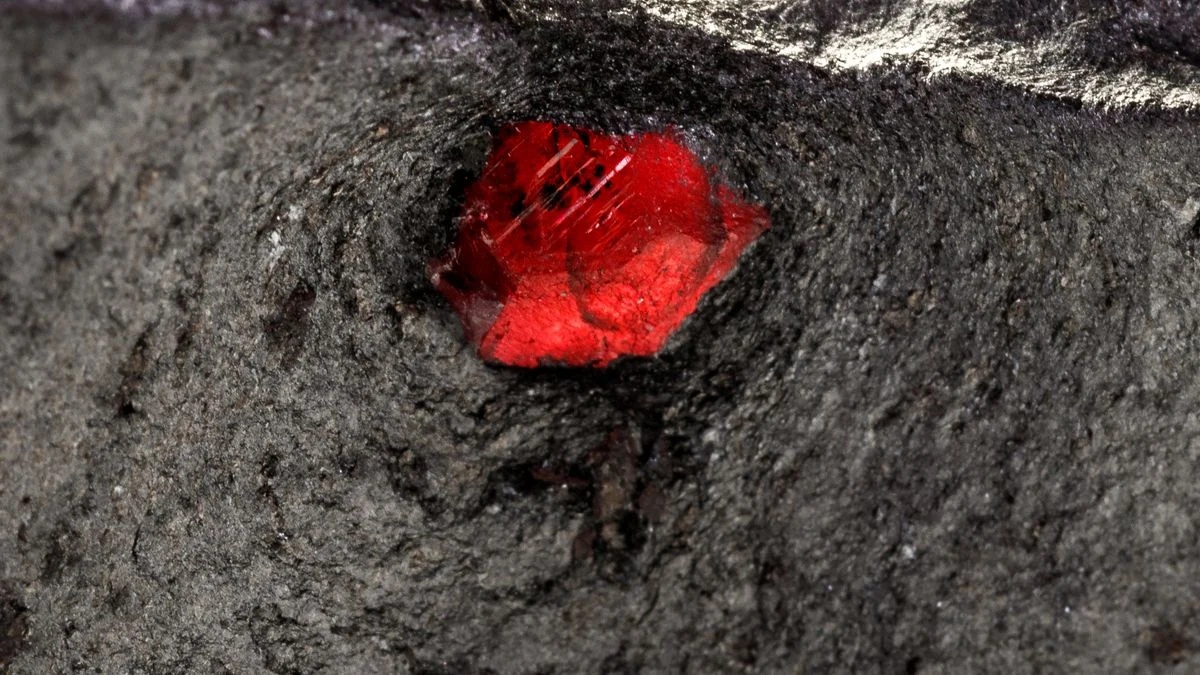


According to Reuters, the country completed a green belt of approximately 3,000 kilometers around the Taklamakan in November 2024. The work is part of a campaign started back in 1978, under the program known as the Three-North Shelterbelt, often called China’s “Great Green Wall.”
It’s not a magical forest, it’s a war against the sand
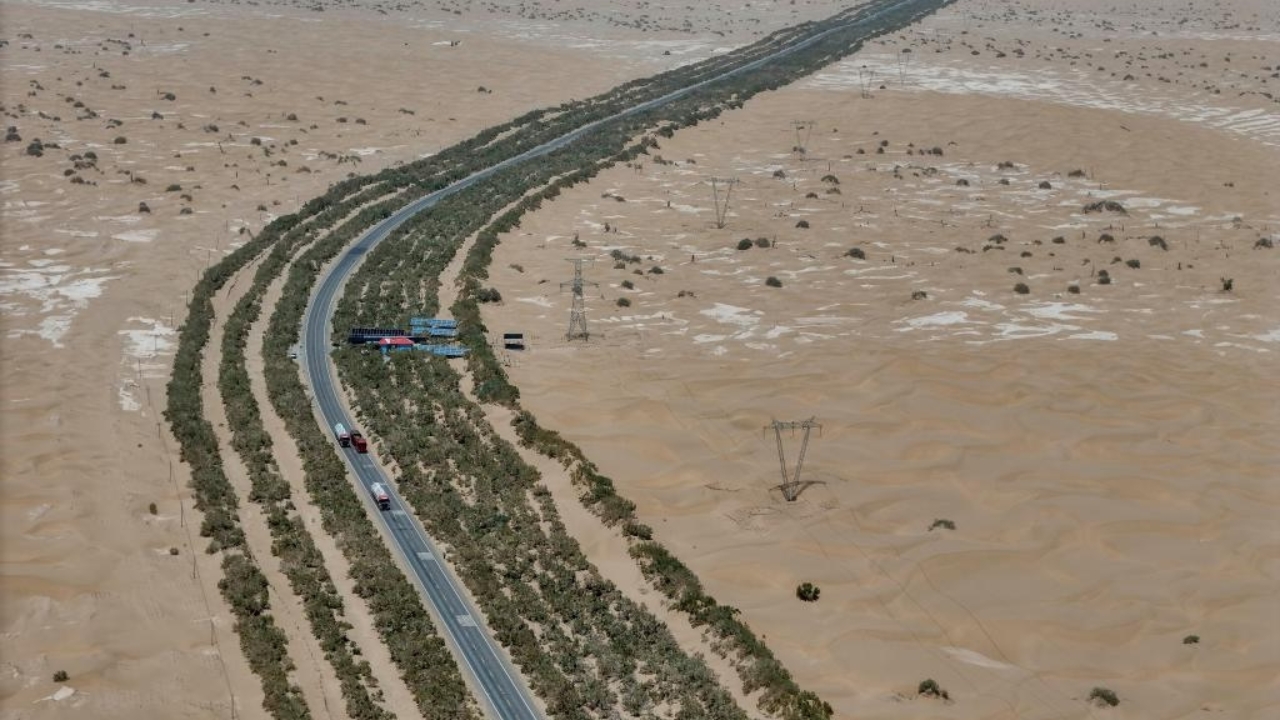
When people talk about “greening the desert,” many imagine a miraculous transformation: dunes disappearing and trees taking over everything. But the reality is quite different.
China’s goal is not to turn the Taklamakan into a tropical forest. What the country is trying to do is much more technical and strategic: hold the sand in the most dangerous spots, reduce dust storms, and protect costly infrastructure works.
The desert is still there. The dunes still exist. The difference is that, in some edges and corridors, the vegetation acts as a living barrier against the wind.
This barrier helps to slow down the sand, create more stable zones, and reduce the risk of roads and facilities being buried. In a region where the wind can move tons of sand over time, any well-planned obstacle already makes a difference.
The most curious technique uses straw as a shield
One of the most interesting parts of the project is also one of the simplest: straw.
In various areas, workers partially bury bundles of straw in the sand, forming squares similar to a chessboard. This technique creates small barriers on the ground and reduces the wind’s force very close to the surface.
It seems too simple to work, but it is precisely this simplicity that makes the method so efficient. The straw holds part of the sand, reduces the movement of dunes, and creates a minimal condition for shrubs and seedlings to take root.
Over time, the straw also helps to retain some moisture and organic matter in the surface layer. In other words, before planting, China first tries to stop the sand from escaping.
It’s like preparing the ground in a place where the ground practically doesn’t want to exist.
The road that became a laboratory in the middle of the desert
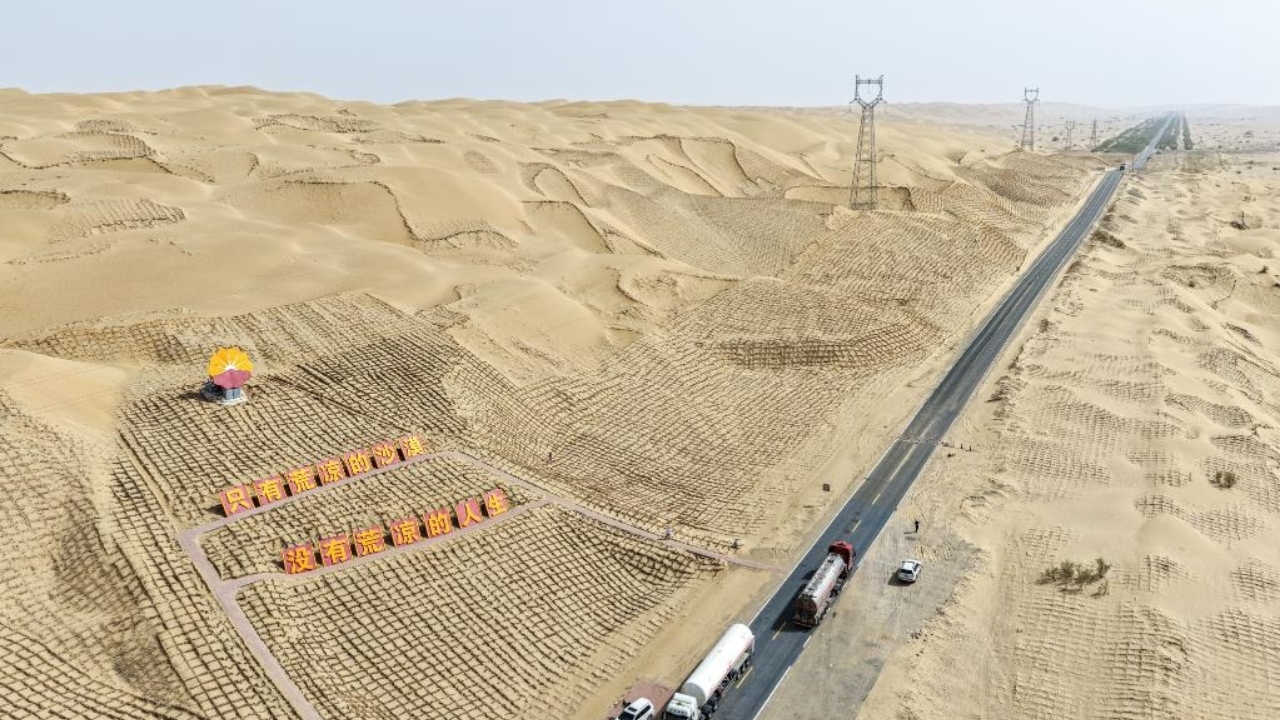
One of the most famous points of this story is the highway that crosses the Taklamakan, connecting regions to the north and south of the Tarim Basin. The road was built in the 1990s to shorten distances and facilitate transportation in an area important to the local economy.
But there was an obvious problem: a road in the middle of a desert of shifting dunes can simply be swallowed.
Therefore, China created a green corridor along the route. A study published in the journal Frontiers in Environmental Science describes the system as a protection belt of approximately 436 kilometers, developed to defend the highway and nearby facilities against the impacts of wind and sand.
This green corridor is not there to beautify the landscape. It reduces the accumulation of sand on the asphalt, helps lower maintenance costs, and creates a kind of “buffer zone” between the road and the desert.
In practice, it is a living engineering work: instead of concrete and steel, it uses plants, water, prepared soil, and constant maintenance.
Solar panels help irrigate trees in the midst of aridity
Planting in the Taklamakan is already difficult. Keeping the plants alive is even more complicated.
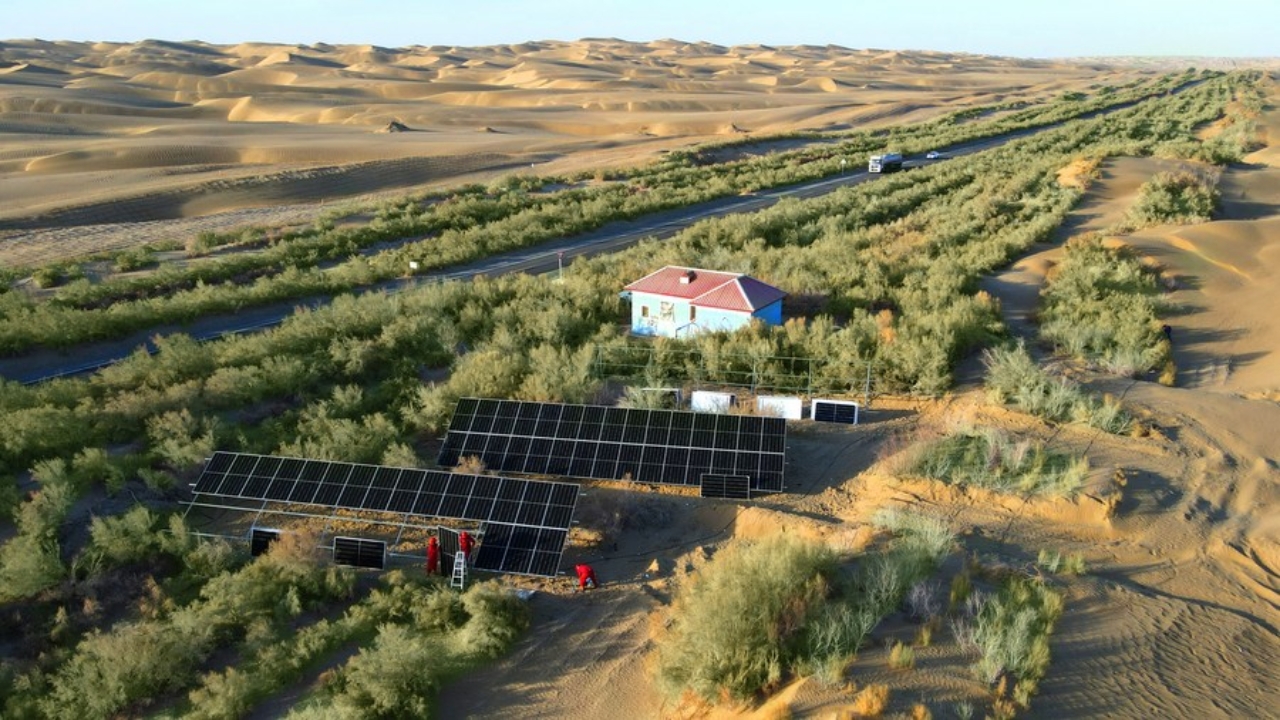
Therefore, the project relies on irrigation. In some sections, wells capture underground water and drip systems deliver small amounts directly to the roots. This technique avoids waste, which is essential in a region where evaporation is very high.
There are also sections where solar panels help power water pumps. The logic is simple: if the desert has plenty of sun, it makes sense to use this energy to keep part of the system running.
But here comes an important point. Not all systems work the same way. Some sections use solar energy, others may rely on conventional electricity or older structures. The project is large, old, and has been expanded in different phases.
And there is a real concern: underground water is not infinite. Researchers warn that continuous use needs to be monitored to prevent soil salinization and a drop in the water table.
In other words, technology helps, but it doesn’t solve everything on its own.
And the famous molten salt at over 500 °C?
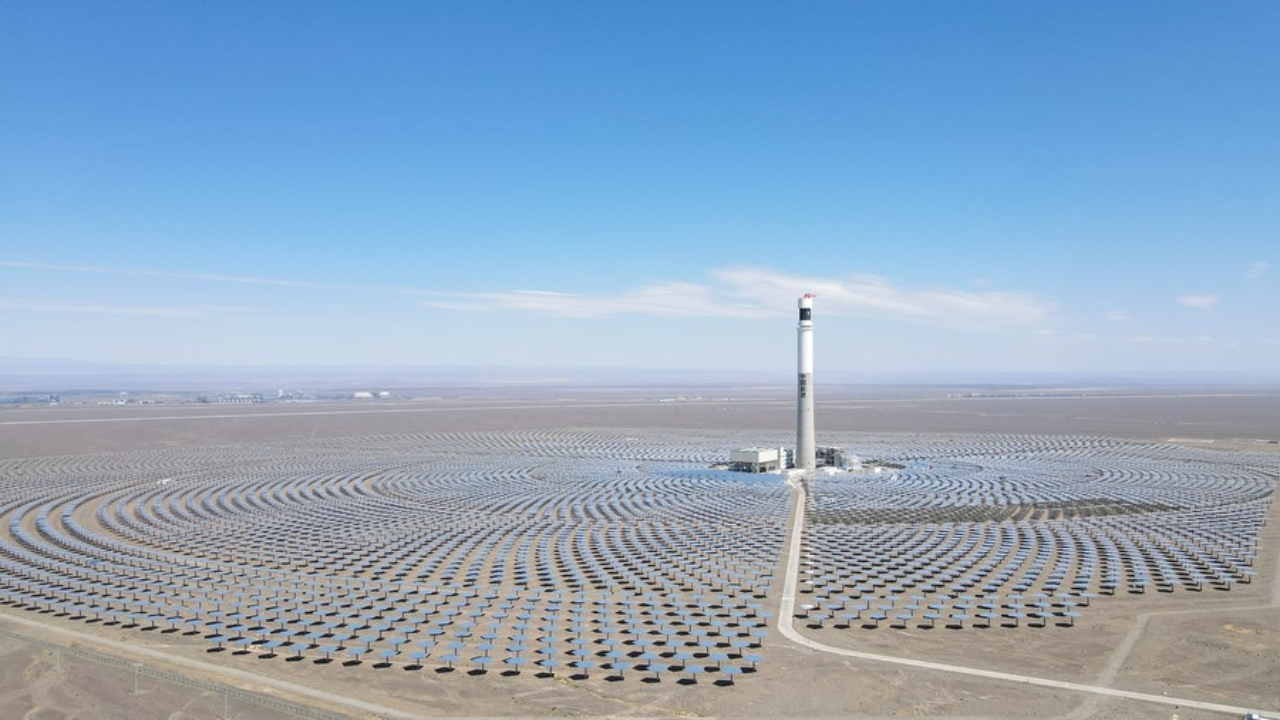
Many videos and texts on the subject mix the green belt of the Taklamakan with solar thermal plants that use giant mirrors and molten salt heated to over 500 °C.
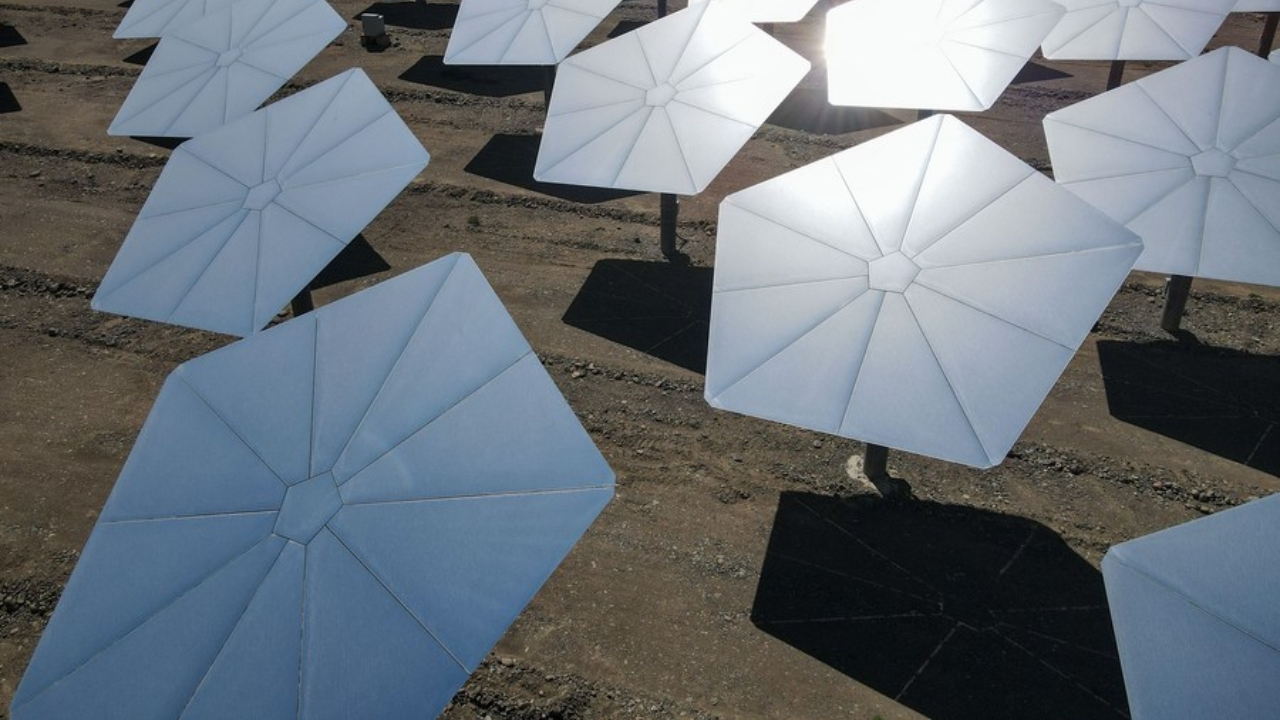
This technology truly exists in northwest China, especially in Xinjiang. SolarPACES, an international base for concentrated solar power projects, records the CEEC Hami project, a solar thermal tower plant with a capacity of 50 MW.
In this type of plant, mirrors direct sunlight to a central tower. The heat warms special salts, which store thermal energy and allow electricity generation even when the Sun is no longer strong.
It’s an impressive technology. But it’s necessary to separate the stories.
There is no solid public confirmation that this molten salt plant is directly linked to the irrigation of the Taklamakan highway green belt. What exists is a regional and technological coincidence: Xinjiang has both large projects against desertification and major investments in solar energy.
So, the most accurate way to tell it is this: solar energy appears in the fight against desertification through pumping systems and also appears in the region in energy megaprojects. But molten salt belongs to another front, linked to large-scale electricity generation.
The impressive side and the delicate side of the project
The idea of surrounding a desert with vegetation is powerful. Visually, it’s almost impossible not to draw attention. But this type of project also raises difficult questions.
How much water will be needed to keep all this alive? Can the soil become too salty over time? Will the planted species withstand pests, prolonged droughts, and extreme weather events? Will the maintenance cost outweigh the benefits?
These doubts do not diminish the size of the project. On the contrary, they show that the Chinese project is more complex than it seems.
It’s not just about planting trees. It’s about maintaining an artificial system functioning in one of the harshest environments on Earth.
China has not defeated the desert, but managed to slow it down
The Taklamakan green belt draws attention because it seems like a human attempt to negotiate with a gigantic natural force. On one side, dunes, wind, extreme heat, and drought. On the other, straw, roots, pumps, solar panels, and decades of planning.
China has not ended the desert. Nor has it transformed the Taklamakan into an ordinary forest. What it has done is create barriers to prevent the sand from advancing uncontrollably over strategic areas.
And perhaps that is precisely what makes the story so impressive.
Instead of selling the idea of a total victory against nature, the project shows something more realistic: in certain places on the planet, survival is already engineering. And keeping trees alive in the middle of a desert like the Taklamakan is a daily battle against the wind, thirst, and time.




Be the first to react!