Portuguese
  Spanish


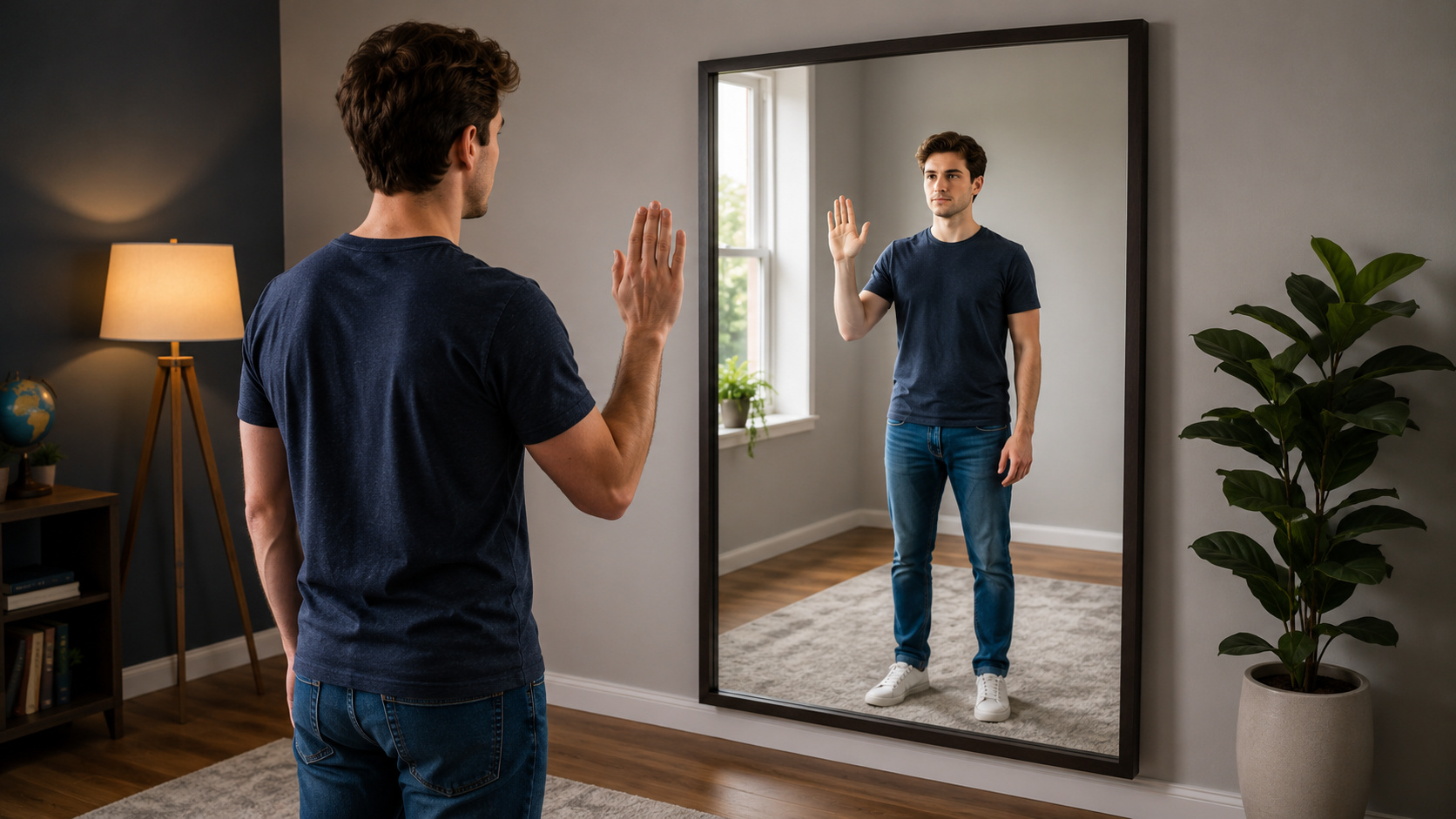

The mirror does not swap left and right: it inverts depth, preserves up and down, and creates an illusion that deceives the brain.
You look at the mirror every day and probably believe it does one simple thing: swaps your left for your right. But this explanation, repeated for generations, is incomplete. According to physicist Christopher S. Baird, associate professor at West Texas A&M University, in an explanation published on January 5, 2013, a plane mirror does not invert left and right. It preserves the sides but swaps the direction of depth.
What happens is stranger than it seems. According to geometric optics, the image appears behind the reflective surface and obeys the law of reflection: what was in front of the object appears as if it were at the back of the image. The Physics Classroom also explains that the image in a plane mirror is virtual, sits behind the mirror, and appears at the same distance as the real object is in front of it. In other words, the mirror does not swap left and right. It swaps front and back, and the brain turns this inversion into a daily illusion.
The paradox begins because the mirror seems to do something it never did
The confusion arises in front of your own face. You raise your right hand and see the “person” in the mirror raise the hand that seems to be on their left side. The brain immediately concludes: the mirror inverted the sides. But this conclusion only seems correct because you interpret the reflection as if it were another person standing in front of you.
-
Oceanographer Turns Abandoned Fishing Nets from Brazilian Waters into Bags, Creating Jobs and Earning Over $7,000 Monthly

-
Australia deploys poisoned sausages and uses traps, shooting, and fences in a battle against invasive cats that kill over 1.5 billion native animals annually, threatening more than 200 species.

-
NASA Rover Captures “Tired Face” on Mars, Highlighting Human Brain’s Tendency to See Faces in Rock Formations

-
Ancient Stone City in the Desert, Once Home to 30,000, Puzzles Scientists with Nabateans’ Water Mastery 2,000 Years Ago





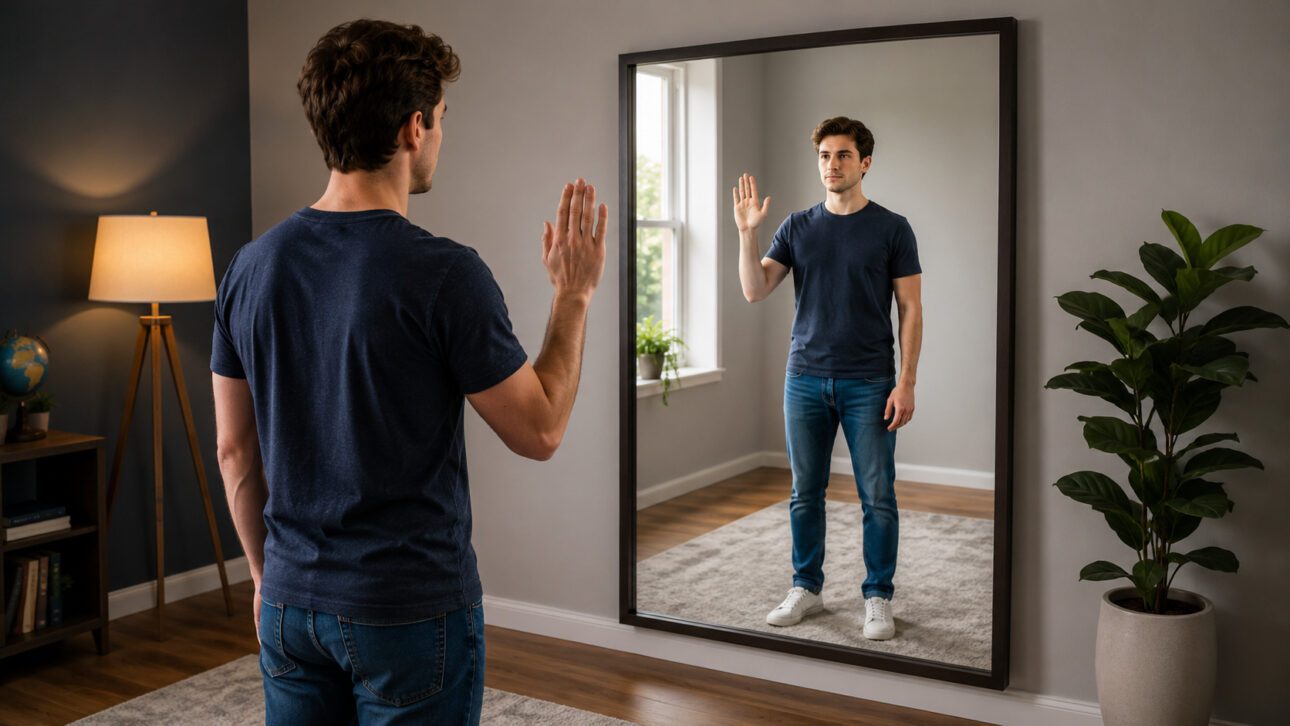
Physically, none of this happened. The right side of your body continues to appear on the right side of the image in the mirror. The top remains top, the bottom remains bottom, and the side was not scrambled. What changed was the depth orientation: what was pointing to the mirror now points back to you.
That’s why words appear “backwards” when reflected. Not because the mirror rotated the letters from left to right, but because the face of the sheet was turned relative to the direction of observation. The mirror returns a symmetrical image relative to the reflective plane, and the brain transforms this symmetry into a false lateral inversion.
The mirror doesn’t turn you upside down because it isn’t rotating your body
If the mirror really inverted left and right, the inevitable question would be: why doesn’t it invert up and down as well? The answer is simple and unsettling: because it isn’t inverting either of these two axes. It just reflects light relative to its surface.


Each point of your body forms an image behind the mirror, at the same distance as it is in front of it. Your eye interprets the reflected rays as if they were coming from behind the surface. This virtual image preserves the vertical and horizontal spatial relationships but swaps the front-back direction.
The illusion only appears because we imagine the person in the mirror as someone who “turned” to face us. But this rotation never occurred. The reflection didn’t turn around. It is an optical reconstruction produced by light.
The real swap happens in depth, and that’s what tricks the brain
Think of a mask looking at the mirror. The nose, which in the real object points forward, appears in the image pointing out of the mirror, towards you. The back of the head, which would be behind, is inverted in relation to the reflective plane. This is the real swap: front and back.
This depth inversion is called in some explanations an inversion on the axis perpendicular to the mirror. The most important point is that the mirror has no preference for left, right, up, or down. It only “responds” to the direction of the light that reaches its surface.
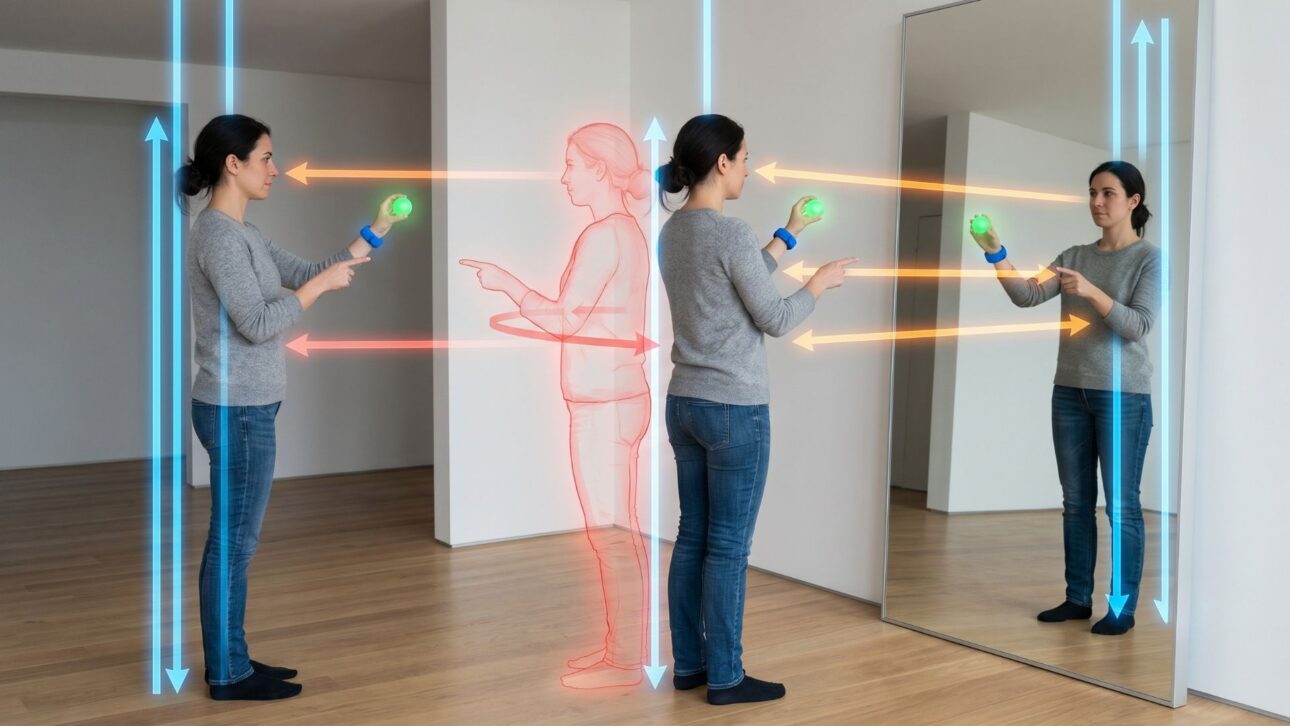
That’s why the phenomenon changes when the position of the mirror changes. A water mirror, for example, may seem to invert up and down because its surface is horizontal. The physical logic is the same. What changes is the axis perpendicular to the reflective surface.
The mental trick is to imagine someone on the other side of the glass
The big mistake is comparing your reflected image with a real person standing in front of you. For a real person to face you, they need to turn their body. When turning, their right hand appears on the left side of your visual field. It’s this comparison that creates the sensation of lateral inversion.
But the reflection is not a person who walked behind the mirror and turned their body. It is a virtual image formed by the trajectory of light. The brain, accustomed to interpreting faces and bodies in real space, completes the scene intuitively and misleadingly.

This is why the paradox seems so strong. Physics is doing a simple thing, but human perception is telling another story.
A common object reveals one of the most elegant illusions of everyday physics
The mirror is so familiar that it seems impossible that it still hides a conceptual trick. But that’s precisely why the question remains fascinating. It shows how simple phenomena can reveal the difference between what light does and what the brain thinks it is seeing.
The mirror does not turn the world sideways. It does not choose left and right. It does not preserve up and down by preference. It merely creates a symmetrical image in relation to its surface, inverting the depth of the scene.
The next time you look at the reflection, the most curious thing will not be your image. It will be realizing that the mirror never deceived you. It was the brain that did it, every day, in front of one of humanity’s oldest and most common technologies.