






 Portuguese
  Spanish


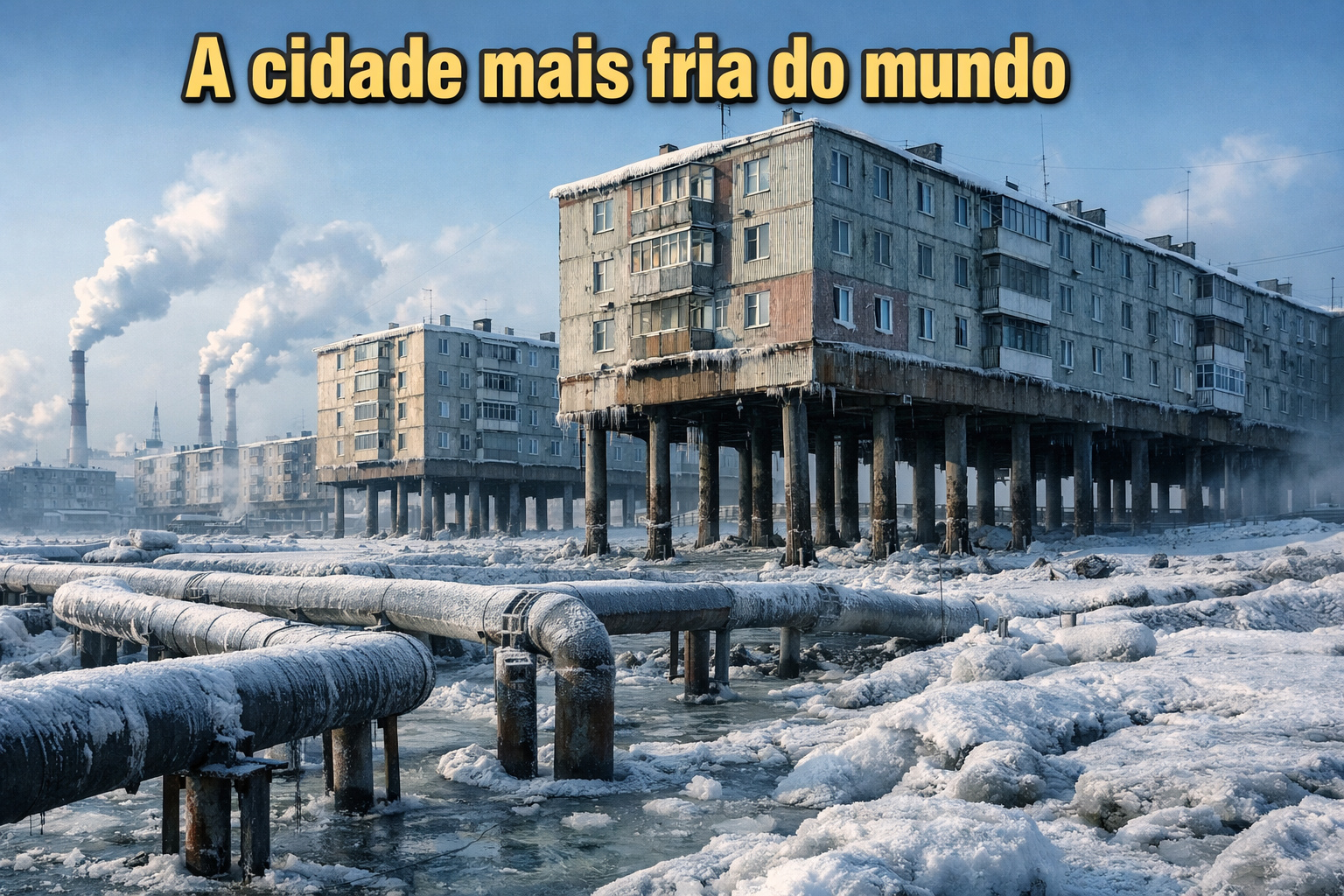


In Yakutsk, Russia, Buildings Are Built on Deep Piles to Avoid Heating the Soil; the Permafrost Never Thaws and All Urban Engineering Depends on Elevated Foundations.
In many cities around the world, the challenge of construction lies in the type of soil, the presence of water, or seismic activity. Here, the problem is even more basic: the ground cannot heat up. Any increase in soil temperature can cause irreversible deformations, compromising entire foundations.
This city was built on permanent permafrost, a type of soil that has been frozen continuously for thousands of years. If this soil thaws, it loses strength, becomes unstable, and can cause the collapse of entire buildings.
The Location: Yakutsk, the Largest City Built on Continuous Permafrost
The city is Yakutsk, the capital of the Republic of Sakha (Yakutia) in the far east of Russia. It is considered the largest city in the world built entirely on continuous permafrost, with a population of over 300,000 inhabitants.
-
Newly Completed Brazilian Highway in the Serra da Rocinha Becomes a 16.5 km Cycling Challenge and Boost for Local Tourism

-
Innovative Mortar Technique Enhances Porcelain Tile Stability, Reduces Buckling and Detachment Risks, and Provides Durable Finish Under Heavy Use

-
Giant Robots Build Entire Neighborhood of 100 3D-Printed Homes in the U.S., Showcasing Technology’s Impact on Construction Industry
-
Helsinki Residents Receive Water That Travels 120 Kilometers Through a Hidden Rock Tunnel from a Lake Before Treatment





During winter, temperatures frequently drop below −40 °C, and the ground remains frozen all year round, even in summer when only a thin surface layer of a few centimeters may soften.
Why Traditional Foundations Don’t Work
In conventional soils, buildings are supported by footings, blocks, or foundation slabs. In Yakutsk, this would be a serious mistake. The heat transmitted by a building directly to the ground would cause the permafrost to melt locally, creating uneven settling and structural failures.
Furthermore, the thawed soil begins to behave like saturated mud, unable to support high loads stably.
The Solution: Buildings Raised on Deep Piles
The local engineering adopted a radical and mandatory system: all buildings are constructed on deep piles driven into the frozen ground. These piles penetrate the most unstable surface layer and anchor into solid layers of deep permafrost.
The building does not touch the ground. Between the base of the construction and the ground is a free space that allows for the circulation of cold air throughout the year, preventing the heating of the frozen soil.
Permanent Ventilation as a Structural Element
This empty space beneath the buildings is not aesthetic or optional. It is part of the structural strategy. Natural ventilation keeps the permafrost cold and stable, preventing heat transfer from the building to the ground.
If this airflow is blocked—by snow accumulation, debris, or inappropriate interventions—the structural risk increases significantly.
Piles, Steel, and Concrete Designed for Extreme Cold
The piles used in Yakutsk are designed to withstand not only heavy loads but also extreme temperature variations. The concrete must resist intense cycles of freezing and thawing, while the steel must maintain ductility even at very low temperatures.
Additionally, driving the piles requires specific planning, as the frozen ground is extremely hard, necessitating adapted equipment and techniques.
Elevated Urban Infrastructure
It’s not just the buildings. Pipes, water, sewage, and heating networks also cannot be buried as in regular cities. Many of these networks are installed above ground, in elevated galleries or thermally protected structures.
Burying pipes would mean heating the permafrost and causing instability in the surrounding soil.
Roads and Sidewalks Also Face Permafrost
Urban paving is another challenge. Roads suffer from deformations caused by small movements of the frozen ground. Therefore, road maintenance is constant, and street projects take into account thermal expansion and the seasonal behavior of the permafrost.
Sidewalks, ramps, and access points need to be flexible enough to absorb variations without cracking.

When Engineering Depends on Cold
Unlike other cities, where cold is a problem, in Yakutsk, cold is part of the solution. The freezing of the ground is essential for urban stability. Any excessive heating represents a risk.
Therefore, climate change and gradual increases in average temperatures are observed with concern. The melting of permafrost could compromise decades of urban engineering.
A City That Only Exists Because Engineering Respected the Soil
Yakutsk does not try to dominate the environment—it adapts to it. The city exists because engineers accepted that the soil could not be treated like ordinary land and developed a specific construction model repeated in thousands of buildings. It is an extreme example of how civil engineering needs to mold itself to natural conditions, not the other way around.
Yakutsk represents one of the clearest limits of urban engineering on the planet. Each elevated building, each pile driven into the permafrost, is a reminder that the city remains standing only because the cold continues to exist. There, civil construction does not fight against nature. It depends on it.






E onde tem petróleo geralmente tem gás.
Sonho de consumo visitar esse local
Por que morar num lugar como esse? Motivação econômica? O quê é produzido lá?
Local riquíssimo em Petróleo.
Petróleo, diamante e urânio