Portuguese
  Spanish


In a video published on the Will Stelter channel on August 27 last year, the cutler visited the Fortress of San Martino, in Italy, a historical complex near Florence that brings together ancient military constructions, a millennial church, tunnels, marks of the Second World War, and an impressive collection of anvils and rare tools related to European metallurgy.
In a video published on August 27 last year on the Will Stelter channel, the cutler and American content creator visited a place unusual even for those accustomed to seeing workshops, ancient tools, and historical pieces: an Italian fortress with hundreds of anvils, giant vices, forge blocks, and preserved structures from different periods.
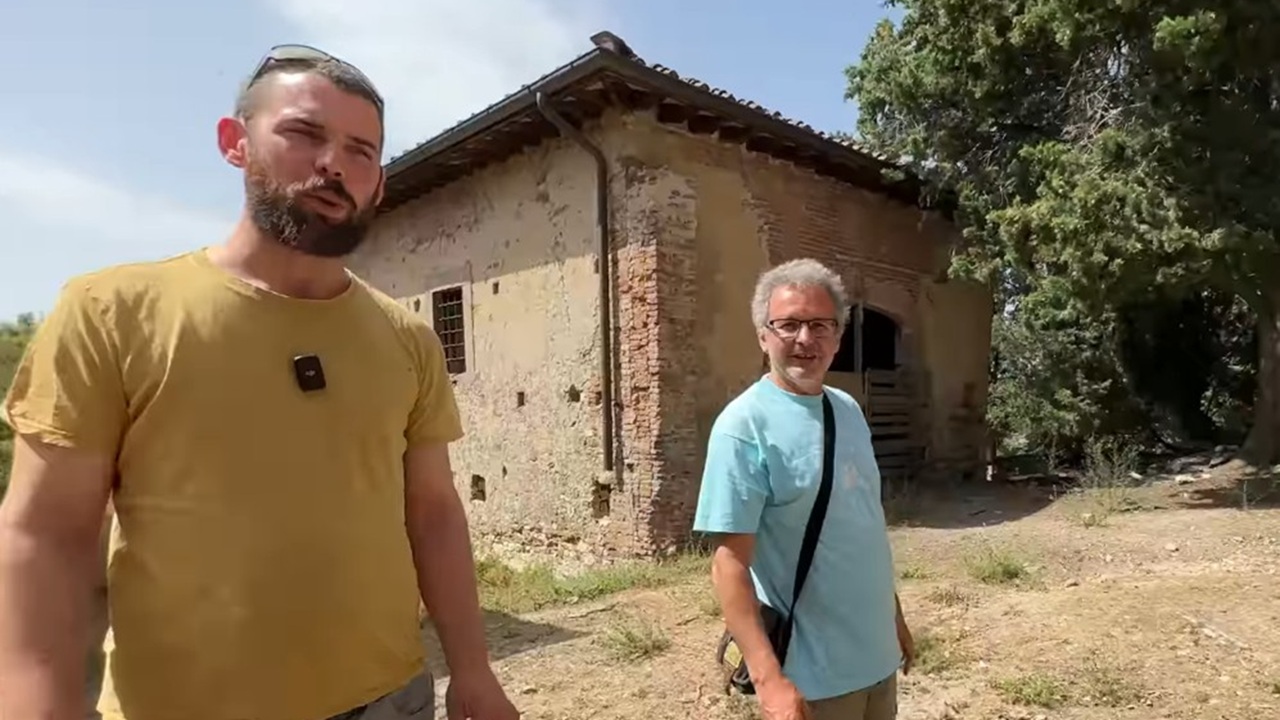
The visit was organized by Oliver Goldschmidt, a cutler who works near Florence, Italy. According to Will Stelter, he already knew he would see something special, but the experience turned out to be much more than just a private collection.
The place, described as the Fortress of San Martino, is located in a mountainous region and the access already indicates the strategic isolation of the construction: a difficult road, where a four-wheel-drive vehicle seems necessary.
-
Creative Uses for Toilet Paper Rolls That Will Change Your Perspective

-
Crab Trapped in Plastic Bottle for 62 Days Near Okinawa Highlights Little-Known Impact of Marine Pollution on Small Animals
-
Esperanza’s Bamboo Barrier in Oaxaca Redirects River and Reduces Erosion by 85% in Five Years

-
Family Builds Homemade Wind Turbine to Power Off-Grid Home, Video Reaches 555,000 Views on Ngô Thị Huyền’s Channel




The military construction that spanned centuries without being used in war
During the tour, the group explains that the fortress is over 400 years old and was built for military purposes, although it was never directly used in a war. Even so, its position was strategic. The location dominates an important passage towards Florence, serving as a control point for those coming from the north trying to reach the city.
The complex is enormous. In the video, it is mentioned that the internal area reaches about 20 acres, equivalent to just over 80,000 square meters. It is also said to be considered the largest fortress in Italy. Amidst the ancient structures, Stelter traverses areas that would have served as accommodations, kitchens, storage spaces, depots, and defense zones.
One of the most curious points is an ancient water reservoir, described as essential for allowing the occupants to withstand long periods in case they were besieged. The space would have a volume comparable to that of a nearby building, reinforcing the size of the underground structure.

Millennial Church, Tunnels, and Marks of World War II
Besides the military part, the fortress houses a church about a thousand years old. Stelter highlights the impact of finding such an ancient building still preserved at the top of the fortress, surrounded by walls, stone, historical tools, and a broad view of Tuscany.
The more recent history also appears in the tour.
A marble plaque is presented as a thank you from the local residents who would have taken refuge in the fortress during World War II.
According to the explanation in the video, the population used the site to protect themselves from the passage of fascists through the region. For Stelter, this detail shows that the construction, even centuries after being erected, still played an important role in protecting people in a moment of threat.
The group also walks through tunnels and lower areas of the fortress, where there were defense points and spaces intended for cannons. At the end of the visit, they still look for some animals that live on the site, such as donkeys and sheep, which roam the area and graze among the ruins and surrounding fields.
Hundreds of Anvils and Rare Tools Gathered in One Place
The most impressive part of the visit, however, is the collection of tools.
Will Stelter begins to count the anvils he finds along the way and reaches 419 pieces seen during the tour. According to him, there were about 260 anvils just in the outdoor area, even before entering the building where others were stored.
The pieces vary greatly in origin, age, shape, and function. There are Italian, French, German, Swiss, English, Belgian, and Russian anvils.
Some are hundreds of years old. Others were made for very specific uses, such as gun barrel manufacturing, cutlery, naval blacksmithing, copper work, or file production.
Stelter draws attention to the size of several of them. A Russian anvil is presented at 770 kilograms, something close to 1,700 pounds.
Another piece, weighing 435 kilograms, is close to 1,000 pounds.
For him, it is impressive to imagine that such large blocks of iron and steel were once incandescent and were manually worked with hammers.
The video also shows giant vises, especially Italian post models. One of them is described as weighing about 400 kilograms, with jaws much larger than those normally found in North American workshops. For Stelter, these vises were some of the most striking pieces in the entire collection.
A collection that shows how metallurgy has changed over time
Throughout the visit, the creator observes how each region produced anvils with their own characteristics. Small differences in the shape of the base, the face, the horn, or the body reveal distinct traditions among Swiss, German, Austrian, French, English, and Italian manufacturers.
The oldest pieces draw attention for their irregular appearance. Many have marks of intense use, deformed faces, worn edges, and signs of hammering accumulated over decades or centuries. For Stelter, this shows a time when iron and steel were more difficult to produce and when making a large anvil required monumental effort.
The visit to the Fortress of San Martino, therefore, goes beyond visual curiosity. The video presents a rare encounter between military architecture, local history, World War II memory, religion, metallurgy, and tool preservation.
For those who follow the world of cutlery and blacksmithing, the place appears as a kind of living, raw, and impressive museum, where each anvil carries not only physical weight but also centuries of work and history.