





 Portuguese
  English
  Spanish
  4 min of reading
  4 comments


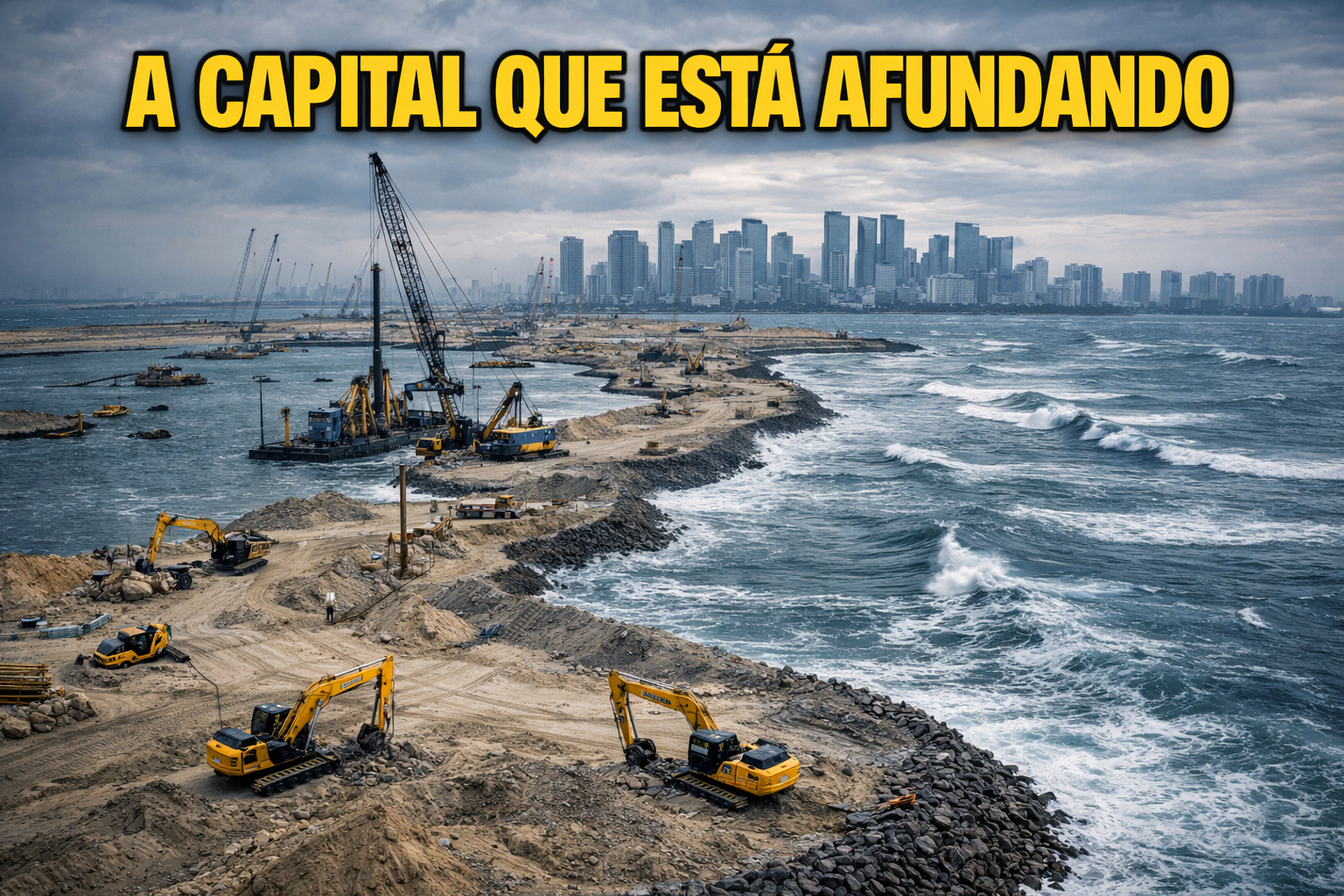


Among Skyscrapers Sinking And The Advancing Sea, Jakarta Bets On Mega Dikes And Artificial Islands In An Urgent Race To Save Millions Of Lives, Entire Neighborhoods And The Urban Future.
Jakarta is not just growing haphazardly. The capital of Indonesia is literally sinking. In some areas of the city, the ground is descending at rates that already exceed 20 to 25 centimeters per year, creating one of the planet’s most critical urban scenarios. To try to contain a predicted catastrophe, the country launched one of the most ambitious coastal engineering programs of the 21st century, combining maritime dikes, artificial islands, and metropolitan-scale containment systems.
A Capital Built On Unstable Ground
Jakarta is home to over 10 million inhabitants in its urban area and more than 30 million in the metropolitan region. Much of the city was built on young, highly compressible alluvial soils, close to sea level. For decades, excessive groundwater extraction has accelerated the subsidence process, causing entire neighborhoods to sink unevenly.


Today, about 40% of the city is already below sea level, making coastal and river flooding increasingly frequent, even during periods without heavy rainfall.
-
Mason shows how to fix moisture on the baseboard before the wall rots: simple technique

-
The retro detail that many people added to the bathroom to make the house charming is now being questioned by designers because it multiplies grout, darkens over time, and turns cleaning into double the work.
-
The so-called Ponte do Futuro, costing nearly half a billion reais, is progressing in its construction and promises to significantly shorten travel time for the population.

-
Simple technique protects external brick wall with pigmented mortar, minimum layer of 5 millimeters and coverage of up to 4 square meters per 20 kg bag.


When The Sea Begins To Invade The City
With continuous sinking and the gradual rise of sea levels, coastal areas of Jakarta have started to suffer from permanent flooding, no longer just exceptional events. In some neighborhoods, saltwater recurrently invades streets, homes, and drainage systems, corroding structures and contaminating the water supply.
In light of this scenario, merely raising streets or reinforcing drainage systems is no longer sufficient. The response would need to involve physical barriers between the city and the sea.
The Colossal Coastal Containment Project
Indonesia launched the National Capital Integrated Coastal Development (NCICD), a mega project designed to function as a permanent shield against the advancing sea. The plan combines the construction of dozens of kilometers of maritime dikes, reinforcement of the existing coast, and the creation of artificial islands that act as external barriers.
These structures are not just simple landfills. They involve millions of cubic meters of dredged sand, deep foundations, reinforced concrete containment, and continuous pumping systems to control the internal water level.
Artificial Islands As Part Of The Defensive System
The artificial islands designed along Jakarta Bay serve a dual purpose. In addition to creating urban and commercial areas, they act as a giant breakwater, reducing wave energy and protecting internal dikes.
The logic is similar to that of large coastal works in Europe, but applied in a much more complex context: unstable soil, high population density, and accelerated sinking.
A System That Requires Constant Pumping
Even with dikes erected, water does not simply disappear. The city depends on large pumping stations capable of removing huge volumes of water accumulated during heavy rains and high tides. Without these active systems, parts of the city would be submerged within hours.

This transforms Jakarta into a city that remains dry only thanks to engineering operating continuously, 24 hours a day.
Billions Invested To Buy Time
The project costs amount to billions of dollars and continue to grow as new sections need reinforcement. Still, engineers and planners recognize that the works do not address the problem at its root: the sinking soil continues.
Therefore, the Indonesian government made an extreme and unprecedented decision: to transfer the country’s administrative capital to another region, while Jakarta remains an economic center, protected by increasingly complex works.
Engineering Against The Clock
The case of Jakarta is not just an infrastructure project. It is an example of defensive engineering against time, where each dike built buys a few years or decades of urban survival.
The city has become a living laboratory of how large coastal metropolises may need to adapt in a world of unstable soils, intense urbanization, and climate change.
When Containment Is The Only Option
Jakarta shows a clear limit of modern urbanization: when the territory gives way, the only option becomes to contain, hold, and physically resist. Dikes, artificial islands, and maritime barriers are not aesthetic or optional solutions, but real lines of defense against the total loss of the city.
In the end, the Indonesian mega project does not merely try to conquer the sea. It seeks to buy enough time for one of the world’s largest cities to continue existing — even as it slowly sinks beneath its own feet.





Jacarta já não é mais a capital da Indonésia .desde setembro de 24 a capital atual é Nusantara na Ilha de Bornéu . Devido a esses problemas citados ..ela está afundando .
Os asiáticos são os q mais poluem o mundo e querem jogar a fatura nas costas da América do Sul., exclusivamente no Brasil.
A natureza é implacável. Não sei se será o suficiente todo esse esforço. Tomara que sim.