Portuguese
  Spanish


In the 2026 World Cup, artificial intelligence simulations made by Claude place France as the most frequent champion, leave Brazil only in sixth among favorites, and indicate risk of elimination in the quarterfinals, even with a high chance of advancing in Group C, against Morocco, Scotland, and Haiti in the tournament.
The 2026 World Cup hasn’t even started yet, but a simulation made with artificial intelligence has already put Brazilian fans on alert. EXAME asked Claude, Anthropic’s AI assistant, to create a mathematical model, simulate the tournament 10,000 times, and point out the teams with the highest chance of winning the title.
According to Exame, the result released on June 2, 2026, placed France as the most frequent champion in the projections, while Brazil appeared only sixth among the favorites. According to the model, the Brazilian team has a high probability of advancing in Group C, but may encounter heavy obstacles starting from the round of 16 and especially in the quarterfinals.
Simulation places France at the top and Brazil out of the top five favorites
Claude’s model pointed to France as the team with the highest probability of winning the 2026 World Cup. The European team appears favored by the combination of recent tradition, consistent performance, World Cup history, and competitive strength accumulated in the last editions of the tournament.
-
The ‘tsunami’ of investments directed at Artificial Intelligence (AI) and semiconductor companies, which prioritize security and more predictable profits, has been a determining factor in the declining trajectory of Bitcoin.

-
Samsung eyes strategic chip factory in South Korea and could shake up the global AI landscape with advancements in HBM memories and advanced packaging.

-
Nvidia makes agreements in South Korea for AI factories and takes data centers, advanced chips, and global cloud to another level by 2027
-
ChatGPT reveals which human job it would choose if it could really work


The projection does not represent an official prediction nor guarantees results on the field. It is a mathematical simulation based on criteria defined by the tool itself, such as World Cup history, recent performance, FIFA ranking, offensive strength, defensive strength, and other indicators used to create a strength index of the teams.
The point that most draws attention for Brazilian fans is the position of the Brazilian team. Brazil was behind France, Spain, Argentina, England, and Portugal, appearing only in sixth place among the main candidates for the title.
This ranking does not indicate a lack of talent in the Brazilian squad. What weighs against the National Team, according to the model’s logic, are factors such as recent performance, instability in the Qualifiers, and the lack of a consolidated tactical identity before the start of the competition.
Brazil has a good chance in the group, but the path complicates in the knockout stage
In Group C of the 2026 World Cup, Brazil will face Morocco, Scotland, and Haiti as opponents. The simulation estimates a probability of over 90% for Brazil to advance to the next phase, indicating a clear favoritism to pass the initial stage.
Even so, the group is not considered completely simple. Morocco appears as the most dangerous opponent in the group, especially for having reached the semifinals of the 2022 World Cup and for being among well-evaluated teams in the FIFA ranking used as a basis by the simulations.
The real alert begins after the group stage. If Brazil finishes first in Group C, the projected path may lead to a confrontation against the Netherlands in the round of 16, according to the model’s calculated design.
From the quarterfinals, the scenario becomes even tougher. France, Spain, England, or Portugal appear as possible opponents in the block that crosses with Brazil’s path, and it is at this stage that Brazil’s modal path ends in the presented simulations.
Claude gave high weight to World Cup history and recent performance
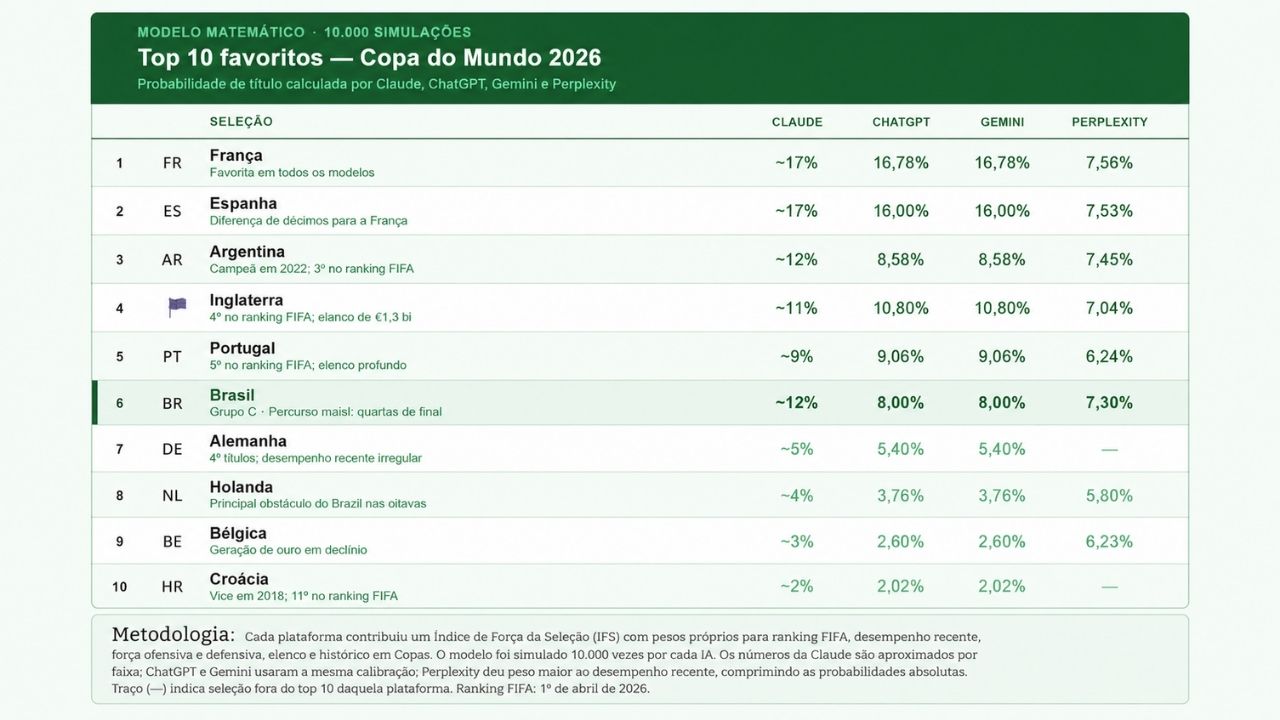
The methodology used by Claude prioritized two main factors: World Cup history and recent performance. The history received a weight of 22%, while the recent form of the teams accounted for 20% within the index calculated by the artificial intelligence.
The logic adopted is that the 2026 World Cup, like other editions of the tournament, does not depend solely on a strong squad on paper. In short competitions, qualifiers, and with enormous pressure, teams accustomed to decisive games may have an advantage over technically competitive teams but less consistent in knockout stages.
This criterion favors teams that combine tradition, regularity, and competitive momentum. France stands out in this aspect for having recent titles, strong campaigns, and solid performance in recent seasons, while Argentina maintains strength due to the weight of its 2022 victory.
For Brazil, the problem is that the heavy jersey was not enough to compensate for less favorable recent variables. The campaign in the Qualifiers and the adjustment period under technical command were treated as risk signals by the model.
Sixth position turns sixth title into a warning for Brazilian fans
Brazil appears with a title probability of around 12% in Claude’s model, yet it ranks sixth among the favorites. The apparent contradiction occurs because other teams have slightly superior or more balanced evaluations in the variables adopted by the simulation.
In the comparative table published by EXAME, France and Spain appear practically tied at the top, while Argentina, England, and Portugal complete the block above the Brazilian team. Brazil, while competitive, appears more dependent on tactical fit, regularity, and overcoming strong opponents in the knockout stage.
For those hoping for the sixth title, the simulation serves less as a sentence and more as a cautionary signal. The model indicates that the team has a viable path, but not a comfortable one, especially if it encounters high-level European rivals before the semifinal.
The sixth position also reinforces a change in perception. Brazil continues to be treated as a contender, but not as an absolute favorite. In a tournament of 48 teams, the margin for setbacks increases, and each matchup can completely change the campaign’s destiny.
France appears as the most frequent champion in the 10,000 simulations
France was the team that lifted the trophy most frequently in the 10,000 simulations conducted by Claude. The model valued the combination of squad quality, recent performance, tradition in knockout tournaments, and consistent campaigns in previous World Cups.
The result does not mean that France will win the 2026 World Cup, but it shows that, within the chosen criteria, it gathers the strongest set of factors. Spain also appears very close, indicating balance in the competition between the two European teams.
The French favoritism arises from a combination of stability and experience. In short tournaments, mathematical models tend to reward teams that demonstrate less fluctuation, reliable defense, and the ability to decide high-stakes matches.
For Brazil, this scenario is especially relevant because France or Spain may appear precisely in a decisive phase of the projected path. If the matchup is confirmed, the team would need to overcome one of the favorites even before reaching the semifinal.
Artificial intelligence does not predict the future, but reveals points of attention
Sports simulations should not be read as anticipated results. Artificial intelligence works with data, weights, and probabilities, but it cannot capture all the factors that change a Cup: injuries, cards, refereeing decisions, internal environment, luck in matchups, and unexpected individual performances.
Even so, the exercise helps to organize risks. By placing Brazil outside the top 5, the model signals that the National Team arrives at the 2026 World Cup with strength, but also with relevant doubts when compared to other favorites.
The value of the simulation lies in showing where the alert is concentrated. For Brazil, the sensitive points are recent performance, tactical stability, and the ability to defeat strong European opponents in knockout stages.
In practice, mathematics does not decide the game. But it helps to see that the path to the sixth title does not depend solely on tradition, the jersey, and individual talent. Brazil will need to turn potential into consistency on the field.
Path to the sixth title may depend on the quarterfinals
The quarterfinals appear as the point of greatest tension in Brazil’s journey. According to the model, it is there that the National Team tends to encounter opponents from the strongest block of the competition, such as France, Spain, England, or Portugal.
This scenario turns a possible Brazilian campaign into a high-risk sequence. Successfully passing through the group stage would be just the first step; the real tournament would start to become more difficult when Brazil faces teams with deep squads, competitive history, and greater recent consistency.
If the projection is correct, the sixth title may depend on a victory against a favorite before the semifinals. This type of confrontation usually separates real contenders from teams that enter the tournament with high expectations but cannot sustain performance in the most pressured games.
For the fan, the message is clear: the National Team is not ruled out, but it also does not appear as the owner of the path. The 2026 World Cup promises to demand more than talent; it will require adjustment, composure, and quick response against prepared rivals.
Simulation increases pressure, but the field can still change everything
The study done with Claude places France at the top, leaves Brazil in sixth, and points to the quarterfinals as a possible limit. But the history of the Cup shows that models can be wrong, favorites can fall, and teams in doubt can grow during the competition.
Brazil enters the competition with tradition, a heavy jersey, and a squad capable of competing against any opponent. At the same time, the simulations show that the path to the title will be less predictable than part of the fans would like.
The projection does not bury the dream of the sixth title, but it reduces the margin for illusion. If they want to contradict artificial intelligence, the National Team will have to prove on the field that they can overcome the weaknesses pointed out by the models.
Do you think the simulations are correct in placing Brazil only sixth in the 2026 World Cup, or does the National Team still have the strength to defy predictions and seek the sixth title? Leave your opinion in the comments and say which rival worries you the most on Brazil’s path.