Portuguese
  Spanish


The tessellated pavement of Eaglehawk Neck, in Tasmania, looks like human work, but it was formed by fractures in the rock and sea erosion over ages.
The tessellated pavement of Eaglehawk Neck, in Tasmania, is one of those natural formations that seem to defy the eye. The rocky surface forms a grid of almost rectangular blocks, so aligned that many visitors have the impression of standing before a manually laid floor, rather than a coastal platform sculpted by nature.
But what seems like human work is actually the result of a rare geological combination. The site is an intertidal rock platform formed in Permian siltstone, fractured by ancient stresses in the Earth’s crust and then shaped by seawater, sand, and salt crystallization until it gained the appearance of an almost perfect mosaic.
Tessellated pavement of Eaglehawk Neck became one of the most impressive geological formations in Tasmania
The location is in Teralina / Eaglehawk Neck, in the Tasman National Park, in southeastern Tasmania, and is known precisely for the geometric patterns that have transformed the pavement into one of the most photographed geological landscapes in Australia. The area is described by the Tasmanian tourism authority as one of the region’s great natural highlights.
-
China’s Artificial Sun Reaches 100 Million Degrees, Six Times Hotter Than the Sun’s Core, Putting Beijing Ahead in the Race for Infinite Energy

-
Steam Machine Converts All Types of Plastic Waste into Durable Building Blocks, Processes Over 90 Tons Monthly, and Is Sold to Municipalities
-
John Deere’s Autonomous 9RX Tractor Uses 16 Cameras for 360-Degree Vision, Operates in Short Weather Windows While Monitored by Smartphone

-
Scientists Develop Needle-Free Insulin That Penetrates Skin, Reduces Glucose in Animals Within an Hour, Paving the Way for Diabetes Patches and Creams for Humans


The scientific importance of the site is also high. The park’s management plan records that the Tessellated Pavement at Eaglehawk Neck has long been recognized as a site of international geoconservation significance and is listed on the Register of the National Estate.


This combination of unusual appearance and geological relevance helps explain why the formation has become a landmark of the peninsula. It is not just a curious rock, but a rare example of how coastal processes can produce such clean geometry that it appears artificial.
Cracks in the Earth’s crust opened the design that later became the natural mosaic of the beach
The basis of the phenomenon began long before marine erosion. The rocky material of the pavement is a siltstone from the Permian age, about 270 million years old, deposited when mud and silt formed layers now exposed on the coast of Tasmania.
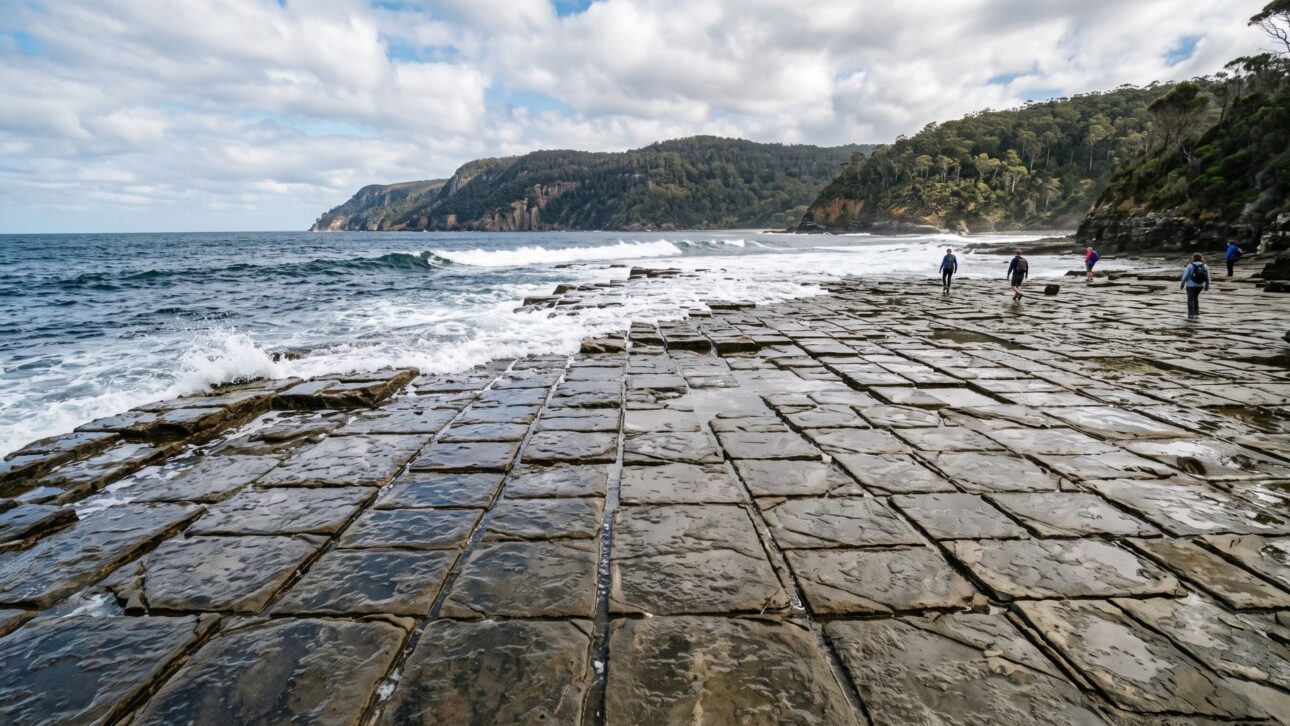
After the rock already existed, stresses in the Earth’s crust opened fractures in the rock block. According to the official geological material from the Parks and Wildlife Service Tasmania, these cracks may have appeared sometime between 160 million and 60 million years ago, forming three main sets of joints that gave the pavement the basic mesh of the current design.
These joints are the skeleton of the pattern. Without them, the platform would just be a common rocky surface. With them, the sea began to find natural lines of weakness to deepen grooves and separate the blocks into pieces that resemble tiles.
Sea erosion, sand, and salt crystallization transformed ancient fractures into blocks with the appearance of a Roman floor
The fractures alone were not enough to create the visual effect that made Eaglehawk Neck famous. The geometric floor aspect appeared because marine erosion began to act on these lines, transporting rock fragments, sand, and sediments over the platform over a long time.
The official geological document of Tasmania explains that saltwater penetrates the cracks and the surface of the rock. In areas that dry more, salt crystals form and exert pressure on the siltstone, enlarging small fissures and causing the surface to flake.
At the same time, the sea also acts by abrasion. Where the water channels sand and other particles along the joints, the wear progresses faster. The result of this combined work is the “tessellated” effect, with regular divisions that make the rock look like a mosaic constructed piece by piece.
Pan and loaf formations show how the same rock can be sculpted in two different ways
One of the most interesting aspects of the pavement is that it does not present a single pattern. In Eaglehawk Neck, the platform shows two classic types of modeling, known as pan and loaf, which arise due to the difference between drying, salt, and abrasion in various parts of the surface.
In the areas further from the sea, which remain dry longer at low tide, the crystallization of salt acts more strongly on the surface of the block.
In these sections, the top part of the rock wears away more quickly than the joints, forming shallow depressions surrounded by slightly higher edges. These are called pan formations.

In the parts closer to the water, the abrasion caused by sand, water, and sediments concentrated in the joints wears down the edges of the blocks more intensely. This leaves the center relatively higher and rounded, creating loaf formations, which resemble small loaves emerging from the surface.
The geological rarity of Eaglehawk Neck has given the site international geoconservation status
Coastal platforms exist in many regions, but the case of Eaglehawk Neck is considered special because it gathered a rare sequence of conditions. It required the right rock, an organized system of fractures, and the prolonged action of the sea and salt for the pattern to become so distinct.
Therefore, the site is not seen only as a landscape attraction. The park management plan highlights the pavement as one of the most important geological elements of the peninsula, alongside other coastal landmarks in the region, such as the Tasman Arch, the Blowhole, and the Devils Kitchen.
This relevance makes the tessellated pavement a rare example of coastal formation where aesthetics first draw attention, but the geological explanation is even more impressive. What seems like a regular and deliberate work is, in fact, the result of an extremely slow rocky history.
The best time to see the tessellated pavement is at low tide, when the blocks are more exposed
Visitors to Eaglehawk Neck find the formation on a short walk from the access area, but the view changes significantly with the tide. The official tourism recommendation for Tasmania is to visit during low tide, when the pavement pattern is more visible.
The morning light also helps to highlight the relief of the platform. In a terrain where small height differences define the visual effect, the lateral incidence of the sun makes the alternation between grooves, edges, and rounded surfaces more evident.
In the end, Eaglehawk Neck impresses because it dismantles a common expectation. The almost perfect regularity of the rocky grid seems human at first glance, but it is entirely natural, a product of tectonic fractures, salt crystallization, and marine erosion acting on the same pavement for millions of years.