






 Portuguese
  Spanish


The new treasure map from the University of Cambridge crossed seismic waves with the thickness of the lithosphere and CO2-rich rocks to point out regions such as East Africa, central Brazil, Mongolia, and Australia. The bottleneck, however, remains processing, not the search for metals.
The University of Cambridge has created a new treasure map to locate rare earths around the world and reduce dependence on Chinese exports. Instead of an X marking the spot, like in pirate maps, the tool uses seismic waves and rock chemistry to indicate where these metals tend to concentrate. Among the regions identified as most promising is central Brazil.
According to La Jornada, the model crosses the thickness of the lithosphere with the presence of CO2-rich rocks to arrive at the best candidates. Besides Brazil, East Africa, Mongolia, Australia, the Kola Peninsula, and the western edge of the Canadian Shield are also highlighted. Still, researchers make an important caveat, that the hardest part is not finding the rare earths, but processing them.
The new treasure map of rare earths
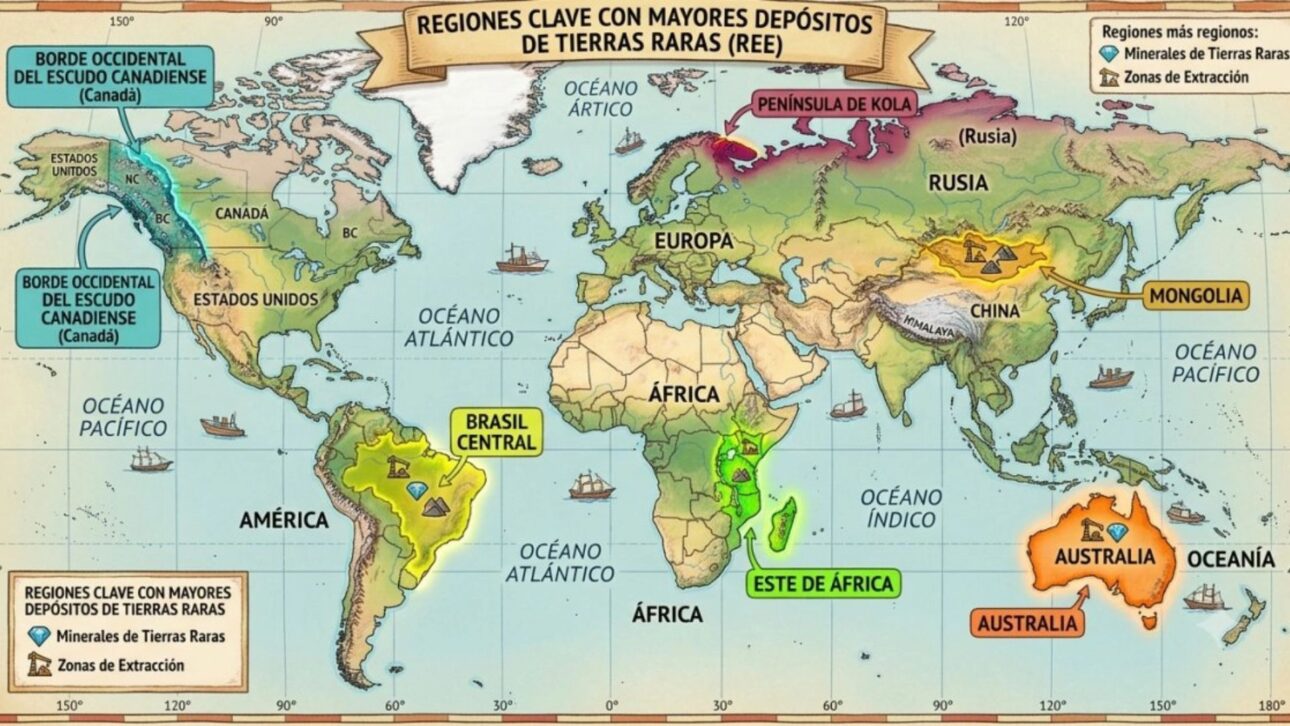
According to La Jornada, it was to tackle this challenge that the University of Cambridge developed what is being called the new treasure map, a virtual map capable of pointing out regions rich in these metals.
-
James Webb Telescope Uncovers Unexpected Clues on Mysterious Moon, Potentially Redefining Planetary Origins

-
$1.5 Billion Sleipnir Vessel Transforms Ocean into Floating Construction Site with 12 Hybrid Engines and Capacity to Lift 20,000 Tons

-
23 Years After Tragedy, Brazil’s Alcântara Space Center to Launch New Suborbital Rocket in 2026 with South Korean SEBIT Project Targeting Near-Space Tests
-
Entrepreneur Turns Neighbor’s Coffee Grounds Waste into Eco-Friendly Pellets, Earning Up to $40,000 Monthly in Brazil


The goal is to provide the world with alternatives to a market currently dominated by China.
The basis of the idea lies in the chemistry of volcanic rocks.
According to geochemist Sally Gibson, cited in the report, rocks with the right composition, rich in CO2, “only appear in very specific locations,” especially at the edges of the Earth’s thicker and older lithosphere.
In other words, finding rare earths involves understanding where these formations are located.
How Seismic Waves Reveal the Best Places
To map the thickness of the lithosphere, scientists turned to earthquakes. According to La Jornada, the team used a global tomographic model, called SL2013, built from more than 500,000 records of S waves generated in various tremors. These waves travel through the planet’s interior and function almost like an X-ray, since when they propagate quickly, they indicate a cold and thick lithosphere, and when they go slowly, a hot and thin lithosphere.
Two other types of waves completed the survey.
According to the publication, Rayleigh waves were used to study the structure and thickness of the crust, including under the ocean floor, while Love waves allowed measuring how rigidity varies along this crust.
The combination of this information gave the new treasure map greater accuracy on where to search.
The Role of CO2 and the Right Rocks
The thickness of the lithosphere, however, is not the only factor fueling the new treasure map.
According to La Jornada, the presence of carbon dioxide in the lithosphere is also decisive.
According to the International Union of Geological Sciences, this gas accumulates in specific rocks, and it is precisely these that signal where rare earths tend to concentrate.
Some types of rock stand out in this aspect.
Among the formations mentioned, carbonatites, kimberlites, and lamproites are those with the highest CO2 content, alongside other volcanic rocks.
It is the combination of a thick and ancient lithosphere and these carbon-rich rocks that guides the search for deposits.
Where Rare Earths Are Outside China and the Real Challenge
With these criteria, the new treasure map pointed out the most promising regions of the planet.
According to La Jornada, besides China itself, Eastern Africa, central Brazil, Mongolia, Australia, the Kola Peninsula, and the western edge of the Canadian Shield appear with the highest concentrations of rare earths.
The presence of central Brazil on the list draws attention to the country’s geological potential.
Being on the map, however, is far from solving the problem.
The researchers themselves warn that the hardest part is not finding these metals, but processing them, a stage in which China has a wide lead.
Therefore, according to the report, interested countries need to train miners and engineers to turn the underground wealth into actual production.
Finding the treasure, in this case, is just the first step.
The new Cambridge treasure map shows that the world does indeed have alternatives to China in the race for rare earths.
By crossing seismic waves, lithosphere thickness, and CO2-rich rocks, the study points to promising regions on several continents, with the center of Brazil among them.
Even so, turning this map into mines and industries depends on technology, training, and investment.
And you, do you believe that Brazil can take advantage of this rare earth potential and break the dependence on China? Do you think the country has the capacity to also dominate the processing of these metals? Leave your opinion in the comments, respecting different views, and share this article with those interested in science, geopolitics, and mining.


