Portuguese
  Spanish


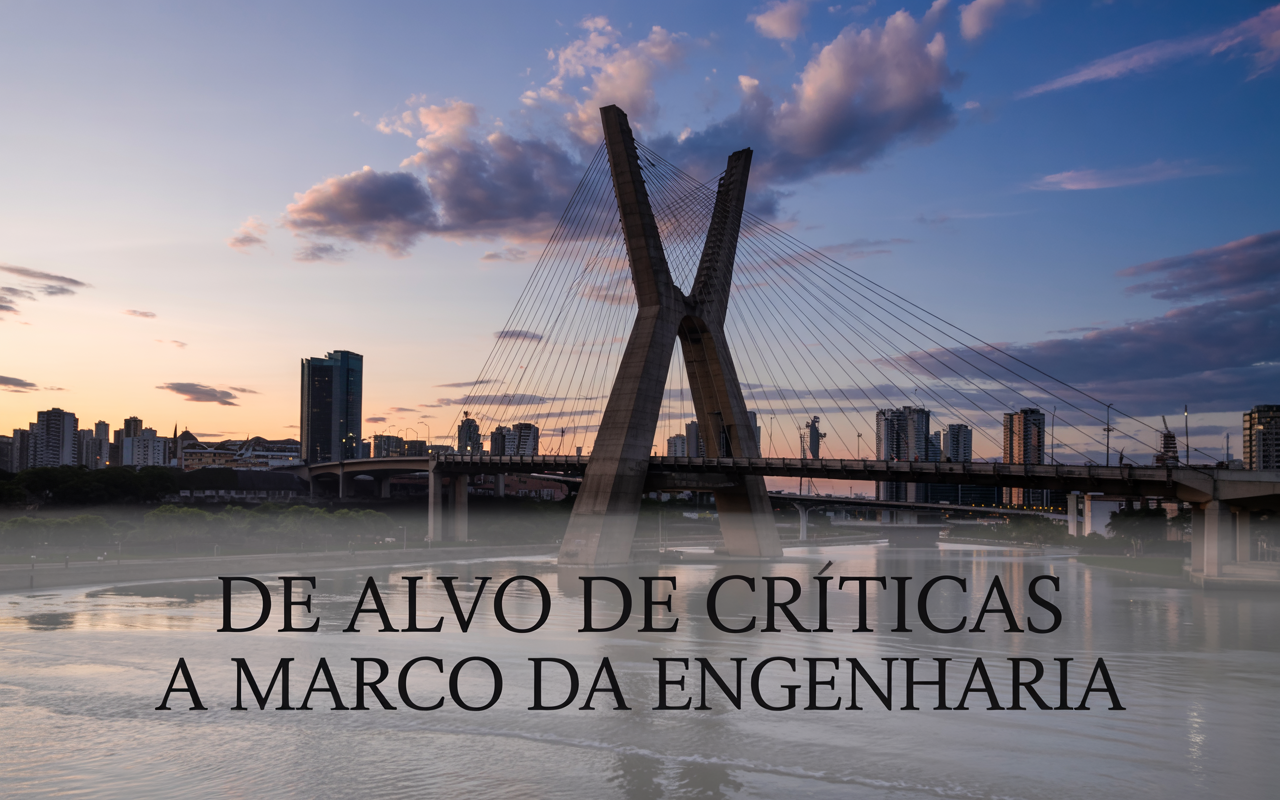

The Estaiada Bridge, Located in the South Zone of São Paulo, Transitioned from Target of Criticism Over Public Spending to Reference in Structural Engineering with a Unique Project in the World.
Inaugurated in 2008, the Estaiada Bridge, officially called Octávio Frias de Oliveira Bridge, is located over the Pinheiros River in the south zone of São Paulo. With a height of 138 meters and 1,600 tons of steel in its structure, the bridge has become a visual landmark of the city, recognized for its singular design and the use of engineering considered innovative for the time.
Since the completion of the work, the bridge has appeared on postcards, advertising pieces, television productions, and corporate events. However, its history involves controversies, criticism, and debates about public investments and urban priorities.
Unique Structure and International Visibility
The Estaiada Bridge is considered the only one in the world with two independent curved lanes supported by a single mast in the shape of an “X”. The project, designed by engineer Paulo de Tarso Santos, was executed to facilitate traffic between Jornalista Roberto Marinho Avenue and Marginal Pinheiros, areas of intense traffic in the São Paulo capital.
-
Couple Converts 1925 Detroit Bank into Home, Earns $40,000 Annually on Airbnb

-
Tired of Seeing People Sleep in the Cold, London, Canada Opens First Modular Shelter for Homeless with 60 Cabins, Heating, Meals, and Dog Area
-
Brazil’s $1.3 Billion, 870-Meter Immersed Tunnel to Be Latin America’s First of Its Kind, Featuring Special Public Facilities and Information Center
-
Brazilian Innovator Develops Concrete Blocks from Recycled Plastic, Eliminating Mortar and Reducing Construction Costs


The structural model is of the stayed type, using supporting cables attached to a central mast. With 144 stays connected to 72 points of the bridge, the work stood out for its execution complexity and technical solution for crossing major avenues with urban space restrictions.
The structure was also equipped with load sensors and monitoring systems to track its stability and behavior over time. These technical resources contributed to the bridge being mentioned in engineering and architecture publications.
High Cost Generated Criticism and Public Discussions
Despite the innovation in the project, the cost of the work, which amounted to around R$ 233 million, generated criticism at the time of its inauguration. The amount was considered high by urbanism specialists and sectors of civil society, who pointed out the lack of infrastructure for cyclists and pedestrians, as well as an emphasis on real estate valuation in commercial areas of the south zone of São Paulo.
There were also questions about the social return of the investment, since the bridge is exclusively for motor vehicle traffic. During construction, reports indicated the removal of families from nearby areas, which also sparked debates about the adopted urbanization model.
Because of this, the Estaiada Bridge was referred to by urban planners and journalists as a “symbol of waste,” in reference to the prioritization of high-cost road works over solutions aimed at sustainable mobility and social housing.
Lighting and Media Presence Consolidated the Bridge’s Image
The transformation of the public image of the Estaiada Bridge occurred gradually, supported by advertising campaigns, scenic lighting, and constant media presence. The bridge began to be used in official city events and illuminated on commemorative dates or public health campaigns, such as Pink October and Blue November.
In 2010, Philips modernized the lighting system by installing low-energy LED lamps. The project utilized technology that allows for changing colors and visual patterns, enhancing the bridge’s visibility during major events.
The structure also became a visual symbol for television programs, sports broadcasts, and promotional materials, contributing to its consolidation as a landmark of the São Paulo capital.
Technical Reference, but Without Environmental Recognition
Although recognized for its technical complexity and visual prominence, the Estaiada Bridge is not considered a model of sustainable engineering. Unlike other contemporary works, there is no record of environmental certifications or the use of technologies aimed at reducing emissions or recycling materials during the project’s execution.
There are also no bike lanes, pedestrian crossings, or urban accessibility directly associated with the bridge, which limits its reach within a broader concept of sustainable urban mobility. Still, civil engineers cite the work as an example of an efficient structural solution in a dense urban context.
Visits and Tourism
Even though it is a bridge aimed at vehicle traffic, the Estaiada Bridge attracts visitors, photographers, and tourists interested in capturing the city’s modern architecture. Being close to business centers, shopping malls, and corporate buildings, the structure has become a point of interest in the south of the capital.
The region has also undergone revitalizations with private and public initiatives focused on cleaning, lighting, and landscaping. Still, there is no official tourist infrastructure installed on the bridge, such as viewing platforms or observation walkways.
The trajectory of the Estaiada Bridge in São Paulo reflects the contrasts present in large public works in Brazil. On one side, there is technical and architectural recognition for the complexity and uniqueness of the project. On the other hand, criticisms persist related to the exclusion of alternative modes and the concentration of resources in already valued areas.