






 Portuguese
  Spanish


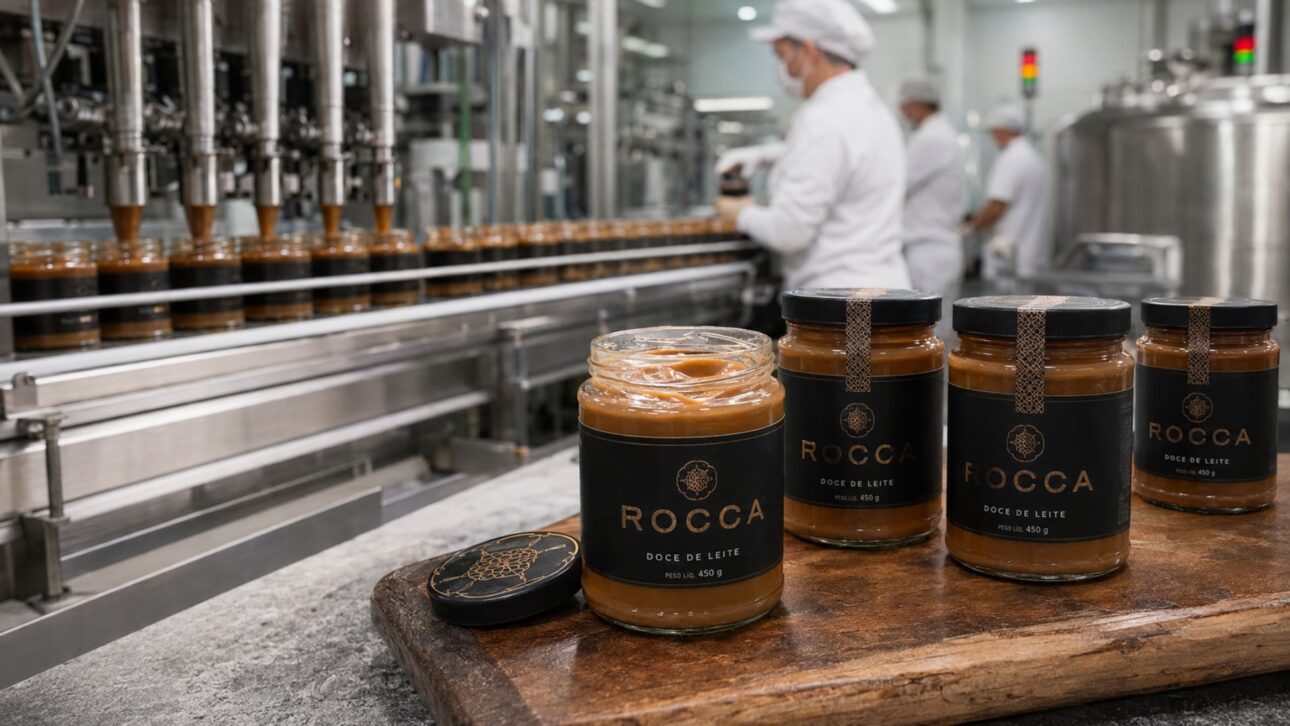
In Pouso Alegre, in the south of Minas, the Rocca family left the milk commodity, bought a R$ 20,000 kettle, and turned their farm’s milk into premium dulce de leche: 2 tons per day and the bet on added value aims for R$ 32 million.
Every small milk producer knows the feeling of working hard and seeing the margin evaporate. You milk, deliver the cheap milk to the dairy, and at the end of the month, the price is dictated by the market, never by you. It was by living exactly this for over 60 years that a family from Pouso Alegre, in the south of Minas Gerais, decided to turn the game around. Instead of remaining hostage to the commodity price, they bought a R$ 20,000 kettle and transformed their own milk into premium dulce de leche.
The story was told by Bloomberg Línea in May 2026 and is a turnaround manual. The brand, named Rocca and run by Rosi Barbosa and Raphael Figueiredo, now produces 2 tons of dulce per day, earned R$ 24 million in 2025, and projects reaching R$ 32 million. All this with a margin that would make any industry envious. It’s proof that betting on added value can be the way out for those suffocated by the milk commodity.
Sixty years selling cheap milk
Rosi’s family, from Pouso Alegre, has been in the milk business for more than six decades and, during all this time, sold their production to large dairies, including Vigor.
-
Chilean Giant Acquires St. Marche, Expanding from Discount to Premium Supermarkets in São Paulo’s High-End Retail Market

-
Northern Brazilian ports surpass the South as the country’s largest grain corridor amid record harvest
-
Amazon launches its own brand in Brazil a week before Prime Day, following a $3.7 billion investment and the establishment of over 300 distribution centers nationwide by 2025.

-
Trump’s 50% Tariff on Brazilian Goods Cuts U.S. Exports by 30%, Brazil Sets Records in 42 Countries and Germany Becomes Top Coffee Buyer


In this model, the producer is just another raw material supplier, and the price is dictated by the purchasing industry.
The problem with the milk commodity is structural.
Production costs rise, the price paid to the producer fluctuates with the market, and the margin becomes increasingly thin, if not disappearing altogether.
This is the reality that has been breaking small and medium producers across Brazil, in one of the most squeezed sectors of agriculture.
It was by looking at this dead end that the family decided to do things differently.
Continuing to deliver cheap milk meant remaining hostage to a system that left almost nothing.
The turnaround needed to come from within the farm itself.
A R$ 20,000 Pot and a Sweet No One Knew How to Make
The solution started small and bold.
In 2014, Rosi and her husband Raphael invested about R$ 20,000 in purchasing the first pot, determined to transform the farm’s milk into premium dulce de leche.
The honest detail is that they started without any manual.
“We bought the pot without knowing how to make dulce de leche,” admitted Raphael Figueiredo to the report.
It was trial and error until they got it right.
The formulation took about a year to reach the final product, made only with milk and sugar, without thickener or artificial ingredients.
This simplicity became precisely the brand’s trump card.
In a market full of industrialized sweets loaded with additives, offering a premium dulce de leche with only two ingredients became a quality differentiator.
The R$ 20,000 pot was the first brick of a business that would grow far beyond what the family imagined.
Why Leaving the Milk Commodity Changes Everything
The difference between selling milk and selling a brand is enormous.
When you deliver the milk commodity, you receive a fixed price per liter, without control and without identity, competing only by volume.
When you transform that same milk into a branded product, you start defining the price, the margin, and the relationship with the customer.
This perception is what drove Rocca.
“We saw an opportunity to leave the milk commodity and transform it into a brand,” explained Rosi Barbosa.
She realized that premium dulce de leche was a segment little explored under the brand-building logic, and it was through this gap that she entered.
Added value is the heart of this strategy.
Instead of fighting for cents per liter of milk, the family started selling a product that the consumer chooses for its name, taste, and story.
It’s the same milk, but with added value that completely changes the final account.
Two Tons of Dulce de Leche per Day
What started in a pot is now an industrial operation.
Rocca produces about 2 tons of dulce de leche per day, with a team of 40 people, in a hub that includes a corral, factory, and office within the farm itself, in Pouso Alegre.
The company processes between 5,000 and 10,000 liters of milk daily to meet the demand.
To get there, it was necessary to modernize the herd.
Led by agronomist and partner Romero Barbosa, the farm adopted the compost barn system five years ago, and productivity jumped from 11 to 35 liters per cow per day, raising total production from 170 to 1,500 liters daily.
Just in this modernization, about R$ 1 million was invested, and another R$ 2 million went in at the end of 2024 in a bottling machine, boiler, and new equipment.
These numbers show the seriousness of the turnaround.
It wasn’t a weekend hobby; it was a complete reconstruction of the operation around premium dulce de leche.
The farm stopped being a supplier of cheap milk to become an industry with its own brand.
R$ 24 million and an enviable margin
The financial result is what proves the success of the bet.
Rocca grossed R$ 24 million in 2025 and projects to reach R$ 32 million, quite a leap for a business born from a pot in the countryside.
More impressive than the revenue is the profitability.
According to the founders, the company operates with an Ebitda margin close to 38%, a very high level for the food sector, where many industries are content with much less.
This number summarizes why leaving the milk commodity was worth it.
The same raw material that yielded minimal margin in the sale of cheap milk began to generate substantial profit in the form of premium dulce de leche.
Rocca’s products are already in networks like Pão de Açúcar, St Marche, Swift, and Casa Santa Luzia, with strength in the Southeast.
The next step is to seek SIF certification to export to countries like Chile, Portugal, and the United States.
The added value, which started in a pot, now targets the international market.
The farm as a premium showcase
Behind the growth is a clear brand strategy.
Rocca works on the concept of the farm as a showcase, using its rural origin as an experience and sales argument, according to Promoview.
Showing where the milk comes from and how the dulce is made adds value to the product that the label alone wouldn’t provide.
This premium positioning is consistent with the product.
A premium dulce de leche made only with milk and sugar, at the family farm in Pouso Alegre, sells a promise of authenticity that the consumer values and pays more to have.
The story of overcoming becomes part of the packaging.
This is where the added value is completed.
It’s not just about a better sweet, but about a brand with a face, place, and purpose, exactly the opposite of the anonymity of milk as a commodity.
The farm became a character, and that has a price.
What the Rocca case teaches the small producer
The central lesson is powerful and replicable in spirit.
Transforming raw material into a brand, adding value, and escaping the logic of milk as a commodity is one of the most solid paths for those who feel squeezed by the price.
Rocca shows that it is possible to move from being a hostage to becoming the owner of one’s own commercial destiny.
But honesty about the size of the challenge is necessary.
Getting a brand off the ground required more than a decade, investments totaling millions, herd modernization, recipe development, and access to large networks, none of which are simple or quick.
For every Rocca that succeeds, there are many producers without the capital or structure to make this leap, and it would be unfair to sell the turnaround as easy.
Even so, the direction of the example is accurate.
In a country where so many milk producers live on the edge, seeing a family switch from cheap milk to a premium dulce de leche worth R$ 24 million shows that there is a way out beyond accepting the price they are told to pay.
The R$ 20,000 vat became a symbol of a choice: stop selling cheap and start selling value.
And you, do you think the path of added value, as Rocca did, is the way for the small Brazilian milk producer to escape the commodity crisis? Tell us in the comments if you would already trade the security of selling raw material for the gamble of building your own brand.


