Portuguese
  Spanish


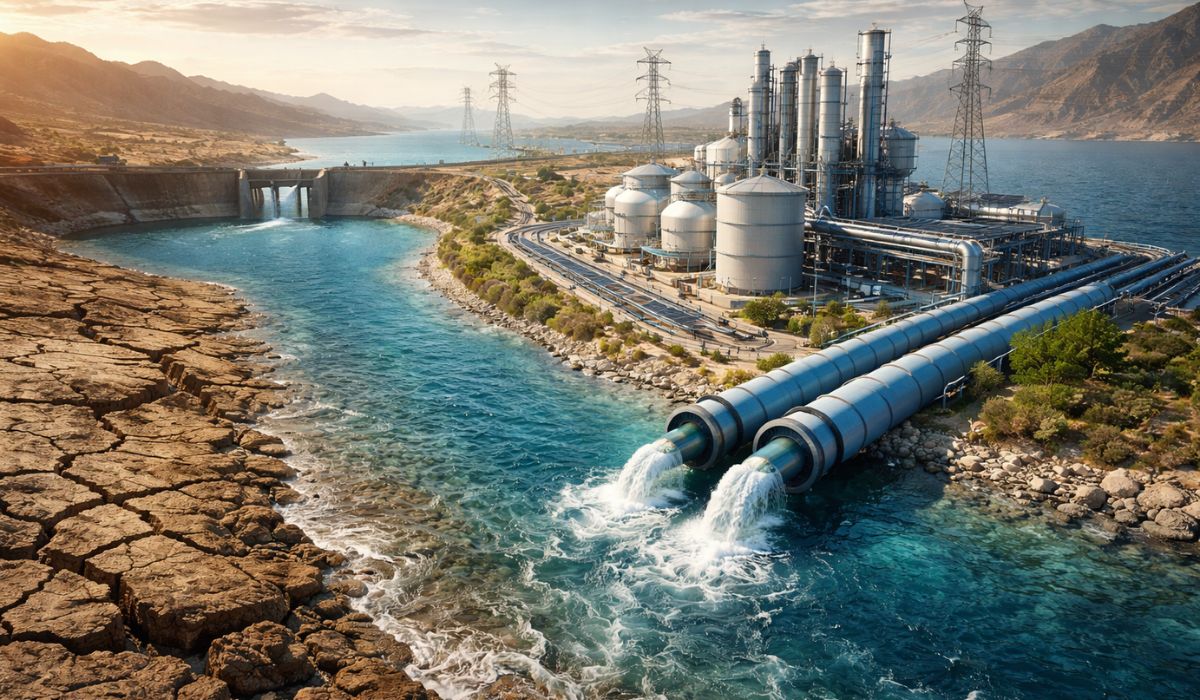

After years of drought, Morocco reorganizes its water policy with desalination plants, basin transfers, and new dams, in a strategy that connects water, energy, and agriculture and repositions infrastructure as a permanent axis of management.
Morocco has increased investments in desalination plants, water transfer works, and new dams to try to reduce the effects of prolonged drought and ensure supply to cities and agricultural areas.
The strategy gained momentum after several years of irregular rainfall, falling reservoir levels, and increasing pressure on rivers, aquifers, and distribution systems.
In recent years, water scarcity has begun to affect different sectors of the Moroccan economy.
-
Netherlands Reports First Child Euthanasia Case Since Rule Expansion for Minors

-
Brazilian Innovator Survives Homemade Submarine Dive in Paraty Despite Hatch Leak and False Oxygen Alarm

-
China Develops Custom 140-Ton Electric Mining Truck with 770 kWh Swappable Battery, Deploys 290 Units in Xinjiang’s Largest Zinc Mine
-
Meta to Launch Arena, a New Prediction App Targeting 3.56 Billion Users, Competing with Polymarket and Kalshi




The reduction in water availability coincided with livestock losses, rising food prices, and difficulties in the fields.
The Minister of Agriculture reported that the country’s livestock had shrunk by 38% in nine years, in a scenario marked by consecutive droughts and lower volumes stored in dams.
In light of this situation, the Moroccan government began to treat water infrastructure as a permanent management front.
The Minister of Water, Nizar Baraka, stated that the country operated 17 desalination plants, had another four under construction, and planned nine more.
The official goal is to reach a capacity of 1.7 billion cubic meters per year by 2030.
Desalination in water supply in Morocco
Desalination involves the removal of salts and other minerals from seawater to produce fresh water.
Generally, this process is done through membranes, such as in reverse osmosis, a technology widely used in countries with low surface water availability and strong dependence on coastal areas.
In the case of Morocco, the expansion of these plants has been incorporated into the national supply policy.
In December 2025, Baraka stated that about 25% of the drinking water consumed in the country already came from desalination and that the official goal is to raise this share to 60% by 2030.
Among the announced projects is a large-scale unit in the Tiznit region, in southern Morocco, with an expected capacity of 350 million cubic meters per year.
Other facilities have also been planned for cities like Rabat and Tantan, as part of a plan that seeks to reduce dependence on rainfall in urban centers and areas with high demand.
Still, the advancement of this technology does not mean that all agricultural production will start using desalinated water.
According to Baraka, this resource will not be allocated for wheat cultivation, mainly due to the cost of the process and the extent of the planted areas.
The government’s option is to direct this water for urban supply and for specific segments of agriculture, releasing more volume from the reservoirs for agricultural areas in the interior.
Renewable energy and the cost of desalinated water
The cost is one of the central points of this strategy.
Desalination requires a large consumption of energy, both in the treatment of water and in pumping and distribution.
Therefore, the Moroccan government has also begun to link water policy to investments in the electricity sector, especially in renewable sources.
In May 2025, Morocco announced an agreement that includes a transmission line of 1,400 kilometers and a capacity of 3,000 megawatts to carry energy produced in the south to different regions of the country.
The package also provides support for desalination projects.
Justifying this integration, Baraka stated that “the use of renewable energy will significantly help reduce water costs”.
The relationship between energy and supply is one of the most relevant technical elements of this model.
The higher the cost of electricity, the higher the final cost of desalinated water tends to be.
Therefore, the combination of renewable generation and water treatment has been treated as a way to reduce operational expenses and enhance the economic viability of plants.
Water transfer between basins and water infrastructure
In addition to the water produced on the coast, the Moroccan government is also betting on transfer systems between basins to redistribute water resources throughout the territory.
This policy seeks to respond to a recurring characteristic of the country: rain does not fall with the same intensity in all regions, and part of the demand is concentrated far from the wetter areas.
One of the main transfer corridors already connects the northwest, which is better supplied, to the regions of Rabat and Casablanca.
According to Baraka, the official intention is to extend this infrastructure by 2030 to reinforce reservoirs that serve agricultural areas of Doukkala and Tadla, regions affected by scarcity.
In practice, this type of work involves dams, canals, pumping stations, and control systems to move water from one region to another.
The goal is to compensate for regional imbalances and create a safety margin during drought periods, especially in areas with strong urban or agricultural pressure.
At the same time, the government acknowledged that the expansion of production in the field occurred, in part, without sufficient coordination with water availability.
In June 2025, Baraka said that there was “a mismatch between the pace of agricultural policy and that of water policy”, a situation that, according to him, was exacerbated by climate change.
Irrigated agriculture, aquifers, and restrictions in the field
The topic gained prominence because, even in years of drought, agriculture dependent on groundwater continued to advance in some areas, alongside the increase in exports of fruits and vegetables to Europe.
This led the government to adopt restrictions in more vulnerable regions.
According to Baraka, the cultivation of melons was prohibited in Tata and reduced by 75% in Zagora, two desert areas known for irrigated agricultural production.
The decision focused on crops with higher water consumption and occurred at a time when the country was trying to contain pressure on aquifers and reservoirs.
These measures add to the effort to reorganize water use in the field.
Instead of indiscriminately increasing supply, Moroccan policy began to combine new water sources with localized restrictions, redirection of supply, and attempts to align production with the actual availability of water.
Rainfall, dams, and water pressure in Morocco
The rains of winter 2025 to 2026 brought relief to the Moroccan water system.
In January 2026, Baraka informed Parliament that the seven-year drought had ended after precipitation was 95% higher than the previous year and 17% above the seasonal average.
At that moment, the average dam filling rate had reached 46%.
The improvement was significant, but it did not change the structural diagnosis.
In February 2026, after new episodes of heavy rain, official data cited by Reuters indicated that the average filling of dams was approaching 70%.
Even so, the recent history of drought and the irregularity of precipitation kept water security at the center of public policy.
According to the World Bank, Morocco is among the countries with the highest pressure on water resources.
The institution points to availability of around 620 cubic meters per person per year and warns of the risk of falling below 500 cubic meters by 2030, a level associated with severe scarcity.
In this context, the country has begun to combine the expansion of supply, regional redistribution of water, and a review of part of agricultural use.
Instead of treating drought merely as an emergency response to a bad rainfall cycle, the Moroccan government has been structuring a long-term policy for supply.
The combination of desalination, inter-basin transfer, dams, and renewable energy helps explain why water management has become one of the main themes of infrastructure in the country.