Portuguese
  Spanish


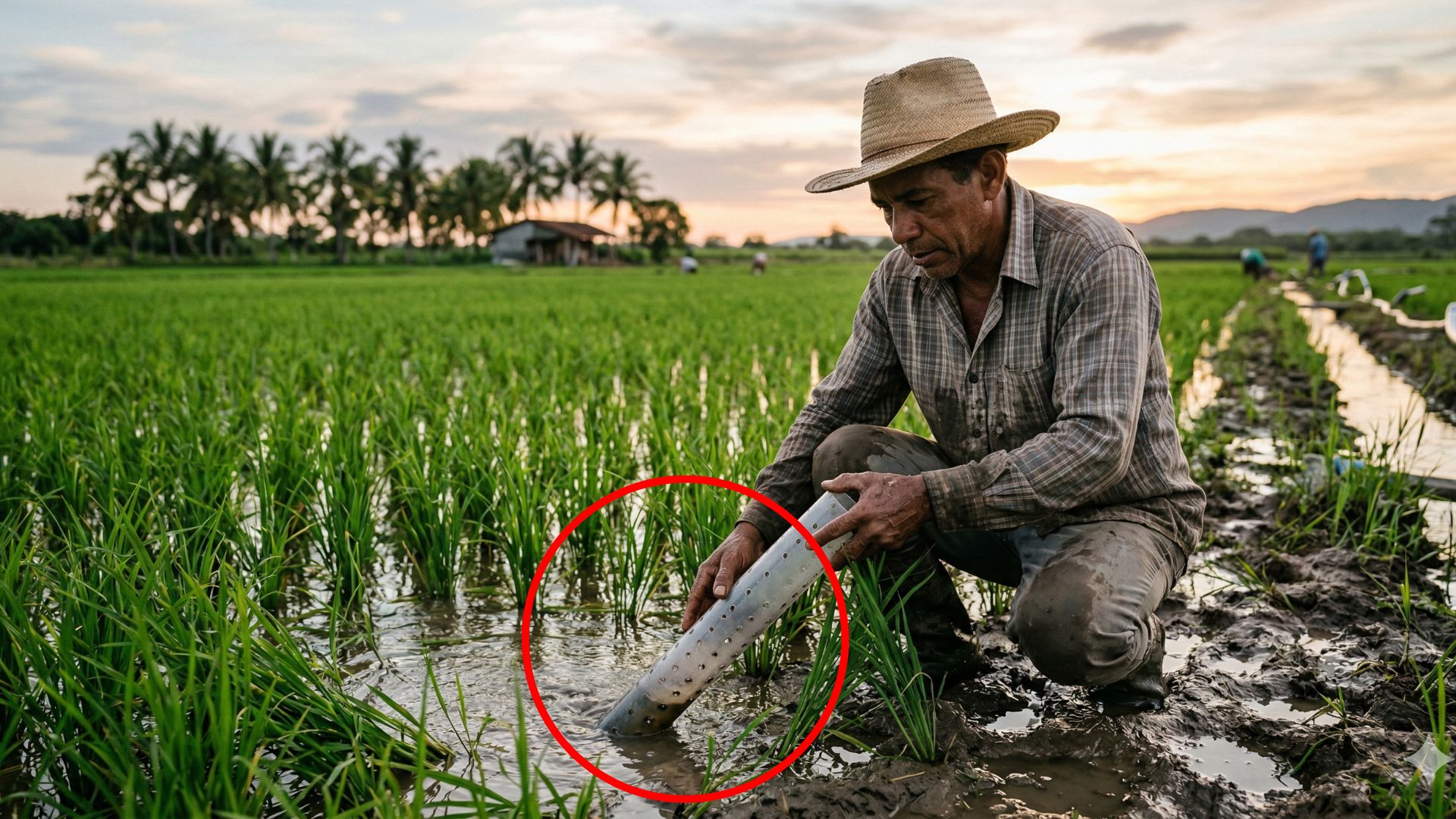


Simple Method Used in Irrigated Rice Replaces Continuous Flooding with Controlled Wetting and Drying Cycles, Guided by a Perforated Tube in the Soil.
This technique reduces water consumption and can maintain productivity while also being associated with lower methane emissions.
The change depends more on management and measurement than on new machinery.
AWD Irrigation in Rice Changes the Logic of Permanent Flooding
Irrigated rice producers have been adopting a simple change in field routine: instead of keeping the crop permanently flooded, they start to alternate periods of flooding and controlled drying, guided by a perforated tube inserted into the soil.
The technique, known as Alternate Wetting and Drying (AWD), allows monitoring the water level below the surface and deciding when to irrigate once it reaches a threshold, generally around 15 centimeters.
-
Brazilian State Sets Example by Investing Over $11 Billion in 2,000 Miles of Highways, Transforming Roads into Corridors Linked to Ports Handling 28.87 Million Tons of Cargo

-
The Fragrant Plant That Thrives in Partial Shade and Enhances Your Home’s Entrance with a Daily Garden Scent

-
Latin America’s Deepest Subway Station Opens in Brazil, Featuring London-Inspired Trains and a Tunnel Under the Tietê River
-
4,000-Year-Old Stone Towers Discovered Across Sardinia, Puzzling Archaeologists About This Mysterious Civilization


According to the International Rice Research Institute (IRRI), this management can reduce water consumption in rice production by about 30% without sacrificing productivity, while also lowering operational costs related to water use.
Perforated Tube in the Ricefield Becomes a Reference to Decide When to Irrigate

The center of the practice is a visual and inexpensive tool, but crucial for standardizing control: the so-called “field tube.”
It is a perforated cylinder, inserted into the ricefield, allowing the water level in the soil profile to be seen even when the surface is no longer covered.
By observing the decline of the level inside the tube, the farmer identifies when the soil has reached the planned drainage condition and then floods the area again.
This procedure transforms a decision that was previously made “by eye,” with a high risk of waste or water stress, into a clear and repeatable monitoring process.
Water Savings in the Crop Appear When Replenishment is No Longer Continuous
In traditional irrigated rice, maintaining a constant water layer is usually associated with controlling weeds and stabilizing the environment for the crop, but this model has a high water cost.
In regions where there are restrictions on water extraction, tariffs for water use, conflicts with urban supply, or simply a lack of availability during dry periods, the difference between losing and saving thousands of liters per day becomes crucial for making the harvest viable.
AWD emerges in this scenario as a management strategy that reduces the volume applied over the cycle by periodically draining the field and re-irrigating only when the soil water reaches the established mark.
Level at 15 Centimeters in the Soil Helps to Prevent Drying Out

The limit of “up to 15 centimeters” below the soil surface serves as an operational reference that helps to prevent over-drying.
In practice, the area is not managed like a “dry field”; the crop remains irrigated, but with intervals where flooding disappears, and the soil enters a drainage phase, without the plant going without water in the root zone for extended periods.
The perforated tube allows for precise visibility of this process, making management safer for those who need to save without risking productivity.
Why AWD Reduces Water Consumption and Energy Costs in Pumping
Water savings occur because the system stops continuously replenishing losses from permanent flooding, which include percolation and other forms of water leaving the system.
By allowing the level to drop before the next irrigation, some of the previously applied water is retained longer in the soil profile, and the need for pumping or opening sluices decreases.
When this logic is repeated throughout the entire harvest, the accumulated result can be a significant reduction in the total volume used, which directly impacts energy costs and reliance on water sources, channels, and reservoirs.
Methane Reduction Enters the Climate Debate on Irrigated Rice
In addition to water gains, the technique is also noted for its environmental impact.
IRRI points out that AWD has proven to reduce greenhouse gas emissions in rice cultivation, especially methane, in an estimated range between 30% and 70%, without causing yield reduction.
The explanation is linked to how methane forms in flooded soils: in a constantly waterlogged environment without oxygen, specific microorganisms produce the gas.
By introducing dry phases, the system temporarily changes the soil’s conditions, inhibiting part of the activity of these microorganisms and reducing methane formation.
Irrigated Rice Management Now Depends More on Measurement Than Habit

This type of result increases interest in a management method that addresses two frequently cited problems in irrigated agriculture: the pressure for water and the growing demand for practices with lower climate impact.
For producers and food chains, the possibility of linking savings in the field with emissions reduction becomes significant in their relationships with buyers, in sustainability programs, and in mitigation initiatives.
Nonetheless, the point that often draws attention outside the technical environment is the simplicity of the decision trigger: a tube in the ground and a measure of depth.
Field Stops Being “Constantly Full” and Becomes a Routine of Observation and Response
The method also changes how irrigation is planned in daily crop management.
Instead of “constantly full,” the management becomes an exercise of observation and response, with cycles depending on soil, climate, field management, and water availability.
The presence of the perforated tube ensures that the decision does not rely solely on the superficial aspect of the ricefield, which can mislead during hot weather or windy conditions, when the water layer quickly disappears, while the subsoil still holds enough water to sustain the plant.
With direct monitoring of the level below the soil, the timing of replenishment aligns more closely with what is actually happening in the zone where the roots operate.
Productivity Maintained with Less Water Becomes a Viability Factor in Dry Regions
From an agronomic perspective, the main promise of AWD is not to increase yield but to maintain production with less water, which in itself changes the viability equation in regions under water stress.
In areas where rice competes for resources with other crops, where the irrigation calendar is limited by usage rules, or where pumping systems make operations costly, reducing volume without losing productivity represents a gain that does not depend on large new machinery or radical changes in the field.

The central instrument of the process is inexpensive, and the principle of management is understandable for those in the field, although it requires discipline and monitoring.
Existing Infrastructure Continues, but the “When to Irrigate” Changes Completely
However, adopting this strategy does not mean abandoning existing infrastructure.
In many cases, channels, sluices, and irrigation routines continue, but with an adjustment in “when” and “how much” to replenish.
The result is irrigation that is less based on the constancy of flooding and more based on a practical indicator of the soil’s water status.
By turning this control into a routine, the producer starts to work with a fixed parameter that reduces improvisation and makes management comparable between fields and between harvests.
Simple Technique Draws Attention Because It Breaks the Image of Always Flooded Rice
The appeal of the technique is also explained by its ease of communication to audiences outside of agriculture: rice, historically associated with flooded fields, appears linked to a procedure that seems to contradict the traditional image and still protects the harvest while saving water.
For those following climate issues, the same practice connects to a global theme of emissions, directly addressing one of the main gases generated in flooded agricultural systems.
In a scenario of recurring water scarcity and a demand for efficiency, the perforated tube in the ricefield becomes a symbol of change achieved more through management than through a revolution in equipment.
If such a significant decision can be made by looking at the water inside an underground tube, how many other agricultural routines still rely more on habit than on measurement?